
The recent coup attempt in Benin Republic and Nigeria’s intervention have raised no little dust. In this analysis BIYI ADEGOROYE examines the issues, positing that while military coups are unfashionable, African rulers and the political class must ensure good governance and respect for rule of law to thwart the return of soldiers.
Nigeria’s recent military intervention in quelling the coup in Benin Republic has been greeted with an admixture of reactions – some salutary, others unsalutary. Advocates of the latter position viewed the move that put paid to the attempt by the Lt Col Paschal Tigriled botched coup perceived the action as undue interference, especially viewed from the prism of Nigeria’s unsuccessful efforts to end its intractable internal security problems.
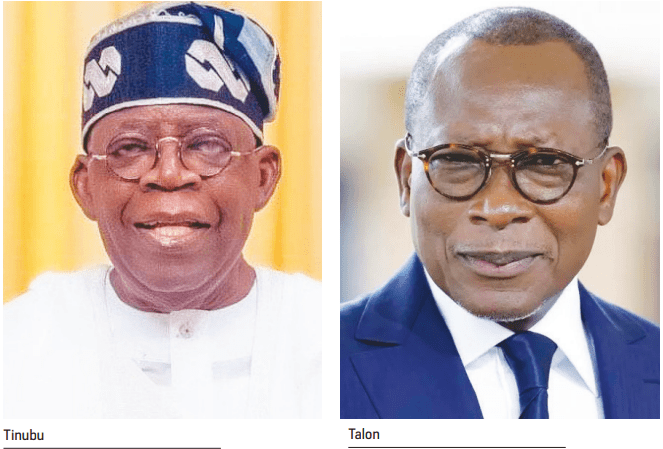
To those who hold the contrary perspective, Nigeria’s action was justified by the principles and praxis of international law, morality and necessity. First, the military assistance followed a note verbale from the embattled Beninois President Patrice Talon, seeking President Bola Tinubu’s intervention.
In International Relations, a note verbale is a diplomatic communication instrument used by the government and mission to pass vital information or address issues of vital concerns. Hence, Tinubu’s reaction to Talon’s May Day invitation was not only timely, but a necessity, falling outside what could be perceived as interference in the country’s domestic affairs.
Besides, it has been argued that the action was not out of tune with ECOWAS and United Nations protocols. For instance, the ECOWAS’ 1999 Protocol Relating to the Mechanism for Conflict Prevention, Management, Resolution, Peacekeeping and Security, covers military assistance to member states. This came on the heels of the 1981 Protocol on Mutual Assistance in Defence in cases of conflict.
The 1999 Protocol allows for the deployment of the “ECOWAS Standby Force (formerly ECOMOG units from national armies) in situations including internal conflicts where there is a massive violation of human rights or an overthrow of a democratically elected government.”
A number of International Relations scholars have argued that on the basis of the foregoing, ECOWAS, led by Nigeria, is empowered to intervene militarily in a member State where a democratically elected government is overthrown. It is on record that Benin had signed and ratified the above instruments.
Similarly, the revised Article 4(h) of the African Union Consultative Act empowers the AU to intervene militarily within member States where the internal legitimate order is threatened; and that is binding on any member states who have consented to this treaty.
Strategic/national interest
Another view is that as a regional power, it goes without saying that Nigeria’s lawful intervention in Benin was in conformity with the country’s strategic interest. Given the recent coup attempt in Nigeria, the comedy coup in Guinea Bissau and current coup contagion in the Sahel, it would be suicidal to allow a successful coup in Benin- Nigeria’s next-door neighbour.
The reason is not far-fetched – a successful coup in Benin would have landlocked Nigeria among the trio of Niger, Chad and Benin, with possible huge support from the next Sahelian state, Mali, all of whom reportedly enjoy the support of Russia.
Experts believe that Nigeria’s current internal security problem fueled by terrorist activities and massive movement of illegal weapons from the Sahel would have further been exacerbated had the coup succeeded. A Nigeria sandwiched by military governments would portend grave implications for the country.
Hence, the response was not only in Nigeria’s strategic national interest, but commonsensical that the country, the largest and most populous black nation should not be a spectator in global geo-political politics for reasons of national security and selfperpetuation.
Worthy of mention is Nigeria’s foreign policy of concentric circles. The country’s history with the Benin Republic, especially in the area of collective efforts in crime management and control is a reference point.
It is instructive to note that in 2021/2022, when cross border robbery was prevalent between Nigeria and Benin Republic, the then Presidents Olusegun Obasanjo and Matthew Kereku met at the Nigeria/Benin Border and ASCON, Badagry, formulated crime control strategies implemented by the then IGP Tafa Balogun and his Beninois counterpart, which culminated in the arrest, trial and conviction of the kingpin, Hamani Tidjani and terminated the weekly bout of robbery of convoys of vehicles for export into Cotonou.
Possible domino effects of coups
Weighing on the issue, former Aviation Minster, Osita Chidoka, argued that Nigeria intervention was timely, adding that with the Sahel on fire, Nigeria must stop the domino of coups now or pay dearly later.
For instance, he described the coup Niger as “directly responsible for the renewed terror offensive in the NorthEast and North-West,” though the Junta that stated that it toppled Bazoum to combat corruption, stabilise the economy, and restore security has done nothing but living to its reason for existence.
After the coup in Niger, more people, 4.3 million, are now in need of aid. “Extreme poverty is rising to 52%. 370,000 internally displaced, mostly women and children. Grain prices: rice up 35%, others 12%+. $519 million debt default, with four missed payments.
Corruption widening.” Security has also worsened as ISWAP and ISIS-Sahel have gained more ground, moving freely through Niger’s ungoverned spaces. After the coup, Western partners withdrawal is creating a security vacuum that jihadists quickly filled. Today: ISWAP corridors stretch from Mali to Niger and Nigeria, extending toward the Gulf of Guinea, Chidoka said.
He added that “If Benin, already under jihadist pressure, falls to a coup, Nigeria’s western flank will tear open. We would be fighting on four fronts: the North-West, North-East, North Central, and the West African coast. “Those who preach “sovereignty” forget a truism: a burning neighbourhood does not respect your fence. Coups in the Sahel do not stay “internal.”
They create ungoverned spaces where extremists grow, recruit, and migrate. Niger’s collapse is already feeding Nigeria’s insecurity. If this domino of coups continues, Boko Haram will look like child’s play”. So, Nigeria demonstrated leadership by effectively restoring democratic order in Benin Republic in conformity with ECOWAS protocols, though the President sought National Assembly’s retroactive intervention.
Political repression as precursor for coup
After the coups of the 70s and 80s, not a few had thought military putsches have become relics of history, but the recent upsurge gave no reason to cheer. Analysts attribute the coup resurgence to the incumbent government’s repression of opposition, lack of good governance and rising insecurity in many African countries.
Others reasons are fragility of democracy in Africa and disregard for rule of law. For instance, the coupists in Benin hinged their action on increased Jihadist threat in the North, military mismanagement, unmerited promotion, as well as President Talon’s moves to amend Constitution to elongate his tenure.
For instance, President Talon who assumed office in 2016 had been accused of high handedness, wanting to bring in a Senate to oversight the Congress; wanting to bring in his finance minister to serve his interest. In 2025, his allies were pushing for constitutional changes that would reset term limits so he could run again in 2026 – a few months before the end of his 10 years tenure
and main opposition Fernado Diaz, claimed victory. Just while that was underway, and Embaló was suspicious of losing the election, he reportedly invited the military, in what former President Goodluck Jonathan described as a phony coup.
Côte d’Ivoire is not any better. Elected in 2010, President Alassane Quatara, who survived a battle with and succeeded Laurent Gbagbo, has just been sworn in for the fourth term, after manipulating the Constitution in 2020.
In the ensuing crisis in October, no fewer than 11 deaths were recorded and nearly 2,000 arrests were linked to post-election violence on October 25.
Most major opposition candidates were barred from contesting, a decision that fueled widespread criticism of the electoral process. Many African rulers’ sit-tight mentality is historic.
In Togo, Faure Eyadema succeeded his father, Gnassingbe, the third President of the country in 2005, after the latter’s 36 years rule, while Paul Kagame, Rwandan President has been in office since 2000.
The situation is worse in Cameroon, where President Paul Biya, with visible health challenges, was recently sworn in for a historic eight term!
No option to good governance
Observers believe that though Western powers are remotely fueling conflicts on the African continent and perpetuating their stooges in office, politicians should ensure good governance, respect for rule of law and avoid tenure elongation through warped referendums.
Dr. Eddy Olafeso, an International Relations Scholar, and former National Vice Chairman of the PDP, agrees with that point. “Without good governance, coup is unavoidable in Africa.
As you can see, only Cape Verde and Senegal have never had a coup since their independence and this is largely because of the people’s confidence in inclusive and reliable elections in the countries.
“But that is not the same in many African countries. Elections are rigged, and the opposition are cannibalised with the support of electoral empires and a subservient legislature.
These anger the people, forcing the youths and intellectuals to migrate from the continent in droves. As you can see, most of the coups are either induced by corruption, repression of the opposition and widespread poverty caused by the political class.”
He called on the ECOWAS leadership to do more than military response to promote good governance, rule of law and fair democratic process among member states.
He said: “These member states must conduct free and fair elections, respect peoples’ will, obey rulings of the ECOWAS’s court, as preventive measures to assert effectiveness and promote political stability in the subregion.”
Beyond the verbal declaration of state of emergency on coups and terrorism in the subregion region by the Dr. Omar Alieu Touray, President of ECOWAS Commission, at the 55th Ordinary Session of the ECOWAS Mediation and Security Council during the week, experts are of the opinion that the regional body must show commitment to rule of law and good governance absence of which spur the coups and insecurity in the first place.