

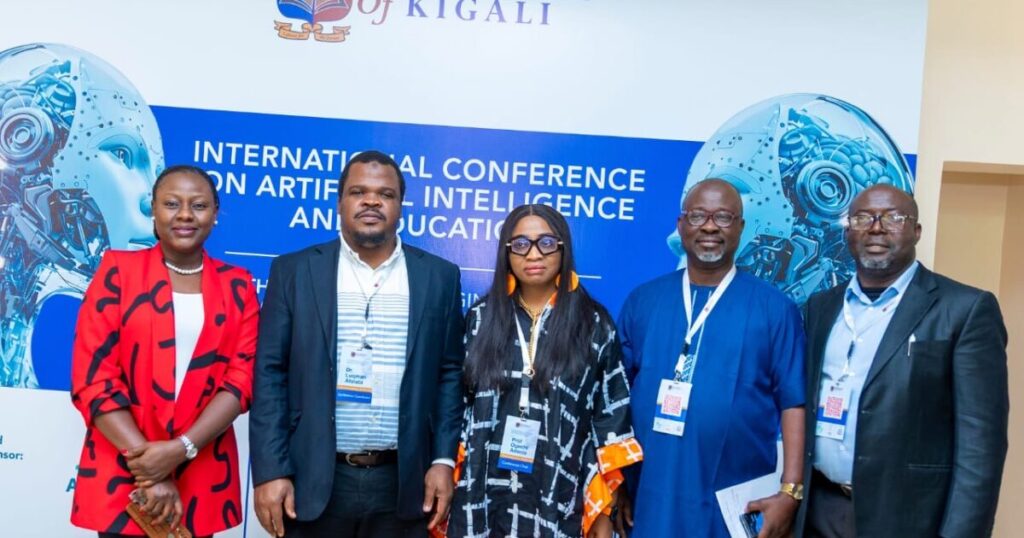
Artificial intelligence will determine the success of the African Continental Free Trade Area and reshape the future of cross-border commerce across the continent, a Senior Lecturer in International Economics and Development, the University of Kigali, Rwanda, Dr Luqman Afolabi, has said.
Delivering a lead paper at the International Conference on Artificial Intelligence and Education in Kigali, on Wednesday, Afolabi argued that Africa’s economic transformation now depends less on physical infrastructure and more on digital “soft infrastructure” — the data systems, payment rails, and skills that enable seamless trade in the AfCFTA’s $3.4tn single market.
He said Africa’s structural challenges — food insecurity, energy deficits, and inefficient financial systems — can be tackled faster through AI-enabled solutions.
Afolabi outlined three areas where AI is already rewriting the rules of African trade, saying, “With Africa holding 60% of the world’s uncultivated arable land yet importing $35 billion in food annually, logistics platforms like Kobo360 are using AI to reduce transport costs by up to 20% and minimise empty miles, ensuring food moves efficiently across borders.”
As regional power pools expand, including the recent synchronisation of the West African Power Pool, Afolabi says that AI-driven predictive maintenance is strengthening grid stability and positioning Africa to lead in “green compute” by powering data centres with solar and geothermal energy.
He identified Afreximbank’s Pan-African Payment and Settlement System as the backbone of the AfCFTA, enabling instant cross-border payments in local currencies and cutting the $5bn lost annually to currency conversion. AI-powered fraud analytics, he said, safeguard the speed and integrity of the system.
“Africa must overhaul its education systems to build a workforce capable of powering the continent’s digital trade ambitions,” he noted, calling for AI literacy and digital trade concepts to be mainstreamed in Colleges of Education, and that “every primary school teacher must become a digital ambassador.”
He cited emerging institutions such as CMU-Africa, ALU, and Afreximbank’s AFRACAD academy as examples of the talent pipelines needed to bridge industry and academia.
To move from potential to reality, Afolabi proposed a two-phase implementation plan: Phase 1 (2025–2026): Harmonise digital trade rules under the AfCFTA Protocol on Digital Trade and operationalise continent-wide digital identity interoperability through the Smart Africa Trust Alliance. And, for Phase 2 (2027), African countries should invest in digital and green computing infrastructure, supported by the AfCFTA Adjustment Fund.
He also set out KPIs for 2030, including raising Africa’s Regional Digital Trade Integration Index from 0.35 to 0.60, ensuring 40 per cent of SMEs have digital credit scores, reducing grid losses below 10 per cent through AI, and achieving full AI literacy among new graduate teachers.
“The AfCFTA provides the market, AI provides the mechanism, and education provides the mindset,” he said, adding that Afreximbank’s leadership in digital payments and skills development is helping code the continent’s future digital economy.
In her remarks, the Deputy Vice Chancellor, University of Kigali, Prof Ogechi Adeola, said Afreximbank continues to play a defining role in shaping Africa’s journey towards a truly integrated continental market under the AfCFTA.
She said, “Its investments in digital trade infrastructure, particularly platforms such as PAPSS and the Africa Trade Gateway, are removing longstanding barriers that have slowed intra-African commerce.”
These innovations, she emphasised, are not only financial tools; they are enablers of economic transformation, making it easier for African businesses and institutions to operate within a unified digital ecosystem.
Adeola said the presentation highlighted how AI is “accelerating this integration.”
“His analysis of the ‘three Fs’ – Food, Fuel and Finance – demonstrated that AI can optimise logistics, strengthen energy systems and secure payment platforms, creating the conditions necessary for the AfCFTA to achieve its objectives. His emphasis on human capital was particularly compelling, noting that without AI-literate teachers and a workforce prepared for the digital economy, the full impact of trade innovations cannot be realised.”
By supporting conferences such as ICAIED and investing in knowledge creation, Adeola noted that Afreximbank is helping to strengthen the competencies required to drive AfCFTA implementation.
“Their work demonstrates that when trade infrastructure and educational capacity advance together, Africa’s vision of a dynamic and digitally enabled single market becomes truly attainable,” she concluded.








