




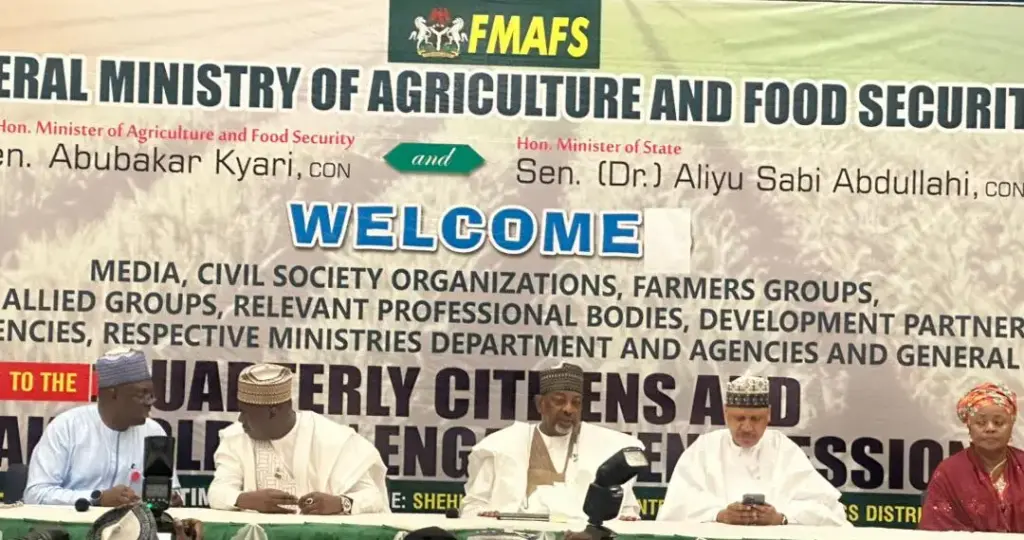
The Federal Government has said its agricultural reforms are beginning to yield results, with prices of essential food commodities dropping by as much as 50 per cent nationwide. The Minister of Agriculture and Food Security, Abubakar Kyari, disclosed this during a quarterly citizens’ engagement session in Abuja on Friday.
According to him, the administration of President Bola Ahmed Tinubu has made food security a key pillar of national stability and economic growth. “Since assuming office, this administration has made food security a top priority, acknowledging the critical role it plays in maintaining national stability and sovereignty,” Kyari said.
“To achieve this, we are focusing on boosting local production and reducing reliance on imports, with the ultimate goal of making affordable, nutritious food accessible to all Nigerians.” He said government interventions were beginning to reflect in market prices. “Our efforts are starting to pay off, with a notable impact on food prices.
In fact, prices of essential food commodities have dropped by 50 per cent nationwide,” the minister said. Food crisis background Nigeria has in recent years faced a severe cost-of-living crisis, largely triggered by economic reforms introduced by the Tinubu administration, particularly the removal of petrol subsidies and the floating of the naira.
The policies significantly increased the cost of living, with food prices more than doubling in many parts of the country compared with levels before Tinubu assumed office. Food inflation rose sharply before moderating slightly following the rebasing of the Consumer Price Index (CPI) by the National Bureau of Statistics last year.
The crisis sparked nationwide hunger protests as many Nigerians expressed frustration over the rising cost of food and declining purchasing power. Despite government interventions, including a new minimum wage and food subsidies, many households continue to struggle to afford basic necessities.
During the 2024 festive season, fatal stampedes were recorded at relief food distribution centres in several parts of the country. Food system experts have attributed the worsening crisis to multiple factors, including climate change, poor post-harvest handling, inadequate storage and transportation infrastructure, and weak market regulation.
Recently, the United Nations Office for the Coordination of Humanitarian Affairs warned that about 35 million Nigerians could face acute hunger this year. Government interventions Kyari said the government has introduced several programmes aimed at boosting agricultural production and supporting farmers.
He disclosed that more than 1.9 million bags of fertiliser have been distributed to nearly one million farmers in the past two years, alongside strengthened regulations to curb the circulation of fake fertilisers.
According to him, the government has also established a National Reference Laboratory and upgraded the National Fertiliser Management Platform to improve quality control and transparency in the fertiliser supply chain.








