



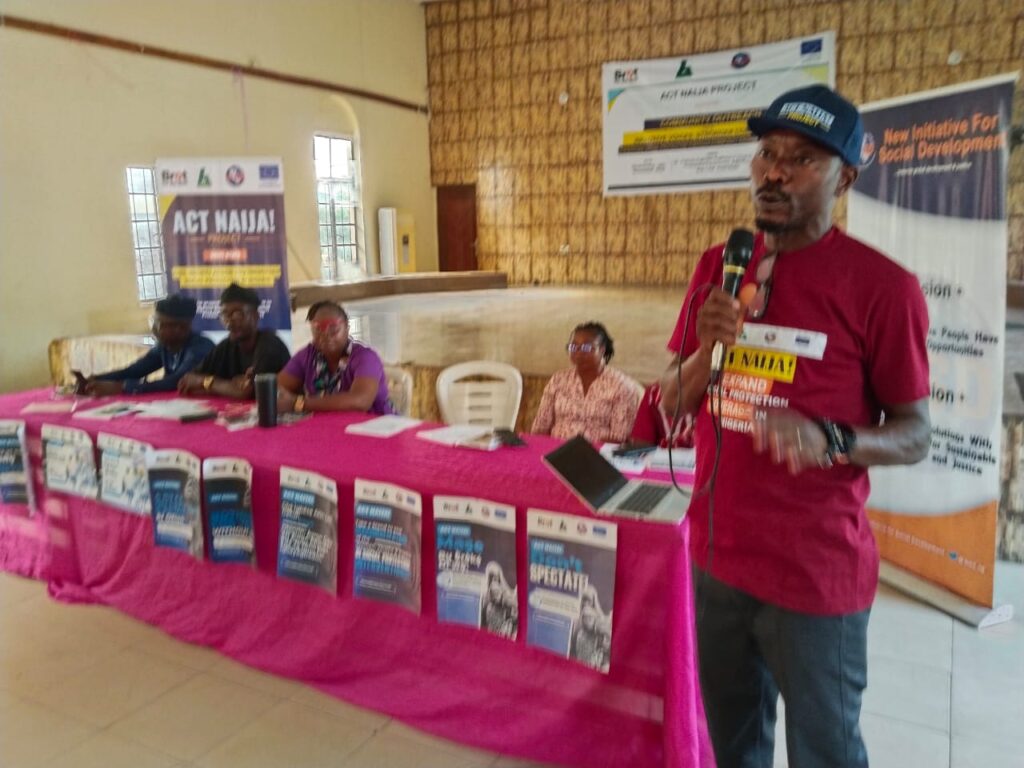
In a bid to deepen awareness of social protection programmes across communities, a Non-Governmental Organisation under the ACT NAIJA project has partnered with the Ekiti State Government to sensitise residents on available social investment initiatives aimed at expanding the state’s social register for the benefit of the vulnerable.
The sensitisation exercise was held in selected Local Government Areas of Ekiti State.
The outreach, titled “Inclusive Voices, Stronger Communities: Enhancing Social Protection Through Community Engagement in Ekiti State,” was implemented by three partner organisations: New Initiative for Social Development (NISD), Africa Network for Environment and Economic Justice (ANEEJ), and Bread for the World (BFTW), Germany.
Programme Officer for the ACT NAIJA Project, Racheal Olori, said the outreach followed an earlier state-level dialogue designed to deepen awareness and gather direct feedback from beneficiaries of social protection initiatives.
She explained that the programme targeted vulnerable groups—including men, women, youths, and persons with disabilities—to help them better understand existing social investment opportunities and how to access them.
Olori added that the event also gave residents the opportunity to interface with representatives of relevant ministries, departments and agencies (MDAs) for prompt responses to complaints and concerns.
According to her, the project was executed through community focal persons, mobilisers, traditional leaders, and gatekeepers to ensure the proper identification of eligible beneficiaries.
Her words: “This community outreach, following the state dialogue we recently organised, is aimed at enlightening community members—men, women, youths, people with disabilities—about existing social protection initiatives in the state, the active programmes being implemented by different MDAs, and those available within their communities.
“It is also a feedback mechanism to hear from beneficiaries about the programmes they have accessed, those their families are currently benefiting from, and the grievances of those who registered but were not approved.”
The Desk Officer for the Cash Transfer Programme in Ado Local Government, Dele Adebayo, highlighted the state government’s efforts in strengthening social protection by maintaining a credible social register from which all beneficiaries are selected. He noted that over 30,000 residents have benefitted so far, with sensitisation carried out through ward facilitators, community leaders, and phone notifications.
Similarly, the Head of Operations at the State Operation Coordination Unit under the Ministry of Budget, Kayode Longe, said the state has recorded significant progress in expanding the social register, which now captures nearly 100,000 households.
Longe acknowledged initial resistance from residents who were reluctant to identify as vulnerable but noted that continuous sensitisation has helped them understand that the register is open to all, as people’s circumstances can change at any time.
Addressing concerns about political interference, he clarified that “community stakeholders, not politicians compile the list of vulnerable households, while the government only moderates the process.”









