
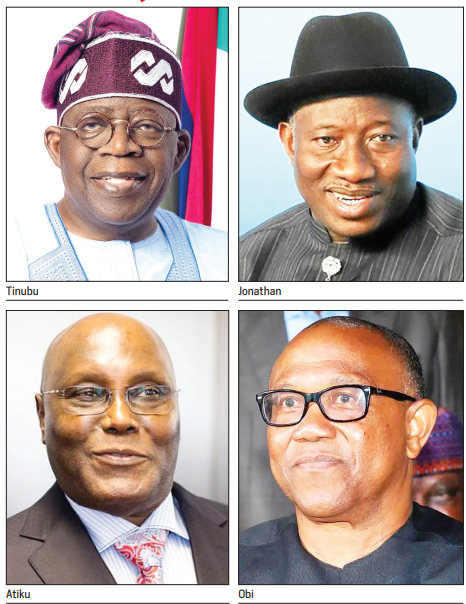

- Former political allies, foes set for battle as 2027 presidential candidates emerge
FELIX NWANERI reports that the stage is set for an interesting presidential contest in the forthcoming general election as the various political parties have elected their respective candidates for the poll

The battle line for the 2027 presidential has been drawn as the various political parties have conducted primary elections to elect their candidates for the country’s highest political office.
Among those who would be flying the flags of their respective parties in the presidential election scheduled for February 16, 2027, include the incumbent, President Bola Tinubu (All Progressives Congress – APC); former Vice President Atiku Abubakar (African Democratic Congress – ADC), Peter Obi (Nigeria Democratic Congress – NDC) and Omoyele Sowore (Africa Action Congress – AAC). Others are former President Goodluck Joinathan (Peoples Democratic Party – PDP), Adewole Adebayo (Social Democratic Party – SDP), Donald Duke (Peoples Redemption Party – PRP) and Seyi Makinde (Allied Peoples Movement – APM).
While their emergence is in line with May 30 deadline set by Independent National Electoral Commission (INEC) for completion of primary elections by the parties, the forthcoming presidential promises to be a battle of former political allies and foes. Interestingly most of the candidates contested the 2023 presidential election and there is no doubt that January 16, 2027 contest would be history repeating itself.
Tinubu: Another date with history
It was clear from day one that President Tinubu would be seeking for a second term given the torrent of endorsements from the various organs, caucuses and stakeholders of the ruling APC even before his administration marked two years in office. Endorsement of the President dates back to April 2024, when the President of the Senate, Godswill Akpabio, led members of the National Assembly to pay the President Sallah homage at his residence in Lagos during the Eid el Kabir celebration.
Setting the tone for an early push for Tinubu’s re-election, Akpabio declared: “As you coast home to victory for a second term, may all the governors seated here also coast home to a second term victory in their states.”
At the gathering were 27 governors from across party divides, former governors and the leadership of the Senate and House of Representatives. A subsequent declaration by the then National Chairman of the APC, Abdullahi Ganduje, that there will be no vacancy in Aso Rock, further gave credence to the belief that the President’s re-election bid had been launched. The Secretary to the Government of the Federation (SGF), George Akume, who spoke in like manner afterwards, particularly advised politicians of Northern extraction to wait till 2031 for another presidential bid.
Although he acknowledged that individuals have the right to aspire for positions, he predicated his stand on the power shift arrangement between the North and South. However, endorsement of the President’s second term bid got to a height, when governors of the APC extraction under the aegis of Progressive Governors Forum (PGF), declared him as the sole candidate of the ruling party for the 2027 presidential election.
Hope Uzodimma, governor of Imo State and chairman of the forum, who announced the decision at the APC national summit at an APC summit in May last year, said the governors were united in their support for Tinubu’s reelection bid. Members of the National Assembly elected on the platform of the APC, who also announced endorsement of the President as the party’s sole candidate for the 2027 presidential election at the summit, said their position was based on his political sagacity.
They maintained that Tinubu has been able to set Nigeria on the path of growth, so a second term, will enable him to consolidate the gains of his administration. Similarly, the zonal caucuses of the ruling party and some members of the opposition political parties equally joined the fray by endorsing the President for a second term. Besides endorsements, some APC youth groups raised funds ranging from N100 million to N200 million and donated same to national leadership of the party for the purchase of the party’s nomination form for the President.
As expected, Tinubu secured the presidential ticket of the APC after a landslide victory in the party’s nationwide direct primary conducted across the country’s 8,809 electoral wards, polling 10.9 million votes to defeat his only challenger, Stanley Osifo, who scored 16,503 votes. With his nomination, this is the second time Tinubu would be on the ballot for a presidential contest and he will join former Presidents Olusegun Obasanjo and Muhammadu Buhari as incumbents to win re-election bids in the present political dispensation (Fourth Republic). In his acceptance speech, Tinubu promised to justify his new nomination by the party stakeholders and its ordinary faithful.
He “I accept, with humility and profound gratitude, the nomination of our great party, the APC, to stand again as its presidential candidate in the 2027 election,” he said. The President, who seized the occasion to reel out his achievements over the last three years, promised to do more to secure a prosperous nation that all Nigerians long for. A former governor of Lagos State, Tinubu’s first foray into politics was in 1992, when he was elected as senator for Lagos West Senatorial District on the platform of the defunct Social Democratic Party (SDP) and served as chairman of the Senate Committee on Banking, Finance, Appropriation and Currency.
With the annulment of the June 12, 1993 presidential election, Tinubu became a founding member of the National Democratic Coalition (NADECO), a pro-democracy group, which for several years, engaged the military for restoration of democratic governance. He later flew Nigeria, but did not give up on the struggle to get the then military junta to declare the winner of that poll, Chief MKO Abiola, as President-elect. Tinubu returned to the country in 1998.
A year later, he was elected governor of Lagos State on the platform of the Alliance for Democracy (AD). He was at a time involved in a struggle with the Obasanjo-led PDP Federal Government over whether Lagos State had the right to create new Local Council Development Areas (LCDAs) to meet the needs of its large population. The controversy led to Federal Government’s seizure of funds meant for local councils in the state. Tinubu equally survived the then centre’s ruling PDP incursion of the South-West, which swept away other AD governors in the zone in the 2023 elections.
He was later to play a major role in the formation of the Action Congress (AC), following the decimation of AD. AC later metamorphosed to the Action Congress of Nigeria (ACN) that merged with other main opposition parties to form the APC in 2013 and fielded former Head of State, General Muhammadu Buhari, who defeated then President Goodluck Jonathan in the 2015 elections.
Tinubu, who succeeded Buhari in 2023, to become the country’s 16th head of state and seventh democratically elected president, defeated 17 other candidates who took part in the election. He polled 8.7 million votes, while his closest rivals, Atiku of PDP and Obi of LP, polled 6.9 million votes and 6.1 million votes, respectively.
Atiku: Will he be seventh time lucky?
This is the seventh bid by former Vice President Atiku Abubakar for Nigeria’s presidency though he has previous made it to the ballot as presidential candidate on three occasions – 2007, 2019 and 2023. His first attempt was in 1993, when he placed third after Chief Moshood Abiola and Babagana Kingibe in the Social Democratic Party (SDP) presidential primary.
In 1998, he was elected governor of Adamawa State, but he was selected before his inauguration by the PDP presidential candidate, Chief Olusegun Obasanjo, as his running mate for the February 1999 election. They went on to win the election and Atiku was inaugurated as vice president on May 29, 1999. After his first term as vice president, some governors elected on the platform of the then ruling party plotted to deny Obasanjo a second term.
The plan was to hand Atiku the party’s presidential ticket in that year’s general elections, but he opted for a joint a ticket with his principal and both won the election. However, the botched plot pitched him against Obasanjo and the cold war that ensued after their inauguration, degenerated to a bitter political battle by 2006, when Atiku declared his ambition to succeed Obasanjo.
Obasanjo’s insistence that Atiku will not succeed him forced the then vice president to leave the PDP for the defunct Action Congress (AC), which handed him its presidential ticket. The election was won by Umaru Yar’Adua (PDP). Atiku rejected the result and called for its cancellation. He, however, returned to the PDP in 2009. While his return was initially resisted by his state chapter of the PDP, he was granted a waiver by the party’s national leadership. That paved the way for him to contest the 2011 PDP presidential primaries.
Atiku was selected by the Northern Elders Political Leaders Forum (NPEF) led by former Minister of Finance, Mallam Adamu Ciroma, as the region’s consensus candidate, but was floored at PDP’s presidential primary by then Acting President Jonathan, who went ahead to win the election. The 2011 defeat did not deter Atiku as he surfaced again in 2014 for the 2015 presidency.
He had before then made good his threat of dumping the PDP should the party’s leadership fail to return it to the vision of its founding fathers with his defection to the then opposition APC. Many had believed that he would be the candidate to beat in the APC presidential primaries given his financial strength and political structure, but he lost the ticket to Buhari.
With the 2015 presidential election won and lost, the former vice president returned to his chain of businesses, but a rumoured 2019 ambition emanated late 2015. It was alleged then that Atiku hosted political meetings in Dubai Dubai, United Arab Emirates, apparently to revive his political machinery ahead of the 2019 presidential election, but the former vice president described the rumour as the handiwork of political mischief makers, who want to draw a wedge between him and President Buhari.
Besides denying the 2019 presidential bid, Atiku added that the success of the Buhari administration has been his preoccupation, and that any true APC member should have the same zeal. But, denial being another name for politics, it was not long before the picture became clear that the former vice president will take another shot at the presidency. However, there was a roadblock to this quest – Buhari’s second term bid. This seeming barrier apparently forced Atiku to resign from the APC on November 24, 2017.
He hinged his decision on the party’s failure to deliver on its promises to Nigerians, who, according to him, have long been desperate for improved economic interventions. While the former vice president promised then to take time to ponder about his next political move, it was obvious that he would be returning to his former party. This belief manifested on December 3, 3027, when he formally returned to the PDP. This set the stage for him to join the 2019 presidential race.
As expected, Atiku defeated 11 other aspirants at the PDP’s national convention held in Port Harcourt, Rivers State on December 7, 2018. He polled 1,532 votes to beat his closest rival, Governor Aminu Tambuwal of Sokoto State, who scored 693 votes, while then Senate President, Bukola Saraki, placed third with 317 votes. Atiku’s emergence as the presidential candidate of the PDP drew the battle line for the 2019 presidency between him and President Muhammadu Buhari but the former vice president lost the February 27, 2019 election to the incumbent. He challenged the outcome of the election but the Supreme Court dashed his hope of upturning the table against Buhari.
However, the loss in 2019 did not deter the former vice president in his bid to lead Africa’s most populous nation. He threw his hat to the ring ahead of the 2023 elections and emerged as the presidential candidate of the PDP. He polled 371 votes to defeat his closest rival, Nyesom Wike (then governor of Rivers State), who had 237 votes in the party’s presidential primary. However, the PDP’s inability to resolve the pre and post-presidential primary election crisis contributed to Atiku’s loss of the main election.
It would be a national tragedy if after the suffering, underperformance, corruption and mismanagement Nigerians have endured, the next government turns out to be even worse
The former vice president polled 6.9 million votes to place second to Tinubu of the APC, who had 8.7 million votes, while Obi, who left PDP at the eve of the party’s presidential primary for LP, garnered 6.1 million votes to place third. Atiku, however, rejected the results and approached the Presidential Election Petition Tribunal (PEPT), which is the court of first instance in presidential election matters, with prayers for it to nullify Tinubu’s victory as declared by INEC. But the tribunal, in a consolidated judgement, unanimously affirmed Tinubu’s election. He appealed the judgement, but it was the same outcome at the Supreme Court, which also affirmed Tinubu’s election.
Many had thought that Atiku would quit politics after his bid to upturn President Tinubu’s election was dashed by the apex court, but he vowed to fight on. He later called on the opposition political parties to come together to create a more formidable front that will salvage Nigeria’s democracy from sliding into a one-party state.
His call was heeded, when key opposition figures like Obi, Rotimi Amaechi (a former governor of Rivers State) ex-Kaduna State governor, Nasir El-Rufai; former Speaker of the House of Representatives and immediate past governor of Sokoto State, Aminu Tambuwal and a former Secretary to the Government of the Federation (SGF), Babachir Lawal, came together and adopted the ADC as the platform to challenge the ruling APC in the 2027 elections.
But as predicted, some of the arrowheads of the coalition later dumped the ADC over unresolved issues, particular choice of a presidential candidate in line with the power sharing arrangement between the North and South. This left Atiku and Amaechi as the frontrunners for the party’s ticket, which the former won. Atiku polled 1,846,370 votes to defeat Amaechi and Mohammed Hayatu-Deen.
The former Rivers State governor secured 504,117 votes, while Hayatu-Deen scored 177,120 votes. In his acceptance speech, Atiku described his emergence as a humbling honour and praised the ADC for conducting what he called a free, fair and transparent democratic process at a time when democracy was under threat in the country. He said the coalition behind the party was formed through sacrifices and compromises aimed at rescuing Nigeria’s democracy from what he termed increasing intimidation and suppression of opposition voices by the ruling APC-led government.
Atiku said his administration will prioritise security, education, healthcare and economic reforms, while promising decisive action against insecurity, unemployment and poverty across the country. He pledged to strengthen the armed forces, invest massively in education and healthcare, and build an economy that benefits ordinary Nigerians. He further promised to pursue policies that would restore investor confidence, stabilise the economy and improve the living standards of citizens.
Obi: Aiming to upset the apple cart
The former governor of Anambra State would be making it to the ballot for a second time after his impressive showing in the 2023 presidential election with 6.1 million votes. Obi was among the frontrunners for the presidential ticket of the ADC but he shocked most party faithful, when he announced his resignation from the party on May 3 and joined the NDC, emerging the party’s candidate at the weekend. The 2023 LP presidential candidate, who was the PDP’s vice presidential candidate in the 2019 election, was affirmed as NDC presidential candidate for the 2027 polls at a special convention on Saturday.
He was sole presidential aspirant ofthe newly registered party led by a former governor of Bayelsa State, Seriake Dickson. While many are wondering how Obi will match the major candidates with deep pockets and political structures across the country, his support ers believe that his profile and doggedness make up for what he lacks in terms of finance given his chequered political history.
Obi contested for the governorship of Anambra State on the platform of the All Progressives Grand Alliance (APGA) in 2003, but Chris Ngige of the PDP was declared winner. Ngige’s victory was overturned in 2006 by the Court of Appeal, which declared Obi the winner of the 2003 election, and he resumed office on March 17, 2006. Obi was however impeached by members of the state House of Assembly on November 2, 2006. He challenged the impeachment and was re-instated by the court on June 14, 2007 and was re-elected in 2010.
In 2019, Obi paired Atiku in the presidential election as running mate on the platform of the PDP and the placed second behind President Buhari of the APC. In March 2022, he declared his intention to run for president on the platform of the PDP but later pulled out and joined the Labour Party. Backed by the Obidient Movemnet – his supporters, mostly youths, Obi’s entrant into race was responsible for the three-horse presidential in 2023, and against the expectations of many, he polled 6.1 million votes.
Duke: A second attempt
The former Cross River State governor emerged as the candidate of the PRP after polling 6,499 in votes in the party’s presidential primary election to beat his closest rival, Kingsley Yakubu, who had 2,699 votes, while Dr. Nnaoke Ufere came third with 784 votes. This is the second time, Duke who was elected as governor at the age of 37 in 1999, would be contesting the presidential election.
His first attempt was in 2019 on the platform of the SDP. Duke’s political journey began in 1992, when he was appointed as Commissioner for Finance, Budget and Planning by then Governor Clement David Ebri. The appointment was however short-lived due to the military intervention of 1993. Duke, therefore, returned to private practice. Following the return to democracy in 1999, Duke was elected as the governor of Cross River State, on the platform of the PDP. He held this position until 2007.
His administration focused on transforming Cross River into an international tourism and business hub. After eight years as governor, Duke announced his intent to run for the presidency in the 2007 elections but stepped down for the PDP’s candidate – Umaru Yar’Adua. Again, he declared his interest in running for the presidency in 2019 and consequently he defected from the PDP to the SDP.
Sowore: Activism meets politics
The rights activist and pro-democracy campaigner emerged as the presidential candidate of the African Action Congress (AAC) through a consensus arrangement. Following his nomination, Sowore stepped down as the national chairman of the party to contest the presidential election for the third consecutive time. He was on the ballot in the 2019 and 2023 elections.
A former president of the University of Lagos Student Union Government (1992–1994), Sowore during this time, led mass protests against military rule, corruption and campus cultism. And venturing into politics has not stopped Sowore’s criticism of political establishments. He is the convener of the RevolutionNow movement, a pressure group dedicated to demanding better governance and an end to systemic corruption. Due to his anti-government stance and activism, he has faced numerous arrests, detainments and harassments by various state authorities.
Adebayo: Second consecutive attempt
The Ondo State born legal practitioner emerged as the candidate of the SDP at the party’s national convention on May 9, to contest the presidential election for the second consecutive time. In his acceptance speech, Adebayo said he joined the presidential race to rescue Nigeria from its current challenges, describing the nation’s condition as alarming. “Nigerians are hungry and homeless.
We are jobless. We are without peace. We are without leadership,” he said, warning against what he described as the growing concentration of power in the country. He stressed that the real danger facing Nigeria is not a one-party state but “one-man rule,” adding: “People say Nigeria is in danger of becoming a one-party state. I disagree. The real danger is oneman rule because that is where they are taking this country.”
He cautioned Nigerians against making poor electoral choices in 2027, saying the country cannot afford another failed government. “It would be a national tragedy if after the suffering, underperformance, corruption and mismanagement Nigerians have endured, the next government turns out to be even worse,” he warned.
On his plans for Nigerians, he reaffirmed his party’s commitment to social welfare, justice, accountability and national development, insisting that Nigeria’s resources must benefit the people rather than a privileged few. He also promised to launch a national jobs and public works programme aimed at drastically reducing unemployment within two years.
Onor: A first timer
The former senator, who represented Cross River Central Senatorial District between 2019 and 2023, emerged as the candidate of Abdulrahman Mohammed faction of the PDP backed by the Minister of the Federal Capital Territory, Nyesom Wike. Onor emerged through a consensus arrangement being the sole presidential aspirant after declaring his intention to contest the 2027 presidential election and obtaining the expression of interest and nomination forms.
He would be contesting the presidential election for the first time if he makes it to the ballot given the legal battle over the PDP national leadership. This is as Wike has repeatedly said that he will work for President Tinubu of the APC. In his acceptance speech, Onor promised to run on a pan-Nigerian platform anchored on energy, courage, competence and intellectual depth if elected. He also assured Nigerians that a PDP government under his watch will prioritize competence and restore public confidence in governance.
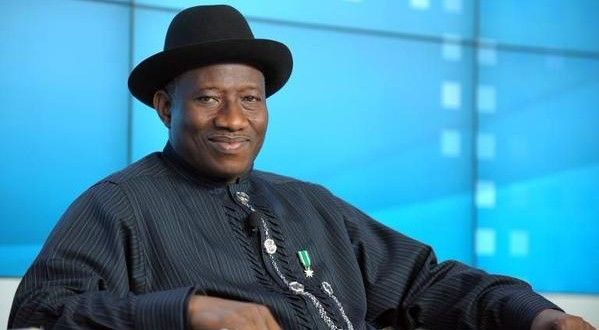
Jonathan: Haze over ex-president’s ambition
The former president has not officially declared for the 2027 presidential contest but he has been declared the candidate of the PDP by the Kabiru Turaki-led factional leadership of the party. Jonathan’s candidature was approved on Saturday at a special national convention held at the party’s office in Abuja. The former president was not present at the convention but his certificate of return was received by Hon. Fred Agbedi, a member of the House of Representatives from Bayelsa State.
Jonathan must however scale the legal hurdle over the PDP’s leadership tussle to make it to the ballot if he accepts the candidacy and that will be the third time he would be running for the office he occupied between 2010 and 2015. Like the presidential frontrunners – Tinubu, Atiku and Obi, Jonathan comes has a rich political profile.
Before entering into politics in 1998, he worked as an education inspector, a lecturer and an environmental-protection officer. His political career began when he became involved with the PDP the late 1990s In 1999, he was running mate to Alamieyeseigha, and the won the Bayelsa State governorship election on the platform of the PDP.
They were reelected in 2003 and Jonathan served as deputy governor until December 2005, when he was sworn in as the governor upon the impeachment Alamieyeseigha by the Bayelsa State House of Assembly after being charged with money laundering in the United Kingdom. He later served vice president between 2007 and 2010 but was named acting president on February 9, 2010, following the Doctrine of Necessity from the Senate due to President Musa Yar’Adua’s trip to Saudi Arabia in November 2009 for medical treatment.
In accordance with the order of succession in the Nigerian Constitution, following President Yar’Adua’s death on May 5, 2010, Jonathan was sworn in as substantive president on May 6, 2010. After serving out Yar’Adua’s tenure, Jonathan contested the 2011 presidential election and won. His re-election bid in 2015, however hit the rocks as he was defeated by a former military ruler, General Muhammadu Buhari, the first time an incumbent president would be defeated in Nigeria.
Makinde: Another first timer
The Oyo State governor emerged as the candidate of the Allied Peoples Movement (APM) to contest the presidential election for the first time. Makinde chose to vie for the country’s number one position unlike most other outgoing governors who opted to contest for senatorial seats.
He joins the race with a political history that dates back to 2007, when he contested for the Oyo South senatorial seat on the platform of the All Nigeria Peoples Party (ANPP) but lost to the candidate of the PDP – Kamoru Adedibu. In 2010, he aspired for the Oyo South 2011 senatorial seat but lost the PDP primary election. He also had an unsuccessful bid for the PDP governorship ticket in 2014 before he defected to the SDP to contest 2015 governorship but placed third.
In 2019, he polled 515,621 votes defeating his closest rival, Adebayo Adelabu of the All Progressive Party (APP) who polled 357,982 votes to emerge as governor of Oyo State. He was re-elected in the 2023 election after defeating Teslim Folarin of the APC.
In acceptance speech of the APM nomination, Makinde said his ambition is not driven by personal interest but by the urgent need to restore hope and rebuild confidence in Nigeria. He maintained that Nigeria possessed the resources and capacity to overcome its challenges through honest leadership and practical reforms that directly impact citizens.
He promised comprehensive reforms in the oil and gas sector, insisting that Nigerians must benefit from the country’s vast natural resources. The APM candidate distanced himself from “miracle promises,” saying what he promised was leadership that listens, learns, and acts.
“This campaign will be about solutions, competence and the future. Together, we can build a Nigeria where security is not a privilege, where opportunities are not reserved for a select few, and where leadership genuinely serves the people,” he said.