
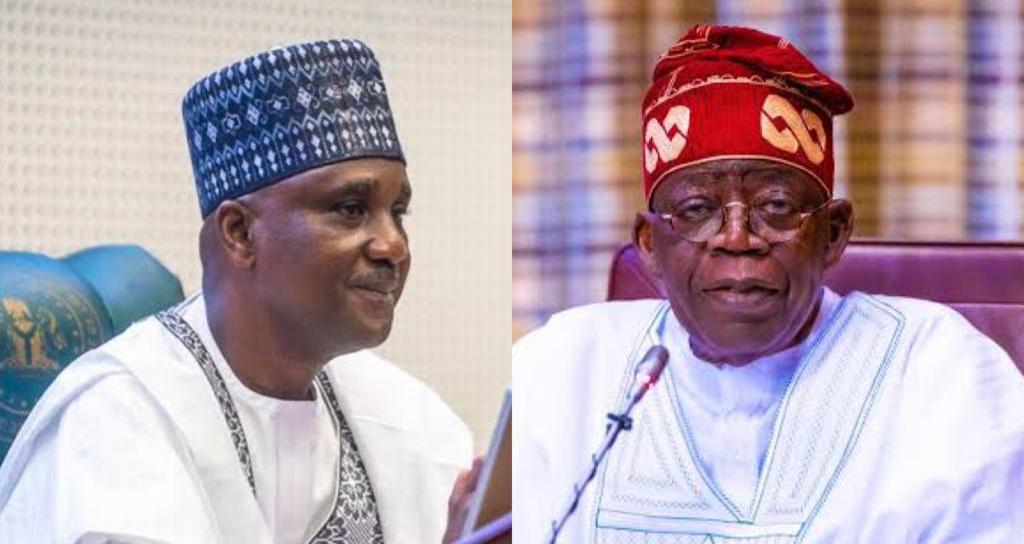
The Speaker of the House of Representatives, Hon. Tajudeen Abbas has congratulated President Bola Tinubu, on the third anniversary of his administration, saying the government is delivering on its Renewed Hope Agenda.
Abbas, in a congratulatory message, noted that Tinubu’s government’s reforms have long-term positive impacts on Nigeria and the people beyond the administration, calling on Nigerians to be patient in their assessment.
The speaker said, “President Tinubu inherited a country on life support. A country on crutches. A country bedevilled by subsidy distortions, exchange rate instability, declining revenues, weakened investor confidence, oil theft, worsening insecurity, and an economy weighed down by years of postponed decisions.
The politically convenient option would have been to continue postponing reality, Speaker Abbas noted, saying, “But President Tinubu chose reform.
He chose reconstruction. He chose long-term national stability over temporary political comfort. And today, Nigerians can see the results of those bold decisions across the country.”
In specific terms, he said Nigeria’s economy under Tinubu has transitioned from fragility to recovery. “GDP growth improved from 2.74 per cent in 2023 to 3.87 per cent in 2025, while major global institutions project 4.4 per cent growth in 2026. Net external reserves improved from about $4 billion in 2023 to over $34 billion by the end of 2025, with gross reserves now above $50 billion, the highest in 13 years.”
The speaker noted further that in public finance, the federation revenues have expanded dramatically under Tinubu’s reforms, with total FAAC allocations rising from about ₦10.9 trillion in 2023 to ₦15.26 trillion in 2024, representing a 43 per cent increase driven by subsidy removal, foreign exchange reforms, and improved revenue generation.
“By 2025, cumulative allocations had crossed ₦22 trillion, with several months exceeding the historic ₦2 trillion mark for the first time in Nigeria’s history. In 2026 alone, the first two months already recorded about ₦3.86 trillion in allocations, representing a further 14.2 per cent increase over the same period in 2025.”
In terms of investment, Speaker Abbas pointed out that capital inflows rose sharply from just US$654.65 million in the third quarter of 2023 to US$5.642 billion by the first quarter of 2025, which means more factories, businesses, jobs, and greater opportunities for Nigerian entrepreneurs.
Next is infrastructural development, where major road, rail, port, and energy projects are advancing nationwide. He cited the Lagos-Calabar Coastal Highway, Sokoto-Badagry Super Highway, Abuja-Kaduna-Kano Highway, and rail modernisation projects that are now opening new economic corridors across the country.
The speaker stated that President Tinubu’s unprecedented resolve in tackling insecurity in the country led to Nigeria’s defence and security allocation rising from about ₦2.98 trillion in 2023 to over ₦4.91 trillion in the 2026 budget, the highest in the nation’s history.
“Operations against terrorism, banditry, kidnapping, oil theft, and organised crime have intensified nationwide. Recent joint Nigeria-United States operations eliminated Abu Bilal al-Minuki, described as ISIL’s second-in-command, alongside several terrorist leaders.”
The oil and gas sector under Tinubu also witnessed drastic improvements, as Nigeria’s crude oil output, which averaged about 1.44 million barrels per day in 2023, has rebounded to between 1.75 and 1.84 million barrels per day, driven by stronger pipeline surveillance, improved security coordination, and regulatory reforms.
Education and human capital development have also witnessed a boost under the Tinubu administration, with over 1.3 million Nigerian students benefiting from the Nigerian Education Loan Fund as disbursements already exceeded ₦242 billion across more than 280 tertiary institutions nationwide.
In manufacturing and industrial development, reforms in taxation, energy, gas infrastructure, and industrial policy are improving the environment for local production and industrial expansion, while housing and urban development saw the building of the Renewed Hope Cities and Estates Programme, targeting 100,000 housing units nationwide across the geopolitical zones and the FCT, he added.
In the digital economy and services sector, the speaker stated that Nigeria’s ICT sector remains one of the strongest drivers of growth, creating opportunities in technology, innovation, financial services, entertainment, and entrepreneurship.
While noting that there are still socio-economic and security challenges, the Speaker stated that the current administration is determined and committed to addressing them with strategies and long-term solutions.
He said it is strategically expedient for Nigerians to renew President Tinubu’s mandate in 2027 to enable the completion of the policies, programmes, and projects of his administration.
Speaker Abbas restated the readiness of the 10th House to collaborate with the Executive arm of the government towards ensuring the welfare of Nigerians and the safety of lives and property. He assured continuous timely consideration and passage of legislation that will directly benefit and impact the lives of the people.
Just as with the National Assembly, Speaker Abbas called for more collaboration between the Federal Government and the subnational governments, state and local governments for the common good of the people.
The speaker called on Nigerians to place nationhood and patriotism over partisanship and ethno-religious and political considerations.
He urged them to continue to support the government, which is a continuum, regardless of the occupants of public offices.