




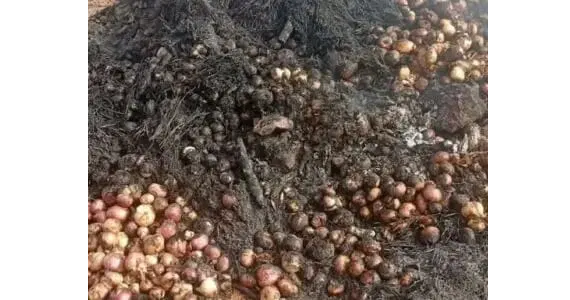
The National President of the Nigerian Onion Producers, Processors, and Marketers Association of Nigeria (NOPPMAN), Aliyu Isah Maitasamu, has said that recent fire incidents, which have destroyed about 6,000 bags of Onions worth over N300 million, may affect the country’s local and international supply chains.
Tragedy struck in Sokoto State as fires razed bags of onions in three villages on separate occasions within one week. Maitasamu, who gave an updated account of the incidents to newsmen in Sokoto, said the first occurred in Kojiyo town, Goronyo Local Government Area, where fire engulfed about 65 local storage facilities.
He said each storage facility contained about 35 bags of Onions. At the time, the price of onions was estimated at N25, 000 per bag within the locality. The loss was valued at almost N56.8 million. “48 hours after the Kojiyo fire incident, another fire outbreak occurred in Dundaye town, Wamakko Local Government Area, where fire engulfed about 51 local onion storage facilities,” Maitasamu said.
He noted that each facility had about 12 partitions. In total, about 612 bags were lost, valued at around N21.4 million. The largest fire outbreak occurred in Duhuwa town, Wurno Local Government Area, where about 324 traditional Onion storage facilities were destroyed. Each contained 18 bags, totaling 5,832 bags valued at around N204.1 million.
“In total, we lost 8,107 bags of Onions from about 440 storage facilities, valued at around N282.3 million within one week,” he said. Maitasamu said the cause of the incidents remains unknown to farmers and the Onion association. “The incident in Kojiyo town happened in the daytime when local security guards woke up to see the inferno within the area.
However, the incident at Duhuwa town occurred on Friday while residents were in the Mosque, observing Jumu’at prayers and returned to find fire engulfing the onion storage facilities,” he explained.
“We have reported to security agencies, and they have swung into action in Goronyo, Wamakko, and Wurno Local Government Areas,” he said, adding that he was hopeful about the efforts of the state Commissioner of Police. “The command is doing its best on the issue.” The president expressed optimism that the police would soon provide an update on the cause.
“No, I don’t see it as banditry because acts of banditry have characteristics we all know. They kill and unleash terror on communities but none of that happened,” Maitasamu said. He, however, suspected internal sabotage. “What really caused my confusion is that the incidents happened at the same time within a week and took place within 48-hour sequences.
“Any member found wanting in the act of sabotaging the efforts of members should be arrested and prosecuted,” he warned. Farmers lose livelihood, savings Maitasamu highlighted the immediate and long term effects of the disaster on supply in Sokoto and across Nigeria, especially for farmers who lost their livelihoods.
“For us, Onion storage is not just about storing Onions for sale but about our people saving their money, saving their investments, like the way you save your money in the bank,” he said. “The way you save your money in banks is the way we save our own money in the form of Onions.
The reason is that when you save N1million today, in eight months it will not become N2million.” “But if I store Onions worth N30,000 today, in the next one or two months, those onions may be worth N60,000, and in the next four to six months, maybe N90,000. So, we are saving something that appreciates over time.
“Secondly, we save to cater to needs. If we had cash at hand, we might spend it unnecessarily. But when you save Onions, and you have bills to settle, maybe hospital bills, you sell 10 bags of Onions to cover that bill. If you have school fees to pay for your child in the university, you sell some bags of Onions to pay.
Or if you want to give your daughter’s hand in marriage, you sell some quantity of onions for the wedding ceremony,” he explained. He noted that the incidents occurred in insecure areas where banditry and other crimes were prevalent.
He expressed sadness that the National Emergency Management Agency, (NEMA), and the State Emergency Management Agency, (SEMA), had not come to assist the victims.








