

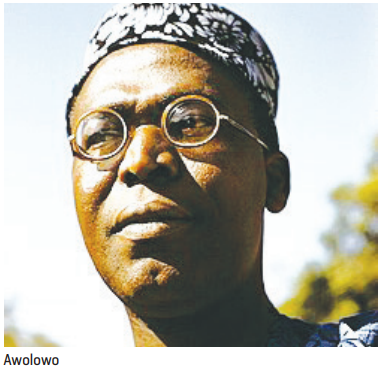
As kidnappings and killings have become the rituals of daily life in many parts of the polity, with the nation-state itself facing the threat of being kidnapped, it is important to remind ourselves that the theological, economic, social and political provocations and disasters that define this era are mere manifestations of Nigeria’s refusal to reconcile itself to the fundaments of how to build a good society as well as an egalitarian federal democracy which Chief Awolowo, more than any other political thinker in the country’s history, articulated and for a few years demonstrated, with long lasting impact.
At the core of the crisis that has engulfed the polity for several decades now is a leadership crisis. This is the reason I would like to reflect today on leadership and what I call “Awolowo’s Theory of Action” in the context of his devotion to politics as future-making.
As we experience what would seem to be the normalization of an internal security landscape in which there is a convergence of jihadist insurgency, communal grievances, some under the name of banditry, secessionist agitations, and criminal economies, those who are not familiar with Awolowo’s insight and foresight would need to be reminded that the man with the round frame glasses had warned the ascendant political order of his age that, if there was no course correction, what we are experiencing now would constitute their generational endowment to the political geography that Frederick Lugard imposed in the heart of Africa.
Thus, it is an irony that while this deeply divided country continues to be bogged down by the politics of the past and the conflicting and contrasting narratives of who wronged whom in the past and how we arrived here, what it truly needs is a reflection on the postulations of a man who almost always emerges from our past to constantly remind us about the possibilities of our collective future.
He was a man whose most important life mission could be said to have been one of future-making. Leaders who are future makers never come too early. This is partly why Chief Awolowo remains relevant today. When we talk about Awolowo’s theory of action and his leadership qualities, which remain unrivaled almost four decades after his passing, we are gesturing at the fact that, ultimately, he was a man concerned fundamentally with Nigeria’s future, Africa’s future, and indeed, the future of the Black people of the world.
An overview of the continent’s current conditions leads to distressing conclusions, with Nigeria standing out, given that it possesses not only the largest population but also the most vibrant and highly skilled labour force, even though a substantial percentage of this has migrated abroad.
From the resurgence of military adventurers in West and Central Africa, the return of presidents-forlife, if they ever went away, in Central and East Africa, symbolized by the nonagenarian in Cameroon, or the octogenarians in Equatorial Guinea, Congo-Brazzaville, Uganda, and Eritrea, and the younger version in Rwanda, to the relentless sufferings imposed on the people of the continent by interconnected crises arising from governance failures, corruption, poverty, poor infrastructure, unemployment, most worryingly the highest rate of youth unemployment (roughly one third of Africa’s 420 million youth, are out of work or have stopped looking for jobs), and violent conflicts, all worsened by climate change and high dependency on primary resources, the extraordinary capacities of the people of the continent and their insuppressible cheerfulness have been challenged in different ways.
Awolowo showed this clearly throughout his political career. What is important is always to imagine a better future, no matter how bad things are. He was constantly asking, “What are the possibilities of a better future?”
This is why I have decided to focus today on “Politics as Future-Making,” using Chief Obafemi Awolowo’s ideas and his public career as a heuristic lens to examine Nigeria’s unending search for effective leadership. This idea of politics-as-future-making could represent a paradox, given that, classically, politics is the art of the possible.
But Awolowo continues to speak from the grave because he decided, while on this side of the divide, never to surrender the future possibilities of politics (based on long-term thinking, planning, and development) to the personalized political exigencies of the search for power.
The question of temporality was always evident in Awolowo’s reflections. From thinking about what to do with the legacies of the past, both its assets and liabilities, to what kind of society and polity could be constructed in the present in order to create a better future, future-making was a focal point of his life’s mission. I think, therefore, that it is important that we use this to reflect on his legacy and re-evaluate the leadership challenges facing Nigeria.
Awolowo looked back, only to look forward. He acted in the present of his time, only to ensure a greater future for the people. What is it in the total composition and structure of Nigeria that makes it difficult, if not impossible, for sustainable good leadership to emerge? Why has the country’s evident good human agency (in areas such as medicine, law, civil advocacy, the arts, including literature, music, etc., etc.) been incapable of weakening if now neutralizing the strong and recalcitrant agency of bad national political leadership?
Awolowo’s vision of the future was captured by the slogan of his first political party, the Action Group: “Freedom for all, life more abundant.” (This was the impetus for the Yoruba sloganization of that universal ideal as “Afenifere.”) In the 1950s, this was a revolutionary idea that made Awolowo an enemy to local and foreign forces that would later combine to ensure he never became Nigeria’s leader.
About four decades of sustained engagement with Awolowo’s thoughts through his writings and speeches, combined with my study of Nigerian history, politics, and society, have led me to distill four cardinal reasons why it has been difficult for the polity to produce sustainable good leadership and transform this suffocating Lugard-ian enterprise into one in which there is freedom for all, and life more abundant.
The fundamental challenges of such a postcolonial state as Nigeria—especially given the nature of its ethno regional composition, the inequalities and inequities built into the system not only by the British, but also by differential exposure of the different peoples and regions to the Enlightenment project and their different degrees of readiness to surrender parts of their ethno-cultural heritage that were incompatible with the march of human progress—constituted, for Awolowo, perhaps the greatest impediments, for creating a fully humanizing polity.
This was why he called Nigeria a “geographical expression,” even as he recognized the potential for good leadership to transform the nature and dynamics of state composition. Thus, Awolowo theorized and later articulated what needed to be done not only to end colonial rule but also to institute a new form of governance, grounded in the best legacies of the Enlightenment.
He also linked this to the best cultural legacies surviving from the histories of Nigeria’s different regions, to build a workable federal democracy and a welfare state. For him, at this point in the 1950s and 1960s, the ideological and political bases of this were the triplet instrumentality of Constitutionalism, Federalism, and Democratic Socialism.
Though Awolowo devoted a considerable amount of time and his life’s work to understanding, analyzing, and then articulating the nature of Nigeria’s political economy, at the point in the 1950s up to the late 1960s when he published some of the most important works on this subject, agriculture was the backbone of the Nigerian economy.
It also dictated the nature of regional and federal revenue and, to that point, the structure of Nigeria’s fiscal federalism. But as crude oil displaced agriculture, both fiscally and culturally, Awolowo foresaw the dangers that the emerging ethos of “national cake” would pose to the future of the polity. But those in power and the core of the political elite did not heed the warning.
As petrodollars flowed into the national coffers, not only did the military-inpower tilt the structure of federal revenue towards dispossessing the constituent parts and the poor masses, but the emergent fiscal federalism became that only in name. Despite their flaws, the moderation and relative fiscal sense of proportion of the leaders of the First Republic gave way as the oil-based political economy transformed not only the leaders but also the broader elite formations, the middle class, and even some segments of the working class into a profligate socioeconomic and political formation.
When, in the early 1970s, a Nigerian leader reportedly said that Nigeria’s problem was not money but how to spend it, the elite led the people into an era of “spend first and think later.” Investment in the future, both in a fiscal and a social sense, was not considered. And in less than a decade, the oil boom turned into oil gloom. However, before that happened, a prodigal political economy had affected not only the social and cultural environments but also our politics. Deliberate and process-oriented leadership was no longer desirable.
“The Army of Anything Goes,” as one mournful departing Chief of Army Staff captured the reality in the late 1980s, turned Nigeria into a “country of anything goes” with a damaged political economy, which, even when the economic index improved, could not change the culture of looting. Thus, the dominant political economy is incapable of encouraging, promoting, supporting, or even tolerating good leadership. The implications of this for governance, and for party and electoral politics, have been devastating. We have worked hard toward the near-total destruction of the ethical basis of public culture.
We have taken the worst aspects of our socio-cultural notions and practices which have been exacerbated by the cultural ill-logic of oil wealth, and expanded and extended them while ignoring the best and the most positive aspects of existing ethno-cultural formations and practices, such as the Yoruba notion and practices of omoluabi (gentleman or the well-bred), the Hausa notion and practices of mutumin kirki (good man), and the Igbo notion of ezigbo mmadu (a person of good character).
Let me use the end of military rule and the process that led to the Fourth Republic as an example of the grotesque nature of elite composition in Nigeria, particularly of the dominant political elite, which some describe as an oligarchy. This oligarchy may have an ethno-regional core, but we would be deceiving ourselves if we failed to recognize that every part of Nigeria has contributed to, and continues to contribute to, its membership.
As General Sani Abacha’s murderous and plundering misrule collapsed and the rump of the military worked their way out of power, this tiny but very powerful and strategically- and tactically-potent elite, combining both their civilian and (retired and retiring) military wing, came together to ensure that the long battle for federal democracy and egalitarian rule, which predated but was restarted almost as soon as the military seized power in December 1983, was hijacked and trivialized.