



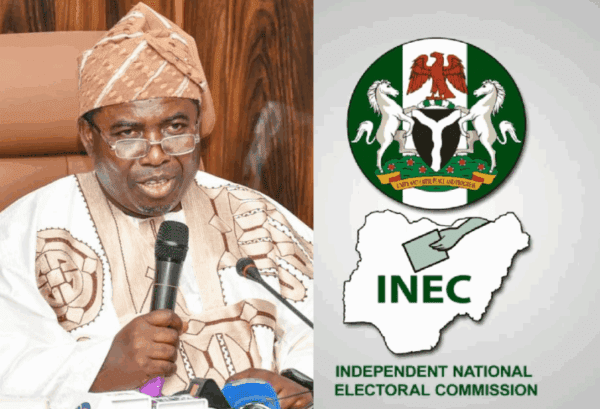
The Independent National Electoral Commission (INEC) has reacted to the widespread controversy surrounding the Chairman of the Commission, Prof. Joash Amupitan, over the alleged links to the ruling All Progressives Congress (APC).
This is as the electoral umpire stated that it will not rely on findings from artificial intelligence or screenshots regarding the purported digital impersonation of its Chairman.
The INEC’s ICT Director, Lawrence Bayode, who spoke in an interview on Channels Television on the viral posts attributed to an account allegedly linked to the commission’s Chairman, said the commission is already engaging security agencies and external forensic experts to verify the authenticity of the content and accounts involved.
He added that the commission would not rely on unverified materials in reaching conclusions.
“We are taking this further because even though we have referred this to security agencies, we rely on evidence. We are also going to be engaging a third party, for instance, forensic experts, to look into this.
“I will not base my judgments on screenshots. I will not allow that to guide my conclusion. We are already looking at it in-house. We are preparing for an election. This is happening,” he said.
According to him, the commission is also considering technical and forensic review processes as part of its internal investigation.
READ ALSO:
Bayode stressed that the commission plans to expand its use of technology ahead of the 2027 general elections, warning that emerging digital threats must be addressed early.
“We are going to be deploying technology massively during the 2027 general election. If this is already happening now, then we need to ensure that we do the needful,” he said.
The ICT director said the issue goes beyond a single account, describing it as part of a broader pattern of digital impersonation and misinformation.
“What we are seeing is something bigger. What we are seeing is digital impersonation,” he said.
He noted that the account in question had reportedly been renamed at some point, raising further concerns about manipulation.
He also argued that publicly available information can be exploited for malicious purposes.
“Email addresses and phone numbers you mentioned are in the public domain. Anyone who wants to create havoc can use all of this information and use it this way,” he said.
During the interview, the anchor referenced claims generated by the AI tool GROK, suggesting possible links to the account.
Responding, Bayode cautioned against relying on artificial intelligence for definitive conclusions.
“You know, GROK honestly can hallucinate just like any modern artificial intelligence system,” he said.
He added that AI outputs must always be verified before being used in public communication or decision-making.
“So yes, any AI system can hallucinate. And so GROK can also hallucinate,” he said.
The controversy stems from a 2023 post shared by APC National Youth Leader, Dayo Israel, which was later linked by critics to alleged engagement from an account said to belong to the INEC chairman.
The post read, “Today I rejoice, not just for delivering my polling unit, but for winning 7 of the 10 polling units in my nearby Igbo-dominated community where APC have NEVER WON… I sat with the youth of the community and forged a partnership.”