
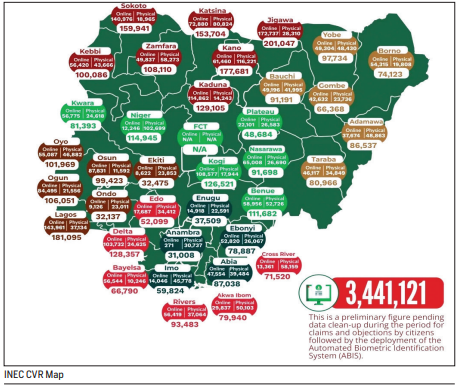
The Independent National Electoral Commission (INEC) has said that it recorded a total of 3, 441,121 completed registrations in the ongoing second phase of the Continuous Voter Registration (CVR) exercise. According to the week 13 update released by the commission, the figure comprises both online preregistrations and physical walk-ins at various centres nationwide as at April 3.
The data revealed that 2,068,384 citizens completed their pre-registration online, while 1,372,737 voters opted for physical registration. It also showed Jigawa leading with 201,047 representing 5.84 per cent of the total registrations; followed by Lagos with 181,095, while Kano State ranked third with 177,681. The update further showed that participation of youths between ages 18 to 34 accounted for 2,354,768 representing 68.43 per cent of the new registrants.
In terms of gender distribution, females accounted for 1,922,143 representing 55.86 per cent of the total new voter registrants, while male accounted for 1,518,978 representing 44.14 per cent. The occupational distribution also showed that students represented the largest single block of new voters at 1,235,931 (35.92 per cent), followed by those in business at 701, 912 representing (20.40 per cent) and farming/fishing at 615,967 representing (18.28 per cent).
The data further showed that 48,330 of the new registrants were Persons with Disabilities (PWDs). The commission explained that the 3,441,121 represented preliminary figure pending data clean-up during the period for claims and objections by citizens, followed by the deployment of the Automated Biometric Identification System (ABIS). The commission emphasised that registration remained suspended in the Federal Capital Territory (FCT) in compliance with Section 9 (6) of the Electoral Act 2022, following the Area Council Election held on Feb. 21.
It would be recalled that in the first phase of the registration, the electoral umpire recorded a rise in new voters with 2,685,725 registrants added to the existing register, the first phase of the CVR which began on 18 August 2025. According to the figure, 1,576,137 individuals completed the online pre-registration, while 1,109,588 finalised their registration through physical capture.
The breakdown of the data released by the commission showed that Osun State recorded the lead in this first phase with 208,357 registered voters. It was closely followed by Kano (159,669), Sokoto (152,650), and Imo (145,561). States like Borno (123,835) and Lagos (123,484) also reflected the growing mobilisation of citizens. In addition, gender distribution revealed that women accounted for the majority of registrants.
A total of 1,508,559 females completed their registrations in this first phase, representing 56 percent of the total, while male registrants stood at 1,177,166 or 44 per cent. On age data, registrants between ages 18 and 34 accounted for 1,974,894, which is 53 per cent of all completed registrations.
Whereas those aged 35 to 49 years total 488,708 or 18.20 percent. Also, registrants between 50 and 69 years stood at 199,494, while those aged 70 years and above accounted for 22,629. Occupational data indicated that students form the largest group on the register. INEC recorded 831,386 student registrants, representing 96 per cent of the total.
The breakdown of the figures also showed that business people followed with 492,866 35 per cent, while housewives accounted for 449,822 74 per cent. Farmers and fishers recorded 295,079 registrations, 151,375 artisans recorded, whereas civil and public servants together accounted for fewer than 70,000 registrants. The Commission also reported that 40,154 registrants identified as persons with disabilities, representing about one and a half percent of the total registrations.
Prior to the 2023 elections, registered voters stood at 93,469,008. While speaking in Abuja at the Nigeria Civil Society Situation Room’s Stakeholders’ Forum on Elections, INEC Chairman, Prof. Joash Amupitan, said the mobilisation was a testament to the rising political awareness, and “we commend the states leading the charge”. He added that the drive for inclusion and participation finds its strongest expression in the commission’s commitment to the CVR exercise. Amupitan added that this process was vital for ensuring the integrity and completeness of our national register.
According to him, “Since the CVR exercise began, we have worked tirelessly to bring the registration process closer to the citizens.” He, however, urged all stakeholders, especially civil society organisations and the media, to sustain the momentum and ensure every eligible Nigerian is registered before the final conclusion of the exercise. According to INEC, “The register of voters is at the heart of democratic elections.
Consequently, the registration of voters is a major function of the Independent National Electoral Commission (INEC). (In response to repeated calls by stakeholders and in order to serve Nigerians better,) The Commission has recently introduced some technological innovations to the voter registration exercise. These innovations are designed to make the registration processes generally easier and to give Nigerians a pleasant and safe electoral experience.
“The CVR exercise will commence on 18th August 2025 with online registration. This will enable prospective registrants to commence their registration online and to book an appointment for a date and time to complete the registration at an INEC State or Local Government Area (LGA) office. The physical or in-person registration will commence on 25th August 2025 at the 811 INEC State and Local Government Area (LGA) offices nationwide.
Thereafter, it will be devolved to other designated registration centres across the country based on an assessment of the CVR exercise. and security situation and other factors relating to safety of personnel and materials. “This document provides information on the location of each INEC State and Local Government offices nationwide for the completion of the online pre-registration and for the physical in-person registration. It also provides the telephone number for the INEC Help Desk in each State. Citizens can call the help desk and the INEC Citizen’s Contact Centre to seek necessary assistance on the CVR process.”