

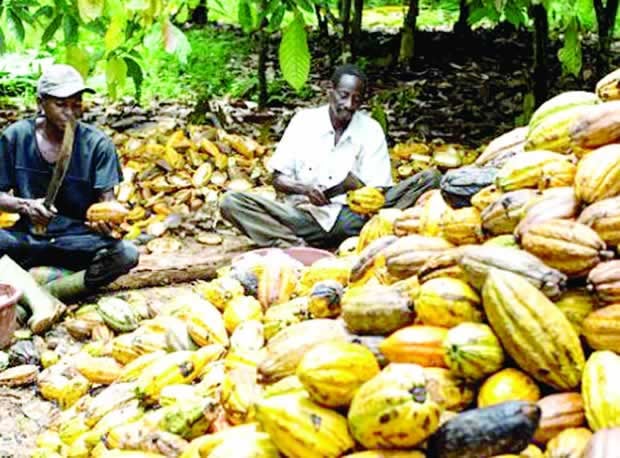
The Cocoa Roundtable Initiative has called on the Federal Government to urgently intervene in Nigeria’s cocoa sector, warning that declining global prices could deepen poverty among smallholder farmers and weaken product quality.
The Director-General of CORI, Adeola Adegoke, said the current downturn in cocoa prices, driven by global supply-demand imbalance, now poses a serious threat to farmers’ incomes and the sustainability of the sector.
He said, “One of the major drivers of the current global downturn in cocoa prices is the imbalance between demand and supply, and while prices peaked at about $12,000 per tonne in 2024 due to low production in major producing countries, the current decline has exposed farmers to severe economic risks.”
Adegoke explained that Nigeria, which operates a free-market system following the dissolution of its Cocoa Board in 1986, is now facing the negative consequences of price volatility despite benefiting from the earlier price surge.
“This decline threatens to erode the gains previously recorded in the sector, as prices have fallen to unsustainable levels that no longer accommodate profit margins or rising input costs, while input costs in the open market have remained unchanged,” he noted.
He warned that without immediate government action, smallholder farmers could suffer worsening economic conditions alongside a drop in cocoa quality, saying, “Government intervention is necessary to ensure the survival of smallholder cocoa farmers. Without such intervention, there is a high risk of compromised quality control, reduced premium production, and increased poverty among cocoa farmers, as their per capita income continues to decline.”
He identified additional structural challenges affecting cocoa production across Africa, including climate change, low productivity, pests and diseases, poor infrastructure, and inconsistent policies: “Several factors have contributed to this situation, including climate change, low productivity per hectare, urban expansion, and competing government interests in other agricultural commodities, as well as pre- and post-harvest losses due to knowledge gaps and limited climate management techniques.”
He also faulted the continued reliance on outdated production and market systems in Africa, calling for reforms to strengthen the continent’s influence in global cocoa pricing.
Adegoke said, “This volatility is further worsened by the continued use of outdated models by most African cocoa-producing countries, without reforms to accommodate regional bloc integration similar to OPEC in the petroleum sector.”
The CORI boss noted that the Living Income Differential adopted by Ghana and Côte d’Ivoire had yet to deliver the expected relief to farmers amid falling prices, saying, “While the LID initiative is commendable, the current condition of smallholder cocoa farmers remains concerning due to the persistent decline in internal cocoa prices, and its limited visible impact calls for careful evaluation.”
He urged African cocoa-producing countries to collaborate more closely, especially Ghana and Ivory Coast, which account for a significant share of global supply.
Adegoke, also the National President of the Cocoa Farmers Association of Nigeria, said, “We reiterate our call for greater transparency and information-sharing from the two leading cocoa-producing countries to jointly address the effects of the LID on the current downturn in cocoa prices.”
He further advocated the creation of a regional bloc among African producers to regulate supply and stabilise prices on the international market.
“The immediate and long-term solution lies in the establishment of a regional bloc by African cocoa-producing countries, similar to OPEC, to regulate the sale of cocoa on the international market and manage the forces of demand and supply,” said Adegoke.
On Nigeria’s domestic framework, he stressed the need for a regulatory body to oversee the sector without direct market participation: “There is a need for a regulatory board that will oversee, support, implement, and enforce policies that protect the country’s cocoa agenda, ensuring compliance with market standards and safeguarding stakeholders across the value chain.”
He added that the proposed National Cocoa Board would help strengthen policy coordination and improve farmer welfare.
“Nigeria cannot continue to operate on autopilot while expecting improvements in cocoa production, quality assurance, investment, policy management, compliance, and market access, as a deliberate and well-structured policy framework is essential to drive growth and protect the interests of farmers,” Adegoke concluded.