


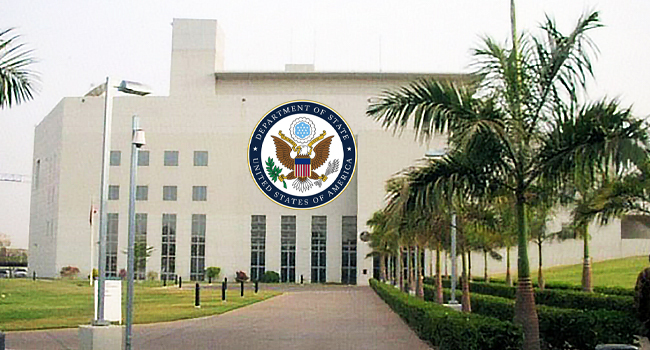
The United States (US) has ordered non-emergency embassy personnel and their families to leave its mission in the Federal Capital Territory (FCT) citing a deteriorating security environment.
The disclosure was made by the US Department of State in a travel advisory published on its official website on Wednesday.
According to the US Department, it made the decision on Wednesday, April 8, 2026, following an assessment of the security situation in Nigeria.
It emphasised the risks posed by crime, terrorism, and civil unrest across multiple regions of the country.
While urging Americans to exercise caution, it maintained Nigeria’s Level 3 travel advisory status, additionally classifying several states under the stricter Level 4 advisory, indicating areas where travel should be avoided entirely.
READ ALSO
The Department listed several high-risk states across northern, central, and southern Nigeria, citing threats such as terrorism, banditry, kidnapping, and violent crime, reinforcing its warning to avoid travel to designated areas.
It also highlighted that violent crime remains widespread in Nigeria, including armed robbery, assault, carjacking, kidnapping, and hostage-taking. It noted that kidnapping for ransom is frequent and often targets foreigners and dual nationals.
The advisory also flagged healthcare challenges, including limited access to medicines, unreliable emergency services, and upfront payment requirements.
The Department further warned that the U.S. government may have limited capacity to assist citizens in certain high-risk areas, urging Americans to avoid such locations entirely.
“Reconsider travel to Nigeria due to crime, terrorism, unrest, kidnapping, and inconsistent availability of health care services. Some areas have an increased risk. Read the entire Travel Advisory,” the statement read in part.
“On April 8, 2026, the Department of State authorised non-emergency U.S. government employees and U.S. government employee family members to leave U.S. Embassy Abuja due to the deteriorating security situation.”
“Terrorist groups such as Boko Haram continue to plan and execute attacks, sometimes collaborating with criminal gangs.
“Potential targets include public spaces like markets, shopping centres, schools, places of worship, government buildings, and transport hubs.
“Civil unrest persists in parts of southern Nigeria, particularly in the Niger Delta and Southeast, driven by armed groups and protests,” the statement noted.