
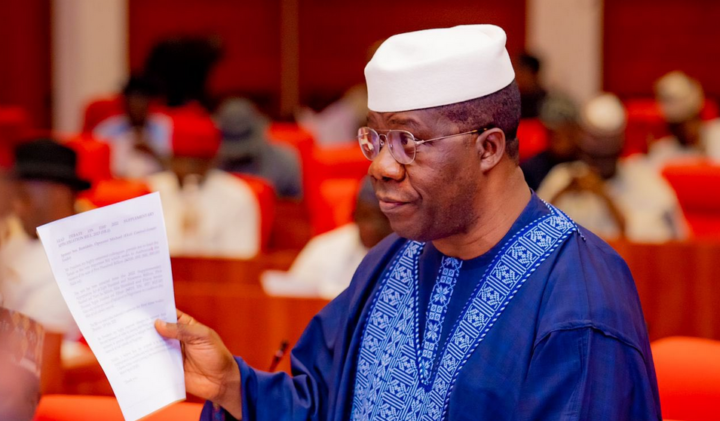
The Leader of the Senate, Senator Opeyemi Bamidele, on Sunday, disclosed that the National Assembly is working on a decentralised police model that would emphasise accountability and discourage the abuse of police powers by the political class.
Bamidele made this disclosure in a statement he personally issued on Sunday to celebrate the life and exploits of President Bola Tinubu on his 74th anniversary, while commending diverse initiatives he had promoted to secure and stabilise Nigeria.
He said that the parliament was committed to crafting a framework for a decentralised police model that would serve the interests of all Nigerians, regardless of their status.
According to him, the proposed model, which has been supported by President Tinubu, aims to devolve policing powers to sub-national authorities to ensure effective governance across the country.
The Nigerian Police has already submitted a 75-page comprehensive framework to the Senate for consideration.
Bamidele noted that the new police framework will incorporate accountability mechanisms to prevent abuse of power, reinforce justice administration, and discourage impunity, saying: “The essence of the model is to ensure the security of lives, private property, and public installations across the federation”.
He commended President Tinubu for building synergy with the National Assembly to address insecurity in the country and for looking beyond traditional approaches to tackle extremism, terrorism, and armed attacks.
Bamidele highlighted Tinubu’s achievements, including his macro-economic reforms, which have strengthened the value of the Naira, increased foreign reserves, and attracted foreign capital inflows.
He also praised Tinubu’s Tax Reform Acts, which have improved the country’s fiscal landscape and increased statutory transfers to sub-national governments.
The Senator said that Tinubu is a leader who has demonstrated allegiance, love, and sacrifice for Nigeria’s collective prosperity, and expressed confidence that the decentralised police model will be anchored to accountability mechanisms and global best practices.
He also described the President as “a man of history, purpose and vision, who rose above barriers, to steer the ship of our fatherland out of the turbulent sea. His reforms, though they came with initial pains, have now started yielding enviable outcomes that promise a greater Nigeria.”
As the father of the Nation, Bamidele noted that Tinubu “has remained firm and resolute, leading daily our fatherland with conviction and resilience, dexterity and patriotism despite the difficult times we are going through.
“His quest for an economically viable, politically stable and socially cohesive Nigeria did not start recently. It started way back in his younger days as a progressive enthusiast that seeks greater good for the greatest number of his compatriots.
“That was the life he lived from when he was in the corporate world to when he ventured into partisan politics in the botched Third Republic.
“As a pro-democracy proponent, he fought valiantly alongside other heroes for the soul of our Nation and for the restoration of democratic order. As the 12th Governor of Lagos State, he implemented pro-people reforms that significantly transformed the state into a city-state of global reckoning that it is today.
“Now, as the 16th President of Nigeria, he has been consistent in making tough policy choices that his predecessors could not decisively make. Today, the choices have brought our Nation from the dark realm of uncertainty to the path that will lead to a glorious future.
“One of such choices is his macro-economic reforms that strengthened the value of Naira; increased our foreign reserves from $35.09 billion in May 2023 to $50.02 billion in March 2026, and sped up foreign capital inflows into the country. By this record alone, our foreign reserve rose by 42.54% under his leadership.
“Also closely related is the Tax Reform Acts, 2025, an initiative of the Presidency that introduced far-reaching reforms to the country’s fiscal landscape,” Bamidele said.
By this initiative, according to him, our fiscal landscape was comprehensively recalibrated, leading to no fewer than 111% increase in statutory transfers to the subnational governments, improved business environment and enhanced tax administration across different levels of government.