
As political activities gradually gather momentum ahead of the 2027 general elections, the race to succeed Babajide Sanwo-Olu has begun to take shape, with the historic five divisions of Lagos State emerging as critical factors in the unfolding contest.
Although the election is still months away, early signals from political actors, particularly within the ruling All Progressives Congress (APC), suggest that beyond competence and political structure, the question of equitable representation among the five division; Ikorodu, Badagry, Ikeja, Lagos Island, and Epe, will play a major role in determining who becomes the next governor.
Lagos State’s political and cultural identity has long been shaped by its five traditional divisions: Ikorodu, Badagry, Ikeja, Lagos (Island), and Epe. These divisions are not just geographical entities; they represent deep-rooted historical, ethnic, and political blocs that continue to influence leadership considerations.
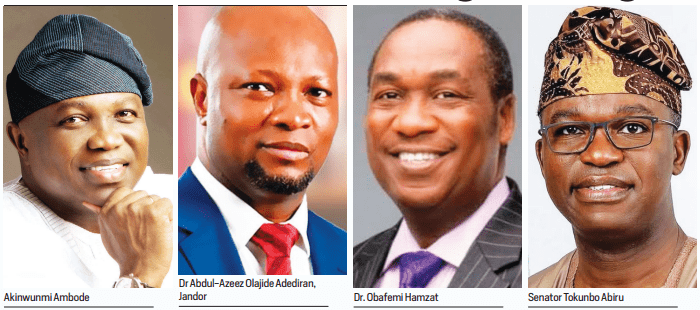
Since the return to democratic rule in 1999, the governorship has rotated, though informally, across some of these divisions, but not all have had equal opportunities. From Bola Ahmed Tinubu (Lagos West/Ikeja Division) to Babatunde Fashola (Lagos Central/Lagos Island Division), followed by Akinwunmi Ambode (Epe Division), and now Babajide Sanwo-Olu (Lagos Central), the leadership pattern has sparked renewed debate about fairness and inclusion.
To start with, Ikorodu Division is increasingly asserting its relevance in the state’s political equation. With its large population and expanding urban profile, stakeholders from the area argue that the time has come for the division to produce a governor. Political leaders and interest groups within Ikorodu are said to be mobilising support and engaging in consultations to ensure the division is not overlooked in the succession plan.
However, for many observers, Badagry Division remains one of the most marginalised in terms of governorship representation. Despite its historical significance as a gateway town and its contributions to Lagos’ development, the division has yet to produce a governor in the Fourth Republic. This perceived exclusion is fueling agitation among political stakeholders, who insist that 2027 presents an opportunity to correct the imbalance.
Also, Ikeja Division, often regarded as the administrative and political nerve centre of Lagos, continues to wield significant influence. As part of Lagos West, the division has historically produced key political figures and remains a stronghold of the APC. While it has had its turn in the past, its political weight means it cannot be ignored in any serious calculation for 2027.
Lagos Island Division, the traditional heart of Lagos, has consistently played a central role in governance. With its deep political networks and proximity to power, the division remains a key player in the succession race. Even though it currently holds the governorship through Sanwo-Olu, political actors from the division are expected to remain influential in determining who emerges as the next candidate.
Epe Division, which produced former Governor Akinwunmi Ambode, is gaining renewed importance due to rapid infrastructural development, particularly along the Lekki-Epe corridor. With increasing economic activities and strategic investments in the axis, stakeholders from Epe may push for another opportunity to lead the state, leveraging the division’s growing relevance. As always, the internal dynamics of the APC will be decisive.
The influence of President Bola Ahmed Tinubu, widely regarded as the political leader of Lagos, is expected to shape the final outcome. Consensus-building, loyalty, grassroots support, and acceptability across the five divisions will likely determine who secures the party’s ticket. While the agitation for rotational leadership among the five divisions is gaining traction, analysts caution that Lagos voters are increasingly focused on performance and vision.
As Nigeria’s commercial hub, the state faces complex challenges, including infrastructure deficits, housing shortages, traffic congestion, and security concerns. The next governor will be expected to provide innovative solutions while sustaining economic growth. As consultations intensify and aspirants begin to position themselves, the interplay between the five divisions and party politics will shape the trajectory of the 2027 governorship race.
Ultimately, while the demand for inclusivity and fairness among the divisions will influence the process, the decision will rest on a combination of political strategy, party consensus, and public acceptance. In the final analysis, the race to succeed Sanwo-Olu is not just about geography; it is about leadership, balance, and the future direction of Lagos State.

Analysts weigh in on the governorship election
From zoning debates to party supremacy and voter expectations, experts say the contest is already evolving into a complex mix of political strategy, regional balancing, and performance-based considerations. Political analyst, Dr. Kunle Adeyemi, noted that while zoning is not constitutionally binding, it remains a strong moral and political factor in Lagos politics.
“Since 1999, we have seen a pattern, though informal, of rotation across certain blocs. Now, divisions like Badagry and Ikorodu are becoming more vocal in demanding inclusion. This will influence negotiations within parties, especially the APC,” he said.
Analysts agree that the ruling All Progressives Congress (APC) remains the party to beat in Lagos, given its longstanding control of the state’s political machinery. However, they warn that the real contest may take place within the party itself.
“Winning the APC ticket in Lagos is almost equivalent to winning the governorship election. “But that also means intense internal competition. Aspirants will need to demonstrate loyalty, political structure, and acceptability across different blocs,” said political commentator, Mrs. Tola Hassan.
While regional considerations remain strong, some analysts believe that Lagos voters are gradually shifting towards performance-based politics. A public affairs analyst, Mr. Segun Oladipo, argued that governance capacity will be a key determinant.
“Lagos is not just any state—it is Nigeria’s economic hub. The electorate is becoming more sophisticated and may prioritise competence, vision, and continuity over purely regional sentiments,” he said. He added that issues such as traffic management, infrastructure development, housing, and security will dominate campaign discussions. Despite the APC’s dominance, analysts say opposition parties still have opportunities if they can unify and present credible candidates.
“The opposition’s biggest challenge has always been fragmentation. “If they can build a coalition and field a candidate with strong grassroots appeal, they could make the race more competitive, especially if there are internal cracks within the APC,” said Dr Adeyemi However, he noted that overcoming the APC’s entrenched structure would require significant mobilisation and strategic messaging. Another factor analysts highlight is the growing influence of young voters, especially in urban centres.
With increasing political awareness and digital engagement, youths are expected to play a more active role in shaping the 2027 outcome. “Young people are no longer passive observers. They are asking questions about governance, accountability, and inclusion.
“This could influence campaign strategies, with aspirants expected to engage more on issues rather than rely solely on traditional political structures,” said Mrs Hassan. As consultations intensify and potential aspirants begin to position themselves, analysts believe the Lagos 2027 governorship election will be defined by a delicate balance between tradition and transformation.
While zoning and political alliances will shape the early stages of the race, the eventual outcome, they say, will depend on a combination of party dynamics, candidate credibility, and voter expectations. In the end, the contest to succeed Babajide Sanwo-Olu is shaping up to be not just a battle for power, but a test of Lagos’ evolving democratic culture.