
- ‘Nigeria needs more troops because of vast land mass’
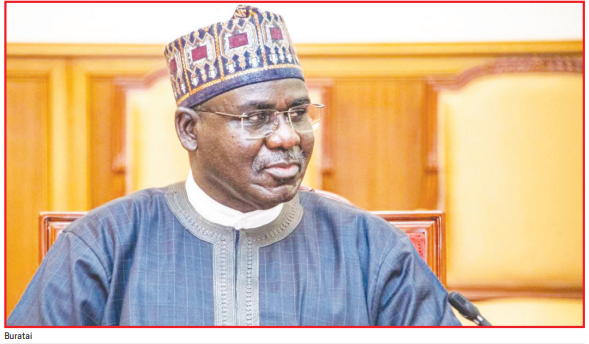
Lt. General Tukur Buratai is a former Chief of Army Staff. In this interview monitored on Channels Television, he speaks on the fresh wave of attacks by terrorists across the North East and North West geopolitical zones and a surge in kidnapping, among other issues, ANAYO EZUGWU reports
What exactly is our problem in terms of fighting this insurgency and does it look like Nigeria has lost momentum in the fight against insurgency?
On the issue of this counter-insurgency, especially the Boko Haram incident in the North-East, NorthWest and part of the North-Central, is something that has historical antecedents, taking back probably to the 80s and the late 90s and so on. =. It’s really unfortunate that it has persisted. Well, I don’t see that the insurgency is somehow overwhelming the troops.
We are now lucky that we have more enablers in terms of the drones, both the ones that are armed, as well as the ones for reconnaissance. A lot of platforms have been injected but the military still needs more of such platforms and the enablers.
If you look at the landmass of the NorthEast, it’s quite enormous. This is what we have always, even during our time, emphasized. If you look at it, the troops are so dispersed and there are challenges of manpower and equipment. If you see any attack happening on the troops, unfortunately a lot of casualties of recent have been incurred.
But I’m glad the recent has really shown the capacity of the Nigerian military to turn things around. And they can do it. This set of service chiefs, and then the generals within the headquarters, I’ve worked with them closely and I know their capacity. But we must understand one challenge, or the challenges of being in the front. It’s not that easy; the issue of the terrain, the issue of even the weather, then in terms of even resupply and having troops to have some rest. All those things are factors that militate against troops’ effectiveness. It is not about equipment alone.
There is the human factor in terms of ability of the troops to resist the elements, the weather element and so on. But by and large, I have seen the assurances of the service chiefs, the Chief of Defence Staff, as well as the Chief of Army Staff. They’ve been to the North-East based on the directive by Mr. President. The Inspector General of Police was also there and they’ve reassured Nigerians that they will handle the situation.
There are those who will say that when you were at the helm of affairs, you had the opportunity to kill it off. What was it that you think technically did not allow us to finally call it end of the game with these insurgents when you were in office?
That’s a very good point and I’ve responded to this type of questions sometimes back. You see, once you allow insurgency to rear its ugly head in any country, it’s always very difficult to clear it within a specific time frame, or a short time frame.
I’ll give you an example. I was in Colombia. It took almost 50 years to fight insurgency in Colombia. In Sri Lanka, they’ve been fighting the Tamil Tigers for over 30 years. So, it’s a very complex nature of operation that requires the totality of the government, the military, the intelligence agencies, and the people.
And it has generally been referred to as the people’s war. This insurgency is the people’s war. Let me emphasize what the Chief of Defence Staff mentioned a few days ago, and to also correct the misinformation that was given. I’m happy the he clarified it. He wasn’t talking political.
It will always be a wishful thinking for one to say you will just clear this type of insurgency overnight. These are people, who have ideology and belief that they have a mission
If you look at the environment he spoke, it was in the North-East operations and if you look at where he was talking to, he was talking in the context of operations. So, all what he said in the NorthEast were operational and it remains there. It wasn’t political, and it wasn’t at the strategic level. If he had spoken about collaborators in Abuja, or he has specifically mentioned something in terms of political, then you can now read it in that context.
But he spoke completely based on the professional understanding at the operational level. So, it wasn’t political. Some section of the press took it as if he was inducting certain individuals within the region.
When we said at the time that Boko Haram was technically defeated, what has happened since then?
Let me conclude from the earlier questions. As I was saying, Colombia, Sri Lanka, it persisted for a long time. But we are not saying that it must be the same thing here in Nigeria. We have this National Security Strategy 2019, and it’s very clear it has that provision for all of government approach in tackling insecurity.
And our focus has always been looking at the army; that it is the army that must do everything to disseminate and wipe out all the insurgents out of the country. But it’s not like that. Just as I said, it is more or less the embedded problem that is within the society and it requires everybody’s effort. We have always mentioned that issue. Well, it will always be a wishful thinking for one to say overnight, you will just clear this type of insurgency. These are people that have ideology and belief that they have a mission.
And once they establish it, they have a perfect society, which is not realistic in this type of environment or this context, Nigerian context. So, technical defeat, you see, if you look at it clearly, 2014, 2015, early up to July, even up to some part of June, I mean August, September, the spate of bombings were so rampant on a daily basis, from Maiduguri up to Abuja. But as of late end of 2016, when technically defeated was declared and so on, you discover that all those things have stopped.
Also, all those local government areas that were hitherto under the Boko Haram insurgents were all recovered. There are certain things that are very clear. All those roadblocks across the country were relaxed and we never had that type of pre-2015 attacks. So, by all standards, you say they have been technically defeated.
Are you worried about the manner in which they look like they are resurgent?
I have mentioned it, and I warned at the time I was appointed ambassador that this is a canker worm, and it may persist much longer than we assume. I mean, we are thinking it’s very clear. And I didn’t give the warning just out of wishful thinking or with any mindset in order to get attention to myself. No, because I know it’s not just the military, it’s not just the army’s responsibility.
This has always been emphasized, and I mentioned at the National Security Strategy 2019 that the whole of society approach is needed in tackling this insecurity. We have done our own up to 2021 and those that took over continued.
Was the success recorded during your time sustained?
The military has always been there. They have not left those places. And today, if you go to certain parts of the North-East and even some parts of the North-West, you will see that accessibility to certain areas is still blocked.
What we wanted was that the military should stay put and conquer those spaces…
No, this is development and when you say the whole of society approach, development and infrastructure. The government has to bring roads, rail, improve infrastructure, improve the social amenities or facilities in those areas as well as provide employment and so on. These are some of the whole of society approach.
Do you regret that you did not ensure the naming of the financiers of terror when you were in office?
You see, this is another issue and that’s why we over-rely on the military. Everybody has his own responsibility. You can’t say I should be responsible to name the financiers of terror. No. The government knows where the source came from. We have other agencies that are responsible. It’s not a matter of mentioning the names; action should be taken.
I think the documents are there and those agencies know whatever is happening. The issue is not a matter of mentioning names. Names can be mentioned but what follows is what the problem is. There are still some Boko Haram detainees or people that have been arrested. For example, they are still not being prosecuted. That is a challenge.
You were heavily criticized, and those who do not believe in the rehabilitation and reintegration are of the view that if these people have killed innocent Nigerians, they don’t deserve a second chance but they were given a privileged opportunity…
You see, I take responsibility for certain things that are strictly Nigerian Army responsibility. But I don’t want to say I disown what transpired in the Safe Corridor operations. It is a government directive. It’s a government decision. It’s not an army decision to rehabilitate repentant members of the Boko Haram group.
The initial concept that we had was we gave them a timeline by which they must surrender between first part of 2016 and up to August or thereabout. We gave them a deadline by which they must surrender. And if they surrender, we assure them of free passage, and then we hand them over to the appropriate government agency to rehabilitate them.
That was our intention. But that deadline passed, and we said no more. As far as the army was concerned, as at that point was involved directly in the kinetic operation to deal and degrade and also to clear the insurgents, and we did that. I’m sure you see my commanders in the field.
These are officers who know what they are doing, and they did everything to degrade and deal with the Boko Haram insurgents. So, at that point, government took another agency, which I don’t want to mention, continued with what we initially wanted to persuade them to do. But as far as the army was concerned, the deadline has passed. But after that, other factors and interests came in. But unfortunately, they see it as if it is the army’s responsibility.
But there are those who believe that that measure was not effective…
Well, it has its own advantages and disadvantages. To the point that the army had its own strategy but after that there are so many gaps. And logically, anybody that has committed such crime, he should be prosecuted.
It doesn’t just matter to pick somebody from the bush or from the battleground and just give him a uniform or give him a dress and rehabilitate him. No! There are procedures to deal with them. So, I think if there is, it may be reviewed. But the point is, it is not strictly army responsibility. But the army contributed to that because it’s a directive.
Today, we are facing what have become more or less a complicated matter and there those who will say going into the elections, we might be seeing more attacks. If you were to advise the government, what must we do immediately to turn the hands of the tide?
First of all, you rightly said, I’ve seen it all. There is no part of the North-East where the troops have been deployed that I have not visited. I have moved both day and night, at dawn, evening, and at times we drive throughout the day and throughout the night, moving to ensure that we motivate our troops, reassure them, replenish them and also ensure that the threats are prevented. I told you at the beginning that the area is so vast, but we have very few troops. So, we need more troops.
As at the time I did my initial assessment, we need not less than five divisions in that place because there are some countries that are less than the North-East size. They have over 10 or more divisions deployed in their country. So, we need more bases, more equipment because of the vast nature of this country. As at now, we have sectors. There are three sectors, which are almost division status. They are in Monguno, in Damaturu, as well as in Maiduguri. But the one in Maiduguri is even larger than all the two combined in terms of landmass.
So, you know, look at from Maiduguri, you go up to border with Yola, Adamawa, or even part of Adamawa is part of the division. And then you go down off to the north, you know, Malam Fatori, and so on. They are all in one division. It’s even more complicated now with the dispersal of troops or deployment of troops in the North-West and in the North Central. So, we are overstretched and these guys are taking advantage of that.
You see the issue of sophisticated weapon is relative, but they improvise mostly. They improvise, like the IEDs. And also they use the motorcycle. They have some limited drones and so on. And they use motorcycles to mount machine guns or anti-aircraft guns on it. These are some of the criminal ingenuity that they apply to take advantage of mobility and so on.
But critically, apart from the government, as I said, the terrain is a big challenge. The weather is a big challenge. All these can be overcome by a sort of efforts by the lower commanders to be alert and to maintain vigilance. These guys once they lose surprise; that is the end. They can no longer fight. I think this is one key issue that I’ve always emphasized when I was the Chief of Army Staff and that’s why we don’t give them space. We move all over and ensure that the commanders get this right.
With the benefit of hindsight, if you had your way, the one thing that you wish you could do to change the dynamics of this war, what would that be?
First of all, which I did very well, was intelligence operation. You may think it’s not strictly military operations, but we have to do it. You identify all those that enable them to move, to be resupplied, and to also gather information about our troops and pass it to them in the bush. So, intelligence operation should be the key. We pick them in the towns, in the villages, in the motor parks, to disconnect them.
That is the first thing. I will give you an example. I mentioned my trip to Colombia. I had a very useful discussion with the Colombian Chief of Army Staff then. He said they developed the capacity to track and trace and arrest all their informants in Bogota, the capital, in the local governments, in the provincial capital, and so on.
So, they disconnected them from the cities, from the villages, from the towns, from the motor parks. This is where all of society’s approach is important. And the other security agencies, the police, must also get into this to pick these people. Then, secondly, the capacity which the army is developing now, the Defence Headquarters is developing as well, I believe the use of these enablers is very effective.
During your time, there are those who believe that the intelligence community was uncoordinated, and there are those who say it is better now. What do you have to say?
I think that is a perception. It’s not that we are not working together. There are challenges and certain things we don’t need to mention openly like this, but there are challenges.
That is the truth. And that’s why I was able to develop the capacity of the Nigerian military intelligence to be able to track and arrest those guys. We achieved a lot. The challenges will continue to be there because those capabilities need to be maintained and sustained, and the equipment is needed to be regular and so on. So, you can’t blame anybody. You can’t blame the Army or the Navy or Defence Headquarters, but it must be sustained. That is the key.
We’ve seen attempted coup recently, and people are saying this is a worrisome trend. Does it bother you that we’re seeing this kind of trend in the Nigerian Army and what does it portend for democracy?
We served almost six years as Chief of Army Staff, and you see how we’re able to defend democracy, and how we’re able to motivate troops throughout, how to make sure that troops, officers and men do not deviate. I had on several occasions had to caution them in order for them to maintain focus on their professional line.
You must always engage the troops and make them happy and also make them train and retrain and operate as well. You see, during my time, there was never any dull moment. Every quarter we have one engagement or the other, one operation or the other. If such thing is maintained, I’m sure there won’t be anybody that would contemplate coup. So, it is unfortunate that we are having attempted coup.