


Background
In many ways, the Tourism and Creative Sector Stakeholders Engagement held early in the year in Lagos, was an historic gathering that was designed to move away from the usual talk shops that have defined the Nigerian tourism and creative industry, with no further action or motion and even where commendable vision was birthed, no political will and structure put in place towards the realisation of the agreed vision.
However, the recent engagement was a clear departure from the past, indicative of a willingness to move tourism and the creative sectors beyond mere posturing level to a higher plane, where concrete vision and goals are pursued aside of the clinical diagnosis.
Composition of participants
The composition of participants was a high level one, an indication of the seriousness of the engagement and the importance that the conveners (Government, tourism associations and Sterling Bank) placed on the gathering.
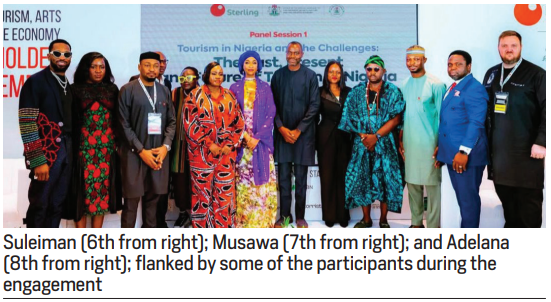
Leading the government participants was the Minister of Arts, Culture, Tourism and Creative Economy, Hannatu Musa Musawa, while from the other conveners and financial sector was the Managing Director of Sterling Bank, Abubakar Suleiman, including the Head of Tourism Business of the Bank, Abiola Adelana and her team.
Others included stakeholders of high calibre from both the private sector and government levels; senior representatives of government, regulators, industry as- sociations, tourism and hospitality operators, investors, development partners, and ecosystem enablers.
Focus
The communique from the engagement, which was made available to this reporter, detailed the focus and the high level of discussions, statement of problem of Nigerian tourism and creative sectors, diagnosis, key insights, action blocks, analysis of roles by the various key players, including the government and action plans envisaged.
Also, of importance is the fact of the policy gap identified and the various pillars dissected, with a commitment to make the engagement a regular and continuous one as well as setting up groups to further the discussions and key issues enumerated, with an expected action plan to give vent to the issues canvassed and set up a reporting and monitoring mechanism.
With the theme; Accelerating Sustain- able Tourism Growth Through Collabo- ration, Investment, and Policy Alignment, the focus was designed to accelerate tourism-led economic diversification through stronger collaboration, targeted investment mobilisation, and policy alignment.
This was against the background of the identified problem; ‘‘that Nigeria has the culture, the coastline, the creativity, and the continent’s biggest consumer market, yet tourism is still treated like a side ‘hustle’.
The real problem isn’t “lack of attrac- tions. It’s that we have not industrialised tourism into bankable projects, predict- able policy, and destination-ready infra- structure.’’
Therefore, the stakeholders’ engagement was conveyed to address among others; to align public and private sector actors on unlocking Nigeria’s tourism and hospitality potential as a strategic driver of economic growth, job creation, foreign exchange earnings, and national brand equity. Discussions were focused on structural constraints across infrastructure, financing, policy, talent, and destination marketing.
Guiding Principles
The participants agreed that the pro- gramme of work should be guided by the following principles: Execution Discipline: Commitments must translate into time-bound delivery.
Bankability: Priority should be given to projects that can attract and sustain private capital. Place-Based Development:
Destination readiness should be delivered through co- ordinated, destination-level programmes. Policy Predictability:
Harmonised and transparent rules across jurisdictions. Inclusivity and Sustainability: Growth that expands jobs, SMEs, and community benefit. Measurement and Accountability:
Clear Key Performance Indices (KPIs), quarterly reviews, and public-private transparency.
Taking a cue from the examples of countries like Rwanda, Dubai (United Arab Emirates) that have scaled up tourism as an important economic player; adding value to their Gross Domestic Product (GDP), it was agreed by the participants that Nigeria too should scale up tourism into a major economic play- er, adding tremendous value to Nigeria’s GDP. The debate, going forward, they posited should not be on value of tourism to the nation, but rather on building its value addition such as; ‘‘jobs creation for young people, foreign exchange for the economy, viable businesses for operators, and improved national positioning. It is not a debate—it is an execution agenda.’’
Constraints
Stakeholders at the engagement identified a number of constraints militating against the development of the sectors, noting; ‘‘Nigeria’s tourism sector remains underleveraged despite its cultural heritage, diverse destinations, creative economy, and large domestic travel market.
‘‘Current constraints include inadequate destination infrastructure, limited access to tailored financing, policy frag- mentation, skills gaps, and weak global positioning.
At the same time, rising domestic tourism demand, expanding creative industries, improving air connectivity, and growing investor appetite create a compelling opportunity. ‘‘The urgent need is structured public-private collaboration that converts demand into sustainable economic outcomes.’’
Key Insights/Takeaways
A. Infrastructure and Destination Readiness: Poor access roads, utilities, security assurance, and visitor services remain major bottlenecks Destination outcomes improve fastest when infra- structure is delivered via place-based public–private collaboration.
B. Financing and Investment Models: Traditional lending structures are not well-suited to tourism cash-flow realities (seasonality, ramp-up periods, capex intensity). Strong demand exists for blend- ed finance, credit enhancements/guaran- tees, and longer tenor funding.
C. Policy and Regulation: Policy inconsistency and slow approvals discourage private investment. Clear incentives and harmonised regulations are needed across the federal and state levels.
D. Talent and Service Quality: Skills gaps affect service delivery, guest experience, and competitiveness. Structured training and certification programmes are required across the value chain.
E. Marketing and Global Positioning: Nigeria lacks a cohesive destination brand and coordinated marketing engine – Storytelling, digital platforms, and private sector participation are critical to repositioning Nigeria.
Strategic Pillars
Participants at the end of the discussions identified a number of pillars that need to be looked into in order to birth an economically viable and sustainable tourism and creative sectors.
Pillar 1: Infrastructure and Destination Development Objective: Improve destination readiness and visitor experience. Lead Stakeholders: Government, private developers, destination managers, and financial institutions.
Pillar 2: Tourism Financing and Investment Mobilisation Objective: Expand access to tailored funding and de-risk in- vestments (guarantees, blended finance, longer tenors). Lead Stakeholders: Banks, DFIs, investors, and project sponsors.
Pillar 3: Policy and Regulatory Enablement Objective: Create a predictable, in- vestor-friendly policy environment with streamlined approvals. Lead Stakeholders: Government, regulators, industry associations.
Pillar 4: Talent and Capacity Development Objective: Build a skilled tourism and hospitality workforce through stru tured training and certification. Lead Stakeholders: Industry bodies, training institutions, operators.
Pillar 5: Marketing and Destination Promotion Objective: Strengthen domes- tic and international visibility through co- ordinated branding and digital activation.
Lead Stakeholders: Government, private sector, ecosystem.
Governance/Monitoring The participants at the engagement also agreed that; A multi-stakeholder Steering Committee will be constituted to oversee implementation, supported by five Working Groups aligned to the Strategic Pillars (Finance, Policy, Destination Readiness, Talent, Marketing).
Progress will be tracked using defined KPIs and reviewed quarterly. A concise Progress Report will be produced after each quarter to document delivery against commitments, risks, and corrective actions.
Call to action
At the conclusion of the day’s engagement; ‘‘the stakeholders reaffirmed a shared commitment to reposition tourism as a strategic economic sector. Success will be determined by execution discipline, cross-sector collaboration, and measurable outcomes.
‘‘All parties are called upon to trans- late commitments into action and work collectively to unlock Nigeria’s tourism potential for sustainable growth, jobs, and global relevance.”
According to the participants, the Communiqué or call to action, ‘‘is issued as the shared record of the Meeting outcomes and will serve as: a reference for industry coordination; a working document for Sterling Bank’s multi-year tourism agenda; and an engagement baseline for government and ecosystem partners.’’
Also, the participants agreed to reconvene periodically to review progress and recalibrate execution priorities as required.
Endnote
While the conveners of the engagement deserved commendations for birthing a new path way to looking at the problems facing Nigerian tourism and creative market by attempting practical solutions to fixing the problems,
it is hoped that as indicated by the commitment given by the participants that the outcomes of this novel engagement will not sit on the shelves of the conveners and participants, but enforced and monitored.
Going forward, it’s hoped that at the time the next engagement is convened in the second quarter of the year that there will be something concrete on the ground that would propel the sectors and rekindle hope.