

Delta State Governor, Sheriff Oborevwori, has outlined comprehensive measures being implemented by his administration to address persistent electricity challenges across the state, combining policy reforms with aggressive infrastructure development to boost power supply and stimulate economic growth.
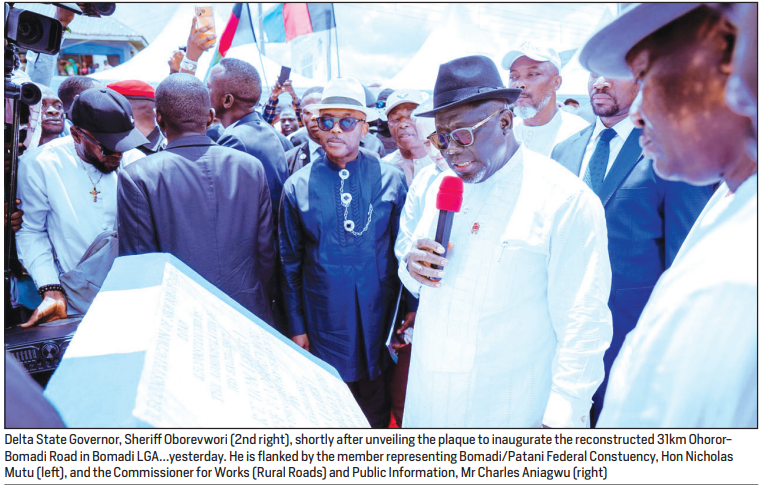
Speaking during the inauguration of the 31-kilometre rehabilitated Ohoror–Bomadi Road on Tuesday, the governor revealed that several communities that had been without electricity for over a decade, have now been reconnected to the national grid, significantly improving living standards and opening up new economic opportunities.
Oborevwori explained that his administration is pursuing a proactive and structured approach to resolving power issues through the extension of 33KV transmission lines, installation of new transformers, and rehabilitation of critical electricity infrastructure in previously underserved areas. “We are taking deliberate and practical steps to address power supply challenges across Delta State.
Efforts are ongoing to extend 33KV lines, install transformers, and rehabilitate critical electricity infrastructure,” the governor stated. He noted that the enactment of the Delta State Electricity Law, alongside the approval of the State Electricity Policy by the Executive Council, has provided a solid legal and institutional framework to confront power sector challenges more effectively.
Oborevwori also disclosed that the rehabilitation of the collapsed 33KV high-tension line from Ogbe-Ogume to Kwale has been completed, while work is ongoing on the restoration of a 7.5MVA injection substation in Kwale, alongside the installation of additional distribution transformers.
According to the governor, efforts are also underway to revive long-abandoned power facilities in other parts of the state, with the State Executive Council already granting necessary approvals for the projects.
He attributed the progress recorded so far to supportive federal policies and acknowledged the role of President Bola Tinubu in creating an enabling environment for subnational governments to improve infrastructure delivery. Reaffirming his administration’s commitment to inclusive and participatory governance, Oborevwori assured residents that the MORE Agenda would continue to be implemented with fairness, justice, and equity