
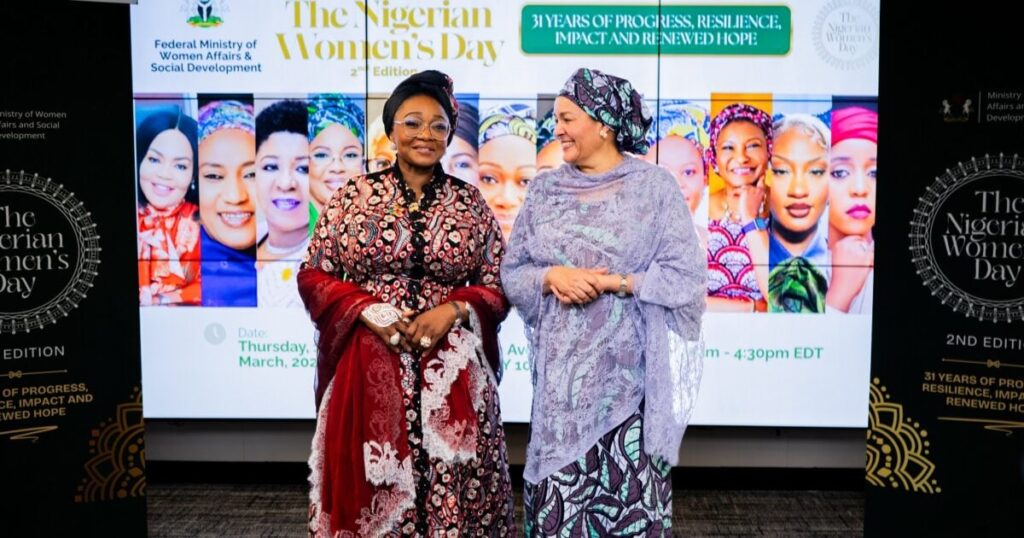
The Federal Ministry of Women Affairs and Social Development convened the second edition of Nigerian Women’s Day during the 70th session of the United Nations Commission on the Status of Women in New York City.
The event was organised under the leadership of the Minister of Women Affairs and Social Development, Imaan Sulaiman-Ibrahim, bringing together global leaders, policymakers, and stakeholders to advance discussions on gender equality and inclusive development, according to a statement on Sunday.
Among those present at the gathering was the Deputy Secretary-General of the United Nations, Amina J. Mohammed. Ministers, diplomats, civil society leaders, gender advocates, entrepreneurs, artists, and members of the Nigerian diaspora also participated in the full-day programme that featured dialogue, cultural displays, and high-level engagements.
The event, themed “31 Years of Progress, Resilience, Impact and Renewed Hope,” highlighted Nigeria’s efforts to advance gender equality globally while reinforcing the administration of Bola Ahmed Tinubu on women’s rights, family resilience, and inclusive development.
Chair of the Board of Directors of Women Radio WFM 91.7, Toun Okewale Sonaiya, delivered the welcome address, outlining the day’s agenda around women’s leadership, innovation, and global cooperation. The session was followed by a specially commissioned opening film showcasing women’s leadership across institutions and international borders.
In her remarks, Sulaiman-Ibrahim issued a call to action, drawing from Nigeria’s nine-pillar Renewed Hope Social Impact Interventions 774 framework. She explained that the ministry plans to reach women across all 774 Local Government Areas through targeted initiatives in energy access, agriculture, digital inclusion, health and protection, creativity and innovation, leadership, education, child development, and family resilience.
She also presented a six-point call to action to governments, development partners, and civil society organisations, urging stronger collaboration, increased funding, and concrete implementation of commitments.
“Transforming women’s lives at scale requires sustained investment, strong partnerships, and coordinated action. There is an urgent need for greater investment in women and girls, both domestically and globally. Women’s empowerment is not a social programme; it is an economic strategy, a security strategy, and a development imperative,” she said.
A major highlight of the programme was a fireside conversation between Sulaiman-Ibrahim and the UN Deputy Secretary-General, Amina Mohammed. The discussion linked Nigeria’s national ambitions with the global gender equality agenda, while participants engaged both leaders on challenges and opportunities affecting women and girls across Africa and other regions.
Three panel sessions were also held during the event, focusing on Global Leadership, Peace and Security for Social Impact; Women, Institutions and the Economy; and Positive Masculinity. The discussions explored women’s roles in governance and global institutions, pathways for economic leadership, and the importance of engaging men in advancing gender justice.
Participants and speakers at the event included the Minister of State for Labour and Productivity, Nkeiruka Onyejeocha; Chairman of the National Population Commission, Aminu Yusuf; Permanent Secretary of the Federal Ministry of Water Resources, Emanso Emabong; and Aisha Abubakar Baju.
Others in attendance included Olori Temitope Ogunwusi; Andrew Mamedu of ActionAid Nigeria; Pauline K. Tallen; Abosede George-Ogan of Women in Leadership Advancement Network; Enene Ejembi; Kafeel Olabiyi-Shittu of the Bank of Industry; Anino Emuwa of 100 Women@Davos; Mary Jandora Sinjen; Bolaji Akinremi; and Tony Ojukwu of the National Human Rights Commission of Nigeria, alongside Nigerians in the diaspora.
Internationally recognised artist and human rights activist Laolu Senbanjo delivered a presentation highlighting how his art challenges stereotypes and promotes social dialogue. During the session, he performed his signature body painting using intricate black-and-white patterns in a live demonstration.
The event also featured vibrant African cultural performances that brought music and dance to the centre of New York City, creating a blend of policy engagement and cultural celebration.
According to the organisers, the second edition of Nigerian Women’s Day reinforces the understanding that the strength of any nation lies in the stability of its families, and that women, children, and households must remain central to economic policy, social investment, and national development planning.








