




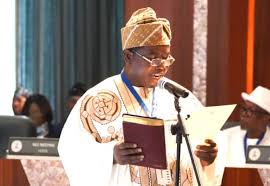
The Chairman of the Independent National Electoral Commission (INEC), Joash Amupitan, has declared that electronic transmission of results would not fail in the 2027 general elections, as he vows to eliminate the glitches that marred previous polls.
Speaking at a Live Town Hall meeting organised by the Civil Society Network on Election Integrity on Sunday in Abuja on the 2026 Electoral Act, Amupitan said result transmission was no longer optional, stressing that under his leadership, the Commis- sion would guarantee seam- less electronic transfer of results across the country.
He said: “The glitch, by God’s grace, will not surface in Nigeria. During my ten- ure, it will never fail. That is the determination.” Amupitan clarified that INEC possesses the technical capacity to transmit results but acknowledged that defin- ing “real-time” transmission remains a practical challenge due to network infrastructure limitations in some areas. “As far as electronic transmission of results is concerned, we have the capacity to transmit the results.
The only concern was real time. What is real time?” he asked. The INEC Chairman compared the process to on- line banking transfers saying, “You make a transfer and the money leaves your account immediately, but the recipient may not get the alert until later.
Does that mean the transaction failed?” Citing the recent FCT Area Council election, the INEC boss explained how difficult terrain and limited connectivity delayed results from a ward in Kuje.
“From Kuje town, Kabir ward is about three and a half hours’ drive, and the ter- rain is very bad. When our officials entered that place, we could not even reach them on phone,” he said. Despite the delay, he main- tained that there was no transmission failure. Apart from that delay, we didn’t have any transmission failure. It shows the system worked.”
Amupitan who identified logistics and not technology as the biggest determinant of election success, noted that “Your election can only be as good as your logistics.” He outlined three benchmarks for measuring a credi- ble election: timely commence- ment, peaceful conduct, and efficient result management and declaration.
“If we advertise 8.30am, we must start at 8.30am. If the process is peaceful and we manage the results properly, then you can say you have a successful election.” The INEC chair admitted that some lapses were “pure- ly human,” but assured Ni- gerians that corrective steps were already underway. “We may not be able to achieve 100 per cent perfec- tion for now, but we will strive as much as possible to give this country the best election.”








