
Voter apathy has become one of the most persistent challenges confronting Nigeria’s democracy. Despite the country’s return to civil rule in 1999, voter turnout in general elections has fluctuated and, in recent cycles, declined significantly.
Millions of registered voters now choose to stay away from the polls, raising concerns about legitimacy, representation and the health of democratic governance. Addressing voter apathy is not merely about increasing numbers on election day; it is about rebuilding trust, deepening civic engagement and restoring faith in the electoral process.
Recall that low voter turnout overshadowed the recently concluded local council elections in the Federal Capital Territory (FCT), Abuja, raising fresh concerns about public confidence in the electoral process at the grassroots level.
The polls, which held across various area councils, recorded significantly reduced participation compared with previous years, with many polling units reporting long periods of inactivity and voters turning up only in trickles.
Observers and voters cited a range of factors believed to have contributed to the low turnout, including apathy, insecurity in some areas, limited awareness about the election timetable, and lingering distrust in the electoral system.
Speaking at one of the polling centres in Abuja Municipal Area Council (AMAC), a resident, Mrs. Aisha Bello, said many eligible voters stayed away because they felt the outcome would have limited impact on their daily lives.
“Most people here feel local councils don’t make enough difference in community development. So, when they were called to vote, many didn’t see a strong reason to come out,” she said.
Some voters also pointed to inadequate voter education ahead of the election. “Many of my neighbours didn’t even know the exact date of the elections.
“By the time they heard about it, it was almost over,” said Mr. Musa Ibrahim, a resident of Bwari Area Council Political analysts have also weighed in, with Dr. Chinedu Okoye, a governance expert at a local university, describing the turnout as “worrying but not surprising”.
“Low engagement at the local government level often reflects a combination of public disillusionment and structural weaknesses in our political system.
When citizens feel that elected officials at the grassroots don’t deliver tangible results, they naturally disengage,” Dr. Okoye said. The situation was mirrored in Kwali Area Council, where several polling units were nearly deserted even at peak voting hours.
Local observers noted that in some centres, turnout hovered around single digits for much of the day. For the returning officers, the challenge of managing the polls with few voters present raised logistical and administrative concerns.
“Our officials were ready and present at all units, but the low turnout made the work both challenging and disheartening,” said one electoral official who spoke on condition of anonymity.
Stakeholders have called for more robust voter sensitisation campaigns ahead of future elections, stronger community engagement by political parties, and reforms to ensure that local governments are more responsive to citizens’ needs.
The low participation sparked renewed calls from civil society groups for deeper reforms, including better civic education, more transparent local governance, and a review of how council officials interact with and serve their communities.
Voter apathy is driven by multiple factors:
Distrust in the electoral process:
Allegations of rigging, vote-buying and irregularities have over the years eroded public confidence in the system managed by the Independent National Electoral Commission (INEC). When citizens believe their votes will not count, participation naturally declines.
Economic hardship: For many Nigerians, election day is just another day of survival. When basic needs such as food, security and employment dominate daily life, civic participation becomes secondary.
Insecurity and violence: Election-related violence, thuggery and intimidation discourage voters, particularly women, the elderly and first-time voters.
Weak internal party democracy: When candidates emerge through opaque or controversial primaries, voters feel disconnected from the choices presented to them.
Youth disengagement:
Nigeria’s youth population is vast, yet many young people feel alienated from mainstream politics, seeing it as dominated by entrenched interests.
Low voter turnout weakens democratic legitimacy. Elected officials may govern with a mandate from only a fraction of the population. Over time, this gap can deepen cynicism and reduce accountability.
Democracy thrives on participation. Without broad engagement, elections risk becoming rituals rather than meaningful exercises in people-powered governance.
Restoring confidence in elections is fundamental. Transparent collation of results, improved logistics, and effective communication from INEC are critical. Where citizens see credible outcomes, trust grows.
The introduction of technologies such as the Bimodal Voter Accreditation System (BVAS) and result-viewing portals must be strengthened, audited and transparently implemented to eliminate doubts. Civic education should not be seasonal.
Continuous voter education campaigns—through schools, religious institutions, market associations and digital platforms—can demystify the electoral process. Civil society organisations must intensify grassroots sensitisation, especially in rural areas where misinformation thrives. Also, political parties must go beyond rhetoric and actively create leadership pathways for young people.
Lowering barriers to entry, promoting issue-based debates and encouraging youth candidacy can re-energise participation. Engaging youth through digital platforms and policy-driven conversations—rather than patronage politics—will also increase interest. Vote buying reinforces cynicism.
Strong enforcement of electoral laws, civic vigilance and economic empowerment initiatives can reduce its appeal. Voters must understand that short-term financial inducements undermine long-term development. Security agencies must ensure peaceful elections.
Visible neutrality and professionalism from security personnel can reassure voters and encourage turnout. Clear policy alternatives between parties motivate voters.
When elections become personality-driven rather than issue-driven, citizens lose enthusiasm. Stronger ideological distinctions can help voters make informed choices.
The role of media
The media plays a critical role in combating apathy. Balanced reporting, fact-checking and issue-based political coverage can counter misinformation and deepen political awareness.
Instead of amplifying sensationalism, media organisations should focus on explaining policies and holding candidates accountable.
Handling voter apathy requires collaboration among electoral bodies, political parties, civil society, the media and citizens themselves. Democracy cannot be sustained by institutions alone; it demands active public participation.
Rebuilding trust will not happen overnight. It requires consistent reforms, transparency and responsiveness from leaders. When Nigerians begin to see tangible links between their votes and improved governance, participation will rise naturally.
Prominent Nigerians speak
As concerns mount over declining voter turnout in Nigeria’s elections, several prominent Nigerians across politics, civil society and academia have weighed in on the causes and possible solutions to voter apathy.
Their views reflect a shared anxiety about the health of the nation’s democracy and the urgent need to rebuild public trust.
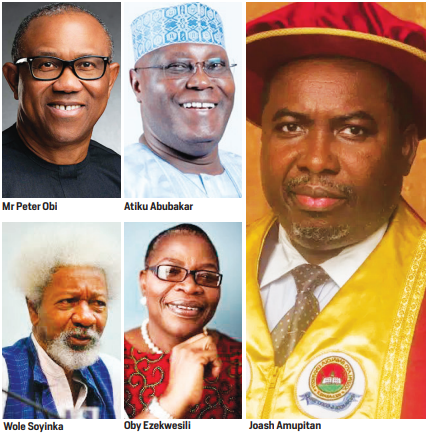
Atiku Abubakar: “Restore faith in the process”
Former Vice President, Atiku Abubakar, has repeatedly linked voter apathy to loss of confidence in the electoral system. According to him, when citizens believe that their votes may not count, enthusiasm naturally wanes.
He calls for comprehensive electoral reforms, transparency in result collation, and stronger independence for the Independent National Electoral Commission (INEC), insisting that credible elections are the antidote to apathy.
Peter Obi: “Engage the youth, protect the vote”
Labour Party presidential candidate in the 2023 general election, Peter Obi, argues that Nigeria’s large youth population can reverse voter apathy if properly mobilised.
He maintains that young Nigerians are politically conscious but discouraged by irregularities, violence and vote-buying.
Obi advocates stronger voter education, protection of votes through technology and issue-based campaigns that focus on governance rather than personality politics.
Wole Soyinka: Citizens must not abdicate responsibility
Nobel Laureate Wole Soyinka has often taken a broader civic view, warning that apathy endangers democracy itself. While criticising systemic flaws, he also stresses that citizens must not abandon the democratic space to political elites.
For Soyinka, active participation— through voting, civic engagement and accountability—is essential to preventing democratic backsliding.
Oby Ezekwesili: “Demand accountability”
Former Minister of Education and public policy advocate, Oby Ezekwesili, links voter apathy to poor governance outcomes. According to her, when elected officials fail to deliver on promises, citizens grow disillusioned.
She advocates issue-driven politics, transparency in governance and active citizen monitoring of public officials as ways to rekindle political participation.
A shared concern
Though their perspectives differ, these prominent Nigerians converge on one point: voter apathy is both a symptom of systemic weaknesses and a threat to democratic consolidation.
Whether through electoral reform, youth mobilisation, internal party restructuring or improved governance, the consensus is clear—Nigeria’s democracy requires renewed trust and active citizen engagement.
The challenge ahead lies not just in diagnosing the causes of apathy, but in implementing concrete reforms that convince Nigerians that their votes truly matter.
Conclusion
Voter apathy is both a symptom and a warning. It signals dissatisfaction but also offers an opportunity for reform. By strengthening electoral credibility, empowering citizens and promoting inclusive politics, Nigeria can transform disengagement into renewed democratic participation.
Ultimately, the health of Nigeria’s democracy depends not just on those who win elections, but on how many citizens believe it is worth showing up to vote.