

…as NICRAT scales up targeted screening, prevention
Skin cancer is emerging as a growing public health threat among Nigerians living with albinism, as prolonged exposure to intense ultraviolet (UV) radiation places them at significantly higher risk of developing life-threatening lesions. In response, the National Institute for Cancer Research and Treatment (NICRAT) has intensified efforts to reduce preventable deaths through expanded screening, early detection and improved access to treatment.
Persons with albinism have little or no melanin — the pigment that protects the skin from harmful UV rays. In Nigeria’s tropical climate, this biological vulnerability translates into a lifetime of heightened exposure to skin damage. Without consistent sun protection and regular medical checks, minor skin changes can quickly progress into advanced cancers.
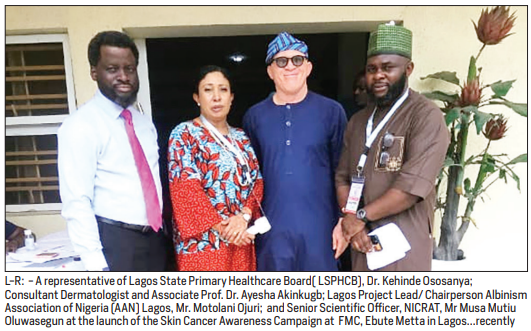
Speaking at the launch of the “Shade the Sun” Skin Cancer Awareness Campaign at the Federal Medical Centre, Ebute Metta Cancer Centre in Lagos, NICRAT’s Director General described the intervention as a focused response to a silent but escalating crisis. “People with albinism are at significantly increased risk of developing skin cancer due to prolonged sun exposure,” he said. “With early detection, consistent protection and timely treatment, many of these cancers can be prevented or treated successfully.”
NICRAT’s Targeted Intervention
Under its National Preventive Oncology Clinical Services and the National Initiative for Cancer Early Detection, Screening and Coordinated Access to Networked Care, NICRAT has activated targeted skin cancer screening services in Lagos, Abuja and Kano. Integrated routine skin checks into structured referral pathways to ensure timely treatment.
The Vice President of the Nigerian Association of Dermatologists and Consultant Dermatologist at the Lagos University Teaching Hospital (LUTH), Dr Ayesha Akinkugbe, explained that the partnership goes beyond screening. It also includes capacity building for healthcare workers to recognise early warning signs of skin cancer and manage simple cases before they become life-threatening.
Stakeholders are also advocating the creation of a national albinism register to generate reliable data for planning and resource allocation. Consultant Physician and Dermatologist at the Lagos State University Teaching Hospital (LASUTH), Dr Folakemi Cole-Adeife, stressed that prevention and early detection are the two pillars of survival. “As dermatologists, we focus on prevention, education and advocacy,” she said.
Persistent wounds or unusual growths could be early signs of skin cancer and should never be ignored
“We educate persons with albinism, their parents and teachers on proper skin care. Secondly, we provide treatment. People with albinism should have routine skin checks at least every four to six months.” She warned that even small sores, persistent wounds or unusual growths could be early signs of skin cancer and should never be ignored. “If you notice anything suspicious, do not wait for your next appointment. Come immediately.”
While acknowledging that avoiding the sun entirely is unrealistic in Nigeria’s climate, she advised being “sun safe and sun smart,” echoing a slogan of the Albinism Association of Nigeria. She recommended limiting outdoor activities between 10:00 a.m. and 4:00 p.m., when UV radiation is strongest.
Ideally, work hours should fall between 7:30 a.m. and 9:00 a.m., and later in the evening from 4:00 p.m. onwards. Protective clothing is critical. Long sleeves, wide-brimmed hats that shield the face and neck, umbrellas and regular application of sunscreen significantly reduce UV damage.
Parents are urged to take children with albinism for skin checks every six months, or immediately if any abnormality appears. The danger of ignoring early symptoms can be devastating. Untreated lesions may progress to advanced skin cancer requiring surgery, chemotherapy or radiotherapy — treatments that are often financially out of reach. A 100- gram tube of 5-fluorouracil cream used for early-stage treatment costs about N150,000.
Cryotherapy using liquid nitrogen, though relatively cheaper, still costs between N15,000 and N20,000 per refill. Surgical procedures range from N70,000 in public hospitals to as much as N1 million in private facilities. Chemotherapy sessions cost at least N350,000 each, often requiring multiple cycles. Radiotherapy can cost between N1.5 million and N2 million per session. Even sunscreen averages N20,000 per 100ml pack. Without health insurance, these costs can be catastrophic.
Experts therefore call for expanded coverage under national and state health insurance schemes to ensure that persons with albinism can access preventive care and treatment without financial ruin. NICRAT’s intensified screening and awareness drive underscores a clear message: skin cancer among persons with albinism is preventable and treatable — but only if detected early and tackled with consistent protection, regular medical checks and stronger health system support.