
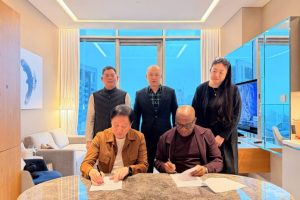
The Chairman of Swiber Africa Group, Dr Orji Uzor Kalu, and the Chairman of GCL Group, Zhu Gongshan, have signed a new energy industry framework cooperation agreement in Dubai, United Arab Emirates. Under the agreement, the two parties will engage in in-depth cooperation across areas including energy system development, strategic lithium resource development, and industrial chain collaboration.
This signing marks an important outcome of strengthened practical cooperation between China and Nigeria, and represents a key step in GCL’s active response to the Belt and Road Initiative and its broader internationalization strategy.
As one of Africa’s leading economies, Nigeria has long faced severe power shortages and a weak electricity grid, which have significantly constrained industrial development and improvements in living standards.
Against the backdrop of the global energy transition and deepening China-Africa cooperation, GCL Group is leveraging its more than 20 years of experience in integrated Oil, Gas, and Green Energy development in African countries such as Ethiopia and Djibouti.
Targeting Nigeria’s pressing energy and resource challenges, GCL is focusing on the development of a new-generation power system and the lithium battery industry chain, while comprehensively expanding its strategic footprints along the Belt and Road corridors. In terms of power system construction, GCL will integrate internationally advanced high-efficiency clean power generation technologies with scenario based system solutions.
A key offering will be the full-time-scale virtual power plant system-successfully deployed in the Suzhou Industrial Park jointly developed by China and Singapore— which achieves a load regulation accuracy of up to 94 per cent.
This system will provide Nigeria with intelligent energy management capabilities ranging from millisecond-level rapid response to medium and longterm precise forecasting. The cooperation will be directly aligned with Nigeria’s Presidential Power Initiative (PPI), with plans to develop major projects including 3 GW of gas-fired power plants, 4 GW of integrated wind and solar energy projects, as well as hydropower and coal-fired power stations.
Nigeria possesses abundant lithium resources, but development has long been limited to low-value-added stages such as raw ore extraction and preliminary processing. Issues including grade volatility and idle capacity have prevented the full realization of resource value. Access to high-quality overseas lithium resources will provide a stable supply of premium raw materials for GCL’s materials business, enabling precise global matching of resources and production capacity.








