
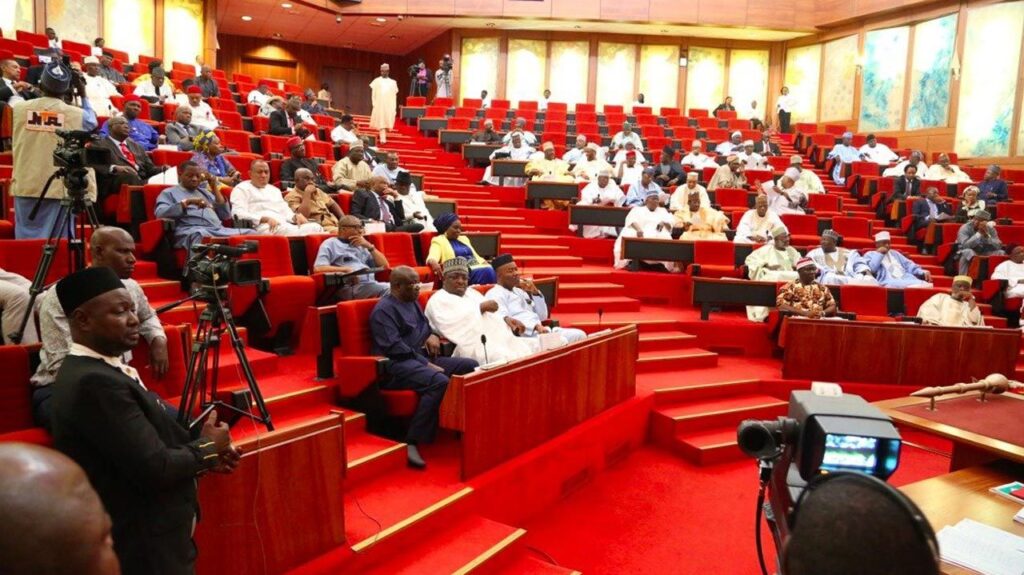
The Senate, on Wednesday, resolved to consider the December 25 United States of America (USA) airstrikes on terrorist hideouts in Sokoto State in a closed session.
The Senate made this resolution following a point of order raised by Senator Abdul Ningi, representing Bauchi Central Senatorial District, drawing the attention of the Chamber to the Military action on Nigerian soil by the United States of America without approval by the National Assembly.
Ningi, who raised the point of order citing Order 9 of the Senate Standing Orders, on matters of privilege, claimed that his privilege as a Senator was breached by the action taken in Nigeria by the U.S.A.
He noted that the National Assembly derives its powers from the Legislative Houses (Powers and Privileges) Act, Cap 208, Laws of the Federation of Nigeria 1990, and the 1999 Constitution (as amended).
Accordingly, the politician stressed that legislative authority resides in the National Assembly, comprising the Senate and the House of Representatives, with responsibility for lawmaking to ensure peace, order, and good governance.
Ningi expressed concern over reports that the US military carried out airstrikes on Nigerian soil, describing the action as a violation of Nigeria’s sovereignty and a breach of the United Nations Charter.
He argued that the Constitution vested the authority to approve military action solely in the President of Nigeria, as Commander-in-Chief of the Armed Forces, adding that even the President cannot constitutionally allow a foreign military to independently conduct strikes within Nigeria without legislative engagement and coordination with local security agencies.
“The title of Commander-in-Chief is not ceremonial,” Ningi said. “It confers real authority and responsibility. Nigeria is a sovereign nation, and its territorial integrity must be protected.”
He condemned the Executive arm for what he described as a lack of transparency, insisting that the National Assembly must be fully briefed on all security actions involving foreign forces.
He warned that excluding the Legislature from such sensitive decisions could set a dangerous precedent and undermine Nigeria’s sovereignty.
However, responding to Ningi’s point of order and argument, the President of the Senate, Senator Godswill Akpabio, ruled that the Senate’s privilege had not been breached and that the matter would be considered in a closed session.
Akpabio said that matters concerning national security are not usually discussed in open session, noting that lawmakers had already been briefed that the operation was carried out with the concurrence and collaboration of Nigerian security agencies.
He assured Senators that a closed-door briefing would be arranged to provide comprehensive details of the incident, stressing the need for discretion in security-related discussions.
“Security is not something we discuss in the open market,” Akpabio said, while commending the senator who raised the issue.
The Senate thereafter deferred consideration of the matter, pending the closed session briefing on another legislative day.