

Nigeria is conducting one of its most expansive social surveys in decades, gathering data on more than 40 Sustainable Development Goal indicators nationwide, the Statistician-General of the Federation, Adeyemi Adeniran, has said.
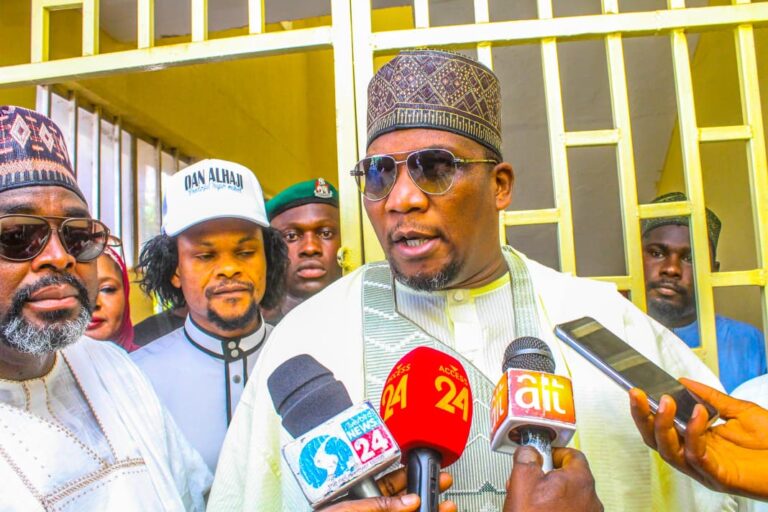
Adeniran said this to The PUNCH during a field visit to enumerators in the Idi-Oro Mushin area of Lagos on Monday, alongside officials from the National Bureau of Statistics and UNICEF Nigeria.
The PUNCH reports that the survey called the Multiple Indicator Cluster Survey, seventh edition, is a partnership with UNICEF, with NBS in the lead. The data is aimed at measuring the welfare of women, men, children and adolescents across the country.
“We are here in Lagos State to carry out what you call a monitoring exercise, to go around the enumeration areas where our team of enumerators and supervisors are collecting data for the Multiple Indicator Cluster Survey round seven that we are doing throughout the state of the Federation. This is one survey that is very important for the country, not just to have data, but because it has to do with the welfare of women, men, children and adolescents,” he said.
Detailing the importance of MICS 7 for policy and development outcomes, Adeniran said the survey captures extensive indicators tied to national welfare and global development goals.
“We also have in that survey not fewer than 40 indicators of the Sustainable Development Goals, which are also captured in that survey. So, it is important to plan for the welfare, for the socio-economic welfare of the citizens,” he asserted.
To ensure data quality and compliance, the Statistician-General said monitoring of field teams was underway and that the team had already gone to Adamawa, with Lagos being the second state to be visited.
“We want to see the level of cooperation that our field staff are getting from the respondents. And we also want to examine whether the enumerators are carrying out the interview in the manner and guidelines that are stipulated for them during the training,” Adeniran said.
He described support structures in place to ensure data sanctity: “We also have data editors at the headquarters that are also checking the data that they are getting on a daily basis, looking at what areas need improvement, and they are giving them feedback on a daily basis to improve on it.”
Adeniran also noted operational obstacles encountered in the field, including capturing children under the age of five and security concerns.
“One of the key challenges that we observe is that the children are in school now. So, whenever our enumerators go around to collect data, the children are not around, which necessitates them always coming back late in the evening. We require a certain number of under-five children… because they are very, very important. The data we are collecting on this category of respondent is so important for their health, for their education and for their growth,” he maintained.
Supporting the nationwide scope and policy utility, UNICEF Nigeria’s Chief of Planning and Monitoring, Wayne Bacale, reaffirmed the breadth of the survey.
He said, “UNICEF has been supporting a number of countries all over the world, and we have expertise on this, so we provide technical support to train our highly competent National Bureau of Statistics staff on how to ensure that the survey is statistically sound and internationally representative.”
Speaking at the stakeholders meeting on Tuesday, Bacale said, “This is the seventh round of the Multiple Indicator Clusters Survey. The National Bureau of Statistics has actually led on this since 1995. We thought that while waiting for the final findings, it would be good to have a preliminary sensitisation of different stakeholders on why the Multiple Indicator Cluster Survey is important and how it would be useful for our ministries, from education to water resources to health, because this information is nationwide.
“Secondly, it’s also multi-sectoral. What it means is that it will cover the situation of children and women in different sectoral priorities, and this, we hope, will be very helpful data that will help us with evidence-based decision-making and policy recommendations. We are currently in the data-gathering phase of the MICS survey, and we hope to complete the data gathering by March this year. Then, after that, we’ll convene the process with the NBS to analyse the data. By June or July, we’ll be able to have the key findings of the survey.”
The National Consultant for MICS 7, Dr Isiaka Olarewaju, emphasised Nigeria’s long participation in the survey and the importance of statistical confidentiality.
“We started the first round in 1995, and it is a four-year periodic survey, and that’s how we joined the rest of Nigeria, which is one of the countries that has participated in all rounds,” he said.
While calling for states to embrace the process and plan to have state-level MICS, he revealed that Nigeria’s MICS data was the most downloaded in the world, “Just as Nigeria data is the most downloaded in the world for MICS, Lagos State would have been there. If it’s only state by state.”
He elaborated on confidentiality safeguards: “Any information we get from the respondent is very, very confidential, is not to be shared with anybody… We don’t include anything that identifies any data supplier. When we analyse the data at the aggregate level, we can talk about what is happening in a local government, what is happening in a state, but they won’t tell anybody what is happening in anybody’s household or family.”
Giving additional context on field logistics, UNICEF Monitoring Specialist Yejimmawerk Desta underscored the survey’s reach: “For instance, we have 50 clusters that are randomly selected, and we have around 100,000 households,” and described the data richness, “Multiple indicator cluster survey is one of the gold standard surveys. It’s child-centric, with cuts across a lot of sectors… But importantly, it brings all the family members – the men, the women, and the adolescents that are in the house. So, it’s really the data that is very rich, and the data will come as a representative at the national and state level.”
In his speech, the Director, Lagos Bureau of Statistics, Tayo Oseni-Ope, urged access to data sets for deep analysis: “We still believe that beyond the data analysis, beyond the highlights… that there should be… a data set available to those states that the MICS was being carried out, especially for further analysis.” UNICEF expressed willingness to oblige this request.
Meanwhile, the UNICEF Planning, Monitoring and Reporting Specialist for Lagos, Olanipekun Oluwasola, reiterated collaborative analysis. He said, “In each of the states, we’ll be working with the Ministry of Planning and all the other ministries. Whatever you want to do, submit to the Ministry of Planning, and as we have, we will not be doing the analysis at the central level. That’s in Abuja. It will be done in that state, for example, in Lagos State, where we have the data set. We will come together as a team. Each of the ministries will be represented so that we can do a deep dive together and see the result together. That way, we are doing two things. We are making the data available. We are building our capacity on how to go beyond the national and state levels to the LGA level, and also, we are producing our results together so that they are more useful, more honed by the state.”