


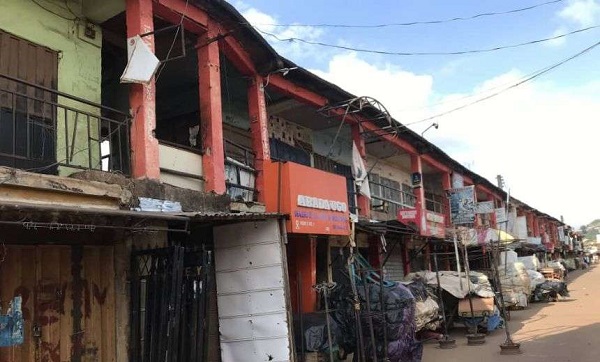
For non-compliance with the directive of Governor Charles Soludo that all socioeconomic activities must go on irrespective of the Monday sit-at-home order by the Indigenous People of Biafra (IPOB), the Onitsha main market has been shut down for one week.
Recall that Soludo had stated that the Monday sit-at-home order is over, insisting that all the markets in the state must open for business or face grave consequences.
Though IPOB had dismissed the insistence of Soludo, contending that it is against the struggle for Biafran emancipation, the Governor described the sit-at-home order as a great economic sabotage.
According to one of the Media Assistants to Soludo, Mazi Ejimofor Opara,
“The position of the state government is clear and unambiguous, and that is the height of economic sabotage, and if you look at the enormous economic loss during each Monday sit at home you will discover that it is a rip off on the economy of the state and that of the business commuty”
Opara further explained that after one week, the market would reopen, but was quick to add that come next Monday, should the market be closed, there shall be stiffer measures aimed at protecting commercial activities in the state.
Also, according to the statement by the Press Secretary to Soludo, Mr Christian Aburime;
“Anambra State Governor, Prof Chukwuma Charles Soludo, has ordered the immediate shutdown of the Onitsha Main Market for one week, following defiance of the market leadership to open, against government directive”
“Governor Soludo’s order for a one-week shutdown of the sprawling market is more than an administrative penalty”
“It is the latest, and perhaps most drastic, salvo in a protracted war over who controls time and economic life in Southeast Nigeria on mondays”
“The enemy is the long-standing, fear-enforced Monday sit-at-home order, a ghostly mandate from non-state actors that has strangled businesses and normalised weekly Monday sit-at-home for years”
The Governor’s move is a direct response to what the government sees as baffling defiance. Despite repeated assurances of enhanced security and appeals to reclaim public spaces, many traders at the iconic market again chose to keep their stalls locked”
” Their absence was a quiet rebellion, but one that spoke volumes about the lingering climate of apprehension”
“The government cannot stand by while a few individuals willfully undermine public safety and disregard official directives meant to restore normalcy; this is plain economic sabotage”
” We are not going to allow this”, Governor Soludo stated, framing the closure as a protective measure for the “law-abiding citizen.”
But his subsequent warning carried the weight of an escalating ultimatum: if the market does not reopen for business after this one-week shutdown, it will be sealed for a month. “And so on and so forth,” he added, drawing a line in the sand.
“You either decide that you are going to trade here or you go elsewhere. I am very serious about this”, the Governor insisted.
“The scene at the market was one of tense enforcement. A joint task force of police, army, and other security personnel moved swiftly to secure the perimeter, turning away the few hopefuls who approached”
“For the Soludo administration, the solution is unwavering enforcement to break a psychological barrier. The strategy is clear: make the cost of compliance with the illegal sit-at-home order higher than the fear that drives it”
“By targeting the economic heart of the region, the government aims to trigger a collective shift in behaviour, betting that the traders’ desire to trade will ultimately outweigh their fear”
“As the gates remain locked this week, the standoff in Onitsha encapsulates the broader struggle in the Southeast. It is a fight over normalcy, authority, and the fragile psyche of a populace caught between enforced directives and imposed orders.
“When the gates are scheduled to reopen next Monday, all eyes will be on the traders. Will they return to their stalls, emboldened by the state’s show of force? Or will the silent, empty aisles deliver a different verdict?”
“The answer will determine not just the fate of a market, but the rhythm of life in Anambra for Mondays to come” the statement read.
Meanwhile, other markets in the state, such as Nkwo – Nnewi spear parts market, Eke- Awka main market and Ekwulobia markets opened skeletal as traders were seen hanging around their shops.
But the traders contended that the closure of the markets is a result of the fear of miscreants coming to attack their shops for not complying with the sit-at-home order.