
…as ASUU hails deal, warns govt on autonomy, funding
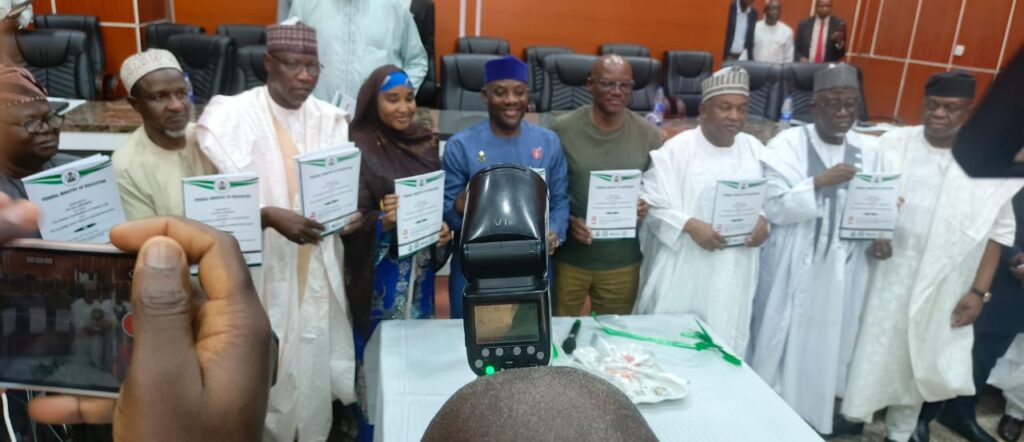
After 16 turbulent years of renegotiations, broken promises and repeated industrial actions, the Federal Government of Nigeria and the Academic Staff Union of Universities (ASUU) have signed a landmark agreement that both sides described as a turning point for the nation’s university system.
At the unveiling and signing ceremony on Wednesday in Abuja, the Minister of Education, Dr Tunji Alausa, declared that the agreement marked “a decisive break from the cycle of discord, distrust and disruption that has haunted Nigeria’s tertiary education system for decades.”
“This occasion represents far more than the unveiling of a document; it symbolises renewed trust, restored confidence and a turning point in the history of Nigeria’s tertiary education system.”
Alausa, who revealed that President Bola Ahmed Tinubu personally drove the process to a conclusion, described it as unprecedented presidential involvement.
“For the first time in the history of our country, a sitting President took full ownership of this long-standing challenge and accorded it the leadership attention it truly deserved.
“Under President Tinubu, we deliberately chose dialogue over discord, reform over delay and resolution over rhetoric.”
According to the Minister, the agreement reflects the administration’s resolve to guarantee quality education and uninterrupted academic calendars, which had been repeatedly disrupted by strikes over the years.
40% pay review, new professorial allowance.
With a comprehensive review of academics’ conditions of service, Alausa announced a 40 per cent upward review of the emoluments of university academics, approved by the National Salaries, Incomes and Wages Commission, with effect from January 1, 2026.
“The emolument of university academics will be reviewed upward by 40 per cent to enhance morale, improve quality of service delivery, reverse brain drain and boost the globalp to competitiveness of our universities.”
The minister explained that the salary structure would now comprise CONUASS and a Consolidated Academic Tools Allowance (CATA), covering journal publications, conference participation, internet access, book and learned society allowances, which he noted were critical tools required for effective teaching, research and global academic competitiveness.
The Federal Government also approved, for the first time, a Professorial Cadre Allowance for full-time Professors and Readers.
“For Professors, the allowance is ₦1.74 million per annum (₦140,000 monthly), and for Readers, ₦840,000 per annum (₦70,000 monthly). This is not cosmetic. It is structural, practical and transformative.”
He said the allowance recognises the heavy academic, administrative and research workload borne by senior academics.
The minister pledged the government’s faithful implementation, saying, “We have laid a durable foundation for industrial harmony in our universities. History will remember today as the day Nigeria chose dialogue, transparency and strong presidential commitment over perpetual crisis.”
President, Academic Staff Union of Universities (ASUU), Prof. Chris Piwuna, who described the agreement as a major step toward rescuing Nigeria’s troubled university system, however, warned that deep structural problems still threaten its survival, as he regretted that the pact ends a struggle that should have been concluded over a decade ago.
“The 2009 agreement was due for renegotiation in 2012, but it dragged on for this long due to the poverty of sincerity in government. What we are unveiling today is the outcome of a prolonged struggle that began in 2017.”
Piwuna traced the tortuous path to the agreement, recalling how successive renegotiation committees led at different times by Wale Babalakin (2017), Munzali Jibrin (2021) and Nimi Briggs (2022) , had failed to deliver a collective bargaining agreement.
According to him, real progress only began after the current administration inaugurated the Yayale Ahmed-led renegotiation committee in October 2024.
“This dragged on for this long due to what we described as poverty of sincerity on the part of the government, but this administration inaugurated the Yayale Ahmed Renegotiation Committee in October 2024.
“About 14 months later, we are here to witness an agreement. This agreement focuses on conditions of service, funding, university autonomy, academic freedom and systemic reforms to reverse decay, curb brain drain and reposition our universities for national development.”
The ASUU president praised President Bola Ahmed Tinubu, Education Minister Dr Tunji Alausa and the chairman of the renegotiation committee, Alhaji Yayale Ahmed, for what he described as uncommon commitment.
“Mallam Yayale is a distinguished Nigerian, a patriot and a man of integrity. At a point, he told me, ‘I stake my integrity on this. That is the highest possession I protect.’ Sir, you will go to heaven.
“We used harsh words sometimes, but today I have nothing but respect for the Honourable Minister of Education and his team.”
Despite celebrating the agreement, the ASUU President howeve,r raised the alarm over what he called persistent government encroachment on university autonomy, describing it as a major unresolved internal crisis.
“University autonomy is universally recognised as the cornerstone of a functional higher education system, but in Nigeria its implementation remains weak,” Piwuna said.
He accused federal and state governments of arbitrarily dissolving governing councils and interfering in the appointment of vice-chancellors.
“Councils’ recommendations are often rejected. Preferred candidates are imposed despite not emerging best. This erodes meritocracy, fuels conflict and creates legitimacy crises in our universities.”
He also warned against the growing culture of “acting vice-chancellors,” saying it undermines stability and governance.
ASUU welcomed the inclusion of research funding in the renegotiated agreement, revealing that it provides for the forwarding of a National Research Council Bill to the National Assembly.
“The proposed bill provides for at least one per cent of GDP for research, innovation and development. Research funding is not a luxury; it is a necessity. We call on the National Assembly to give this bill an accelerated hearing.”
Speaking further, the ASUU president accused university managements of mismanaging funds won through union struggles.
“Across our universities, there are repeated allegations of mismanagement, contract irregularities and financial recklessness. Our universities are now run by consultants. Consultancy has become a clean way of cleansing funds fought for by ASUU.”
He also faulted governing councils, describing many of them as “politicised and compromised. The problem is no longer lack of voices demanding funding, but lack of institutions enforcing accountability,” he warned.
Piwuna also expressed concern over newly upgraded Federal Universities of Education, accusing some vice-chancellors of fast-tracking promotions without due process.
“Chief lecturers and professors are not equivalent. Promotion to professor requires research output, postgraduate supervision and external assessment. We must not erode standards.
Beyond the universities, ASUU painted a grim picture of Nigeria’s economic reality, linking it directly to access to education.
“When minimum wage was N18,000, it was equivalent to 111 dollars. Today, N70,000 is just 47 dollars. Our lives have been devalued. With PMS above N800, the right to free movement is being curtailed. Today, the hungry is simply starving.”
He declared ASUU’s readiness to work with the government to rescue the country, saying, “We want you to tell your colleagues that they have an ally in ASUU. The country must be rescued and rebuilt in the interest of the people.”
While expressing optimism that the agreement would be fully implemented, Piwuna admitted lingering doubts.
“Looking at our history with government, there is still that pessimistic side, but it is our belief that the union would not need to issue a strike threat for the full implementation of the 2025 FGN–ASUU renegotiated agreement.”
Earlier, the Minister of State for Education, Prof. Suwaiba Ahmad, described the agreement as “the renewal of a covenant between government and the academic community.”
She said, “I understand what it means to plan a semester only for it to be disrupted, to mentor students whose academic journeys are stalled by strikes, and to pursue research amid limited resources. This moment is deeply personal to me.
“This Agreement carries a deeper significance. It represents a shared resolve to break with the past, to replace confrontation with collaboration, and to anchor engagement on trust rather than suspicion.
“This agreement signals a renewed phase of trust-building and cooperation. It is our collective expectation that its faithful implementation will contribute to industrial harmony, improved working conditions for academic staff, enhanced teaching and research outcomes, and a more predictable academic calendar for our students and their families.”
The minister of State praised both the government and ASUU negotiating teams for patience and patriotism, noting that the deal signals “a renewed phase of trust-building and cooperation.”