
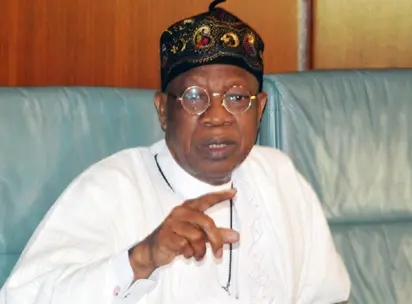
The immediate past Minister of Information and Culture, Alhaji Lai Mohammed, has revealed that his selection as Minister by former President Muhammadu Buhari in 2015 was the culmination of years of trust, shared values, loyalty, and dedicated service, rather than a single decision.
Lai Mohammed made this revelation in his book titled, Headlines and Soundbites: Media Moments that Defined an Administration.
Sunday Telegraph recalls that the book was officially launched in Abuja on Wednesday, December 17, 2025, coinciding with what would have been Buhari’s 83rd birthday, and provides a detailed account of Mohammed’s experiences and reflections while serving in the Buhari cabinet.
Reflecting on the early days following Buhari’s inauguration on May 29, 2015, Mohammed noted that it took some time before the former President finalized his cabinet appointments.
According to the former Minister, owing to the trust and confidence Buhari had in him, I was personally invited to join the Ahmed Joda-led Transition Committee in April 2015, even after other members had been named.
READ ALSO:
The Committee’s mandate was to coordinate with the outgoing administration of President Goodluck Jonathan, review handover documents, and develop a blueprint for the incoming government.
Mohammed recounted the phone call that preceded his appointment: “A voice asked, ‘Is this Alhaji Lai Mohammed?’ I replied in the affirmative. Then I was told, ‘Please hold for Mr President.’
“Then another voice, apparently that of the President-elect, came on the line and asked: ‘Lai, where are you?’
“‘Your Excellency, I am in Lagos.’
“‘What are you doing in Lagos?’ he asked.
“‘I live in Lagos, Your Excellency,’ I replied.
“He then went straight to the reason for the call: ‘Are you not coming for the inaugural meeting of the Transition Committee in Abuja tomorrow?’
“I replied, ‘Your Excellency, I am not a member of the committee.’ He then said, ‘Ok, Tunde (Sabiu, his longtime personal assistant) will call you,’ and he hung up.
“Within the hour, I received a call from Tunde, who asked where he should deliver the letter appointing me to the transition committee,” Mohammed narrated in the book.
Mohammed said that when the initial committee was announced and his name was not included, he did not feel overlooked or offended; instead, he was simply pleased that the party had secured victory in the elections.
He noted that Buhari’s personal invitation to join the committee marked the start of a close and trusting relationship that endured until the former President’s passing on July 13, 2025.
Mohammed also recounted that, a few days before Buhari’s 100th day in office, a trusted aide of the President asked him to provide support to the presidential spokesmen ahead of the milestone celebration.
“At that point, Buhari had yet to appoint his ministers but had already named Femi Adesina and Garba Shehu as his official spokespersons.
“I did not need a soothsayer to tell me that the call was a further indication of the President’s confidence in me.
“The same confidant told me on another occasion that if there was anyone the President was very sure would make his cabinet and whose portfolio he was already sure of, that person was me,” he wrote.
Mohammed said his relationship with Buhari dated back to 2012, when he requested through Mallam Nasir el-Rufai that Buhari write the foreword to his first book, Witness to History. Buhari graciously agreed, wrote the foreword, and attended the book launch.
Mohammed recalled another significant interaction during the period leading up to the 2015 general election, following the merger that created the All Progressives Congress (APC).
Having served as the opposition spokesman for the Action Congress of Nigeria and later the APC for more than ten years, Mohammed said he frequently attended meetings with Buhari in Kaduna alongside his political mentor, President Bola Tinubu, and Chief Bisi Akande. These sessions typically took place on Mondays and Thursdays.
He emphasized that these years of consistent engagement, built on mutual respect and shared political convictions, helped establish the trust and confidence that Buhari later placed in him when appointing him as minister.
“Serving in Buhari’s administration for nearly eight years allowed me to witness firsthand the former President’s dedication to discipline, integrity, and national service—values that guided my own conduct in office,” Mohammed said.