

- How Rivers emergency rule, adoption of ADC
- By coalition leaders, defections, others shaped polity in 2025
The year 2025 has been an interesting one for Nigerians politically. FELIX NWANERI writes on the major events that have so far shaped the nation’s political space
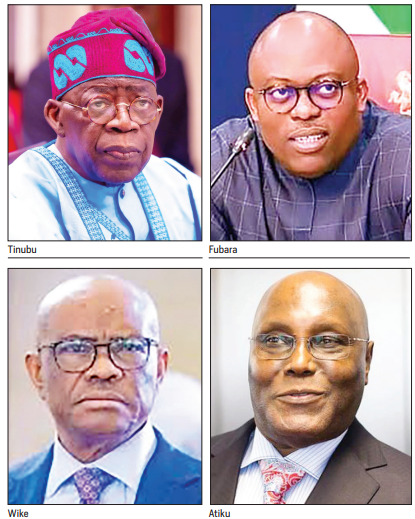
From the degeneration of the rift between the governor of Rivers State, Siminalayi Fubara and his predecessor, Nyesom Wike that led to the declaration of state of emergency in the oil-rich state by President Bola Tinubu to adoption of the African Democratic Congress (ADC) by leaders of the opposition coalition and upsurge in defections by members of the opposition political parties to the ruling All Progressives Congress (APC), the year ending has been politically remarkable.


Other landmark events that shape the polity within the period under review include gubernatorial election in Anambra State, heightened security challenges, replacement of service chiefs and resignation of the Minister of Defence, claim of genocide against Christians, death of former President Muhammadu Buhari, emergence of Prof. Nentawe Yitwada as national chairman of the APC, Peoples Democratic Party (PDP) crisis and conviction of the leader of Indigenous People of Biafra (IPOB), Nnamdi Kanu, for treason.
Rivers emergency rule
The political fireworks in 2025 started on March 18, with President Tinubu’s declaration of a state of emergency in Rivers State and suspension of Governor Siminalayi Fubara, his deputy and all lawmakers in the state House of Assembly for six months. In a nationwide broadcast Tinubu said he took the decision following a “disturbing security reports detailing incidents of vandalisation of pipelines by some militants without the governor taking any action to curtail them”.
The President, who made the announcement after one of Nigeria’s highest producing crude oil pipelines, the Trans-Niger Pipeline, suffered significant damage due to a blast, maintained that he cannot not allow the “grave situation” to continue.
The blast occurred at a time the political rift in Rivers State between Nyesom Wike (now Minister of the Federal Capital Territory) and his anointed successor, Simi Fubara, was at a boiling point. Wike had ensured that Fubara, who served as Director of Finance and Accounts, government house and Accountant General, while he held sway as governor of the oil-rich Rivers State emerged as his successor given their friendship. However, the collapse of the once father-son relationship less than six months after exchange of the governorship baton left many bewildered.
The crack in the duo’s relationship was noticed shortly after the May 29, 2023, inauguration but was dismissed by their respective camps. However, the October 30, 2023, move by some members of the Rivers State House Assembly loyal to Wike to impeach Fubara confirmed the speculation of a no love lost relationship between the duo.
The impeachment move against Fubara started with the suspension of the House Leader, Edison Ehie and other three lawmakers – Victor Okoh (Bonny Constituency), Goodboy Sokari (Ahoada West Constituency) and Adulphus Timothy (Opobo/Nkoro Constituency) – said to be the governor’s loyalists. The impasse that ensued saw a part of the Rivers House of Assembly Complex being destroyed by an explosion, while some policemen fired teargas and water cannons at Fubara, when he visited the complex to assess the extent of damage from the explosion. While Fubara survived the impeachment plot, both camps in the crisis resorted to a battle of claims and counter-claims.
Fubara’s camp did not only alleged that Wike was seeking gratification from Fubara, it also claimed that the former governor insisted on calling the shots in Rivers State from Abuja. Wike, who initially described the crisis as a PDP affair, not only denied that he sought for financial gratification from Fubara, but accused him of hobnobbing with his political adversaries. This, according to him, suggested that the governor was trying to take control of the PDP structure in Rivers State. Despite interventions by President Tinubu and some Rivers State stakeholders, the supremacy battle has failed to subside, with new dimensions almost on a daily basis.
From emergence of two factional speakers of the state Assembly – M artins Amaewhule (Wike-backed faction) and Edison Ehie (later Victor Oko-Jumbo (Fubara-backed faction) to the cabinet reshuffle and resignation of Wike’s loyalists from the state executive council and the crisis over the recent local government elections, 2024, the crisis culminated in the emergency rule and appointment of a former Chief of Naval Staff, Vice Admiral Ibok-Ete Ibas as sole administrator of the state.
The President lifted the state of emergency on September 17, and Fubara who resumed office the next day (September 18), in a statewide broadcast, described the six month emergency rule period as enormously challenging but necessary to restore order and safeguard democratic institutions. He added that as governor, he chose to abide by the declaration and co-operated fully with President Tinubu and the National Assembly, prioritising peace above personal or political gain.
Coalition of opposition leaders settle for ADC
It was euphoria in some political quarters, when notable opposition leaders, on July 2, announced adoption of the African Democratic Congress (ADC) as the platform they intend to use in their bid to wrest power from the ruling All Progressives Congress (APC) in the 2027 general election.
The choice of ADC by these opposition leaders, including former Vice-President Atiku Abubakar, ex-Governors Peter Obi; Rotimi Amaech, Nasir El-Rufai and Aminu Tambuwal, among others, was after several back-and-forth movements, including moves that initially linked them with the Social Democratic Party (SDP) and application for registration of a new political party – All Democratic Alliance (ADA).
Adoption of the ADC by leaders of the opposition coalition was sequel to the voluntary resignation of the Raph Nwosu-led National Working Committee (NWC) of the party to make way for the emergence of David Mark (a former Senate president) and Rauf Aregbesola (a former governor of Osun State) as interim national chairman and interim national secretary, respectively, although some chieftains claimed that the party was forcefully taken over by the coalition leaders.
The party, which later navigated its way out of the initial legal impediment posed by the suit filed by some aggrieved legacy members of the, following the Independent National Electoral Commission (INEC) recognition of the Mark-led leadership, in September, issued a directive for leaders of the coalition to resign from their parties and register fully with it.
While Amaechi was the first among the arrowheads of the coalition to formalize his membership of the ADC, following his formal registeration as a member of the party in July, Atiku, who resigned his membership of the PDP on July 16, waited till November 24, before he officially registered as a member of the ADC.
El-Rufai, on his part, officially joined the party on November 28. However, the party’s leadership is still in the dark over inability of one of its key partners, Obi, to fully identify with the opposition coalition as he is still holding on to the membership of the Labour Party on which he contested the 2023 presidential election.
Surge in defections
Akin to politics of post-election years, 2025 witnessed a gale of defections by members of the various opposition parties to the ruling APC. The drift, which started in the National Assembly in October 2024, when the first of legislators of the opposition extraction moved to the ruling party, has seen over 80 per cent of senators and House of Representatives members elected on the platforms of the PDP, LP, New Nigeria Peoples Party (NNPP) and Social Democratic Party (SDP) defecting to the APC in the outgoing year.
This development has given the ruling party absolute majority in both chambers of the National Assembly, but the defectors, like what obtained in the past, cited intractable divisions and crisis in their respective parties as reason s for their action. Chieftains of the main opposition party are also not left out of the defection frenzy.
However, PDP’s loss of eight of its governors – seven to the APC and one to Accord Party – drove the defections to an all-time high. Delta State governor, Sheriff Oborevwori, kick-started the move in April, when he collapsed the entire structure of the PDP in the state to the APC.
He moved to the centre’s ruling party with his predecessor and vicepresidential candidate of PDP in the 2023 election, Ifeanyi Okowa; a former senator that represented Delta South Senatorial District for 16 years, James Manager and other major stakeholders in the state chapter of the PDP.
Also defected alongside Oborevwori were his deputy, Monday Onyeme, members of the state Assembly, commissioners, hundreds of political appointees, local government chairmen, PDP leaders and thousands of supporters. While their defection marked an end to the 26-year-old grip of PDP on the oil-rich state, Senator Manager, who announced the move, said they took the decision after a resolution that Delta State “cannot continue to be in a sinking boat.”
The governor of Akwa Ibom State, Umo Eno, followed suit in June, when he officially announced his defection to the APC after a long waiting game. The governor, who attributed his defection to the PDP crisis, also moved to the ruling party with members of his cabinet.
Eno was the first governor of opposition extraction to publicly endorse President Bola Tnubu for a second term. He had while speaking at the flag-off of the Akwa Ibom section of the Lagos to Calabar Costal Road in April, declared that the people of the state are solidly behind the President and that they will support him to remain in power till 2031. It was another loss for the PDP, when Governor Peter Mbah of Enugu State defected to the APC in October. His move marked PDP’s loss of its major power base – the South-East geopolitical zone – to the ruling party.
Mbah, who took along his entire cabinet, state lawmakers, council chairmen, councilors and political appointees as well as over 80 per cent of PDP executives in the state, described his decision as a bold but necessary step to align Enugu’s vision of transformation with the national reform agenda of President Tinubu.
He also noted that the South-East, particularly Enugu, had for decades shown unwavering loyalty to the PDP but had not always been fairly represented when it mattered most. Other PDP governors, who defected to the APC within the year are Douye Diri of Bayelsa State, who officially joined the APC on November 3 and Siminalyi Fubara of Rivers State, who joined the ruling party on December 9.
Governors Agbu Kefas of Taraba State, on his part, dumped the PDP for the APC on December 14, while the decision of Plateau State governor, Caleb Mutfwang, to join the ruling party was announced two weeks ago by the National Chairman of the APC, Nentawe Yilwatda, during the party’s 14th National Caucus meeting at the State House Conference Centre in Abuja. Osun State governor, Ademola Adeleke, who dumped the PDP for Accord Party on December 9, has already emerged the party’s flag bearer for the 2026 gubernatorial election in the state.
Yilwatda emerges APC national chairman
The APC settled on a new national chairman, with Prof. Nentawe Yilwatda emergence on July 24. Yilwatda, who was then Minister of Humanitarian Affairs, was nominated to replace Abdullahi Ganduje, who resigned from the position in June on health grounds. His emergence followed a meeting between President Tinubu and governors elected on the platform of the APC at which the former university don was picked as a consensus candidate.
The party’s National Executive Committee (NEC) later ratified his appointment. Yilwatda, who hails from Plateau State, was the APC’s gubernatorial candidate in the state during the 2023 elections. He also served as a Resident Electoral Commissioner for the Independent National Electoral Commission (INEC) between 2017 and 2021, overseeing elections in Benue, Anambra, Osun, Rivers, and Cross River states.
Insecurity rekindles clamour for state police
From the Boko Haram insurgency ravaging the North-East geopolitical zone to banditry and kidnapping in the North-West; farmers/herders clash in the North Central; militancy cum oil theft in the South-South and agitation for self-determination in the SouthEast, there is no doubt that the picture about Nigeria is a nation at war with herself.
It was against these backdrops that echoes of state police reverberated across the country in 2025 as stakeholders insisted on new strategies to curb the various security challenges, which according to stakeholders, pose significant threat to the unity and development of Nigeria.
The Boko Haram insurgency, which is driven by Islamic extremists, has not only claimed thousands of lives and property worth billions of naira, it has equally turned many Nigerians to refugees in their own country. Across the country are camps for Internally Displaced Persons (IDPs). The crisis has equally crippled economic activities in most north eastern states.
In the case of bandits ravaging the North-West; kidnapping for ransom and cattle rustling have become lucrative businesses for them. Activities of these outlaws have equally claimed several lives and impeded educational advancement of youths in the zone over mass adoption of students as witnessed in Kebbi and Niger states. Similarly, ethnic tension has continued over activities of killer herdsmen across the country. The herders/farmers conflict, which has claimed thousands of lives, is mainly as a result of disputes over land resources between mostly Muslim Fulani herders and mainly Christian farmers.
Though the impact of the crisis has been more devastating in the North Central, particularly Benue and Plateau states, the herders have also advanced towards the southern part of the country, thereby expanding the frontier. A fresh twist was added to the abductions, following kidnapping of Christian worshipers in Kogi and Kwara states. It is against the backdrop of the worsening security situation that most citizens are of the view that the crisis at hand is a serious one that must be addressed with the speed of light.
Those who shared this view, not only criticised the security framework of the Tinubu-led administration, but described it as a failed system that has made killings across the country a recurring tragedy. These stakeholders called for establishment of state police, which according to them will ensure better security for citizens’ lives and property.
They posited that the nation’s security architecture, particularly the Nigeria Police Force, as presently structured, lack what it takes to effectively tackle the nation’s security challenges. President Tinubu, apparently heeding the call, in September,, declared that establishment of state police is unavoidable, as part of efforts to strengthen security across the country.
He followed this with a call on the National Assembly to begin immediate legislative actions to allow states willing to operate state police to do so. “I call on the National Assembly to begin reviewing our laws to allow states that require state police to establish them,” Tinubu said in a statement, while declaring nationwide security emergency as well as directing security agencies to expand recruitment.
He added: “Today, in view of the emerging security situation, I have decided to declare a nationwide security emergency and order additional recruitment into the armed forces. By this declaration, the police and the army are authorised to recruit more personnel.” His position was backed by the Southern Governors’ Forum and the Southern Nigeria Traditional Rulers Council, which described the move as a constitutional necessity for addressing the country’s complex security challenges.
Anambra guber election
The people of Anambra State reelected Governor Charles Soludo for a second term on November 8. The former governor of the Central Bank of Nigeria, according to results declared by the Independent National Electoral Commission (INEC), won in all the 21 local government areas of the state.
The governor, who contested the election on the platform of the All Progressives Grand Alliance (APGA), polled a total of 422,644 votes to beat all challengers in a landslide victory with his closest challenger, Nicholas Ukachukwu, of the APC polling 99,445 votes. Sixteen out of the 19 registered political parties participated in the election out of which the African Action Congress (AAC) and National Rescue Movement (NRM) fielded female candidates, while candidates of the remaining 14 parties were males. However, six parties fielded female running mates. They are Accord, All Progressives Congress (APC), Action Peoples Party (APP), Boot Party (BP), Labour Party (LP) and Zenith Labour Party (ZLP).
The candidates are Charles Onyeze (Accord) Jeff Nweke (Action Alliance – AA), Chioma Ifemeludike (African Action Congress – AAC), Chuma Nwosu (African Democratic Congress – ADC), Nicholas Ukachukwu (All Progressives Congress – APC), Charles Soludo (All Progressives Grand Alliance – APGA), Echezona Otti (Allied Peoples Movement – APM) and Chidubem Nweke (Action Peoples Party – APP). Others are Jerry Okeke (Boot Party – BP), George Moghalu (Labour Party –LP), Geoffrey Onyejegbu (New Nigeria Peoples Party – NNPP), Ndidi Olieh (National Rescue Movement – NRM), Jude Ezenwafor (Peoples Democratic Party – PDP), Vincent Chukwurah (Social Democratic Party – SDP), Paul Chukwuma (Young Peoples Party – YPP), Martin Ugwoji (Zenith Labour Party – ZLP).
PDP crisis
The PDP witnessed a fierce battle over control of its structure between the Nyesom Wike camp and PDP governors led by Seyi Makinde (Oyo) and Bala Mohammed (Bauchi) in the outgoing year.
Wike, who was rewarded by President Tinubu for his support for the APC in the 2023 presidential election, is said to be working to weaken the PDP given his endorsement of the President for a second term, while the governors under the aegis of PDP Governors’ Forum, are poised to have one of their own, possibly Makinde, emerge as the party’s presidential candidate for the 2027 elections.
While interventions by some stakeholders of the party doused the dust over the power-play at the beginning of the year, the crisis over claim to the party’s national secretaryship between Samuel Anyanwu and Sunday UdeOkoye further polarized the main opposition party.
The crisis saw the PDP leadership in and out of the various levels of the court until a five-member panel of the Supreme Court ruled on the matter in favour of Anyanwu in May. Consequently, a move was made to chart a new course, following the charge by some PDP founding fathers for the party’s leadership and stakeholders to adopt a strategy that will produce a presidential candidate from the southern part of the country in 2027.
Erstwhile National Secretary of the party, Prof. Jerry Gana, who moved the motion on behalf of the founding fathers at a PDP Consultative Conference, noted that such will not only ensure victory for the party at the polls, but will promote justice, fairness and equity. As part of the rebuilding effort, the party convened a national convention to elect a fresh set of party officers, for the next four years.
However, crisis rocking the PDP is yet to abate despite the belief that the convention that held between November 15 and16, would set a gold standard for internal party democracy. While Dr. Kabiru Tanimu Turaki (SAN) was elected as national chairman amidst court injunctions and internal disputes, leading to the expulsion of high-profile members like Wike for anti-party activities and dissolution of some state structures, the factions in the crisis have refused to yield ground. INEC, on its part, has refrained from recognizing any of the factional National Working Committees laying claim to the leadership of the party.
Demand for new states
The joint constitution review committee of the 10th National Assembly received 55 proposals for the creation of new states and 278 requests for the establishment of additional local government areas from various interest groups across the country in the course of its assignment. The committee also received two requests for boundary adjustments and 69 bills seeking amendments to various constitutional provisions. The proposals submitted by various interest groups span the six geopolitical zones and some of them have passed second reading at the Senate and House of Representatives.
Demands from the North-East are Savannah State (from Borno), Kwararafa State (from Taraba), Katagum State (from Bauchi), Amana State (from Adamawa), South Sardauna State (from Taraba) and Muri State (from Taraba). From the North-West are Gurara State (from Kaduna), New Kaduna State (from Kaduna), Hadejia State (from Jigawa), Gobir State (from Sokoto), Kainji State (from Kebbi and Niger), Tiga State (from Kano) and Ghari State (from Kano) From the North Central are Edu State (from Niger), Okun State (from Kogi) Okura State (from Kogi), South Plateau State (from Plateau), Lowland State (from Plateau), Plateau State (new carve from existing Plateau), New Kogi State (from Kogi, Nasarawa and Edo), Ifesowapo State (from Kwara) Abuja State (from the FCT), Apa State (from Benue) and Ayatutu State (from Benue). From the South-East are Orashi State (from Anambra, Imo, and Rivers), Orlu State (from Imo), Anioma State (from Delta), Etiti State (Imo and Anambra and Abia), Aba State (from Abia) and Adada State (from Enugu) Demands from the South-South are Atlantic City State (from Rivers (Bori State (from Rivers), Iwuroha State (from Rivers), Obolo State (from Akwa Ibom), Warri State (from Delta), Toru-Ebe State (from Delta) and Ogoja State (from Cross River). From the South-West are Ijebu State (from Ogun), Igbomina State (from Osun, Kwara and Ekiti), Oke-Ogun State (from Oyo), Ibadan State (from Oyo), New Oyo State (from Oyo), Ife-Ijesha State (from Osun, Ondo and Ekiti), Remo State (from Ogun) and Lagoon State (from Lagos and Ogun).
Yakubu bows out of INEC
After 10 unbroken years as chairman of INEC, Prof. Mahmood Yakubu, on October 7, bowed out as head of the election management body. Yakubu was first appointed head of the electoral umpire by then President Muhammadu Buhari in October 2015 and reappointed in 2020.
His handover to May Agbamuche-Mbu, who oversaw affairs of the commission until the appointment of Prof. Joash Amupitan as the substantive chairman of the commission on October 9, by President Tinubu, marked the end of his second term.
The former Executive Secretary of the Tertiary Education Trust Fund (TETFund) made history as not only the longest chairman of Nigeria’s electoral management body but also has the record of overseeing the conduct of two general elections in 2019 and 2023 as well as several off-cycle governorship and legislative polls.
He also oversaw the conduct of three Federal Capital Territory (FCT) council elections. While in the eyes of many, the infamous “technical glitch” during the 2023 presidential election diminished the innovations and achievements of the Yakubu-led INEC, there is no doubt that introduction of technology in the conduct of elections under his watch has greatly improved the credibility and outcome of polls as well as earned the commission applauses.
Among the technological tools is the use of the Bimodal Voter Accreditation System (BVAS), which replaced the flawed manual processes with fingerprint and facial recognition. It was also under Yakubu that the electoral commission unveiled the INEC Result Viewing Portal (IReV), which allows Nigerians to view polling unit results live thereby strengthening transparency and public confidence.
Endorsements for Tinubu’s re-election
It was torrent of endorsements for President Bola Tinubu ahead of the 2027 general election within the year under review. Governors of the APC extraction under the aegis of Progressive Governors Forum (PGF), took the lead, when they declared Tinubu as the sole candidate of the ruling party for the 2027 presidential election.
Hope Uzodimma, governor of Imo State and chairman of the forum, who announced the decision at an APC summit in May, said the governors were united in their support for Tinubu’s re-election bid.
Kaduna State governor, Uba Sani, seconded the motion. Members of the National Assembly election on the platform of the APC, who also announced endorsement of President Tinubu as the sole candidate for the 2027 presidential election at the summit, said their position was based on his political sagacity, President of the Senate, Godswill Akpabio, who moved the motion, said President Tinubu has been able to set Nigeria on the path of growth. Similarly, the zonal caucuses of the ruling party joined in endorsing the President for a second term.
And in what appears a departure from the norm, some members of the opposition political parties equally joined the fray by endorsing the President for a second term even when their respective parties are strategisiing on how to wrest power from the ruling APC.
Notable among these opposition politicians is Governor Soludo (APGA), who made his position public during Tinubu’s visit to his state in May. The Anambra governor emphasised that APGA and the president’s party (APC), will work together, adding that the two political parties share a common belief in progressivism.
Buhari’s death
Former President Muhammadu Buhari died in London on July 13, following a long illness at the age of 82. His body was flown back to the country on July 15 and was buried at his home in Daura, Katsina State. Dignitaries that attended burial include Presidet Tinubu, GuineaBissau President Umaro Sissoco Embaló and Buhari’s Vice-President Yemi Osinbajo.
Buhari made history in 2015 when he became the first opposition candidate in Nigeria’s modern era to defeat a sitting president at the polls, unseating Goodluck Jonathan in what was widely praised as the country’s most credible election. A retired major general, Buhari first ruled Nigeria in the 1980s after taking power in a military coup.
He later rebranded himself as a civilian politician, adopting a softer image in flowing kaftans and declaring himself a “converted democrat”. Known for his austere style and fiery rhetoric against corruption, Buhari was seen by his supporters as a reformer. “I belong to everybody and I belong to nobody,” he often declared, seeking to position himself above Nigeria’s entrenched political factions.
Sack of service chiefs
President Tinubu, on October 25, approved sweeping changes in the nation’s military leadership that saw the appointment General Olufemi Oluyede as the new Chief of Defence Staff, replacing General Christopher Musa. Oluyede was until his appointment the Chief of Army Staff. Waidi Shaibu, a Major General, was appointment new Chief of Army Staff, while Kelvin Aneke, an Air Vice Marshal, took over as Air Chief.
Idi Abbas, a Rear Admiral, was announced as new Naval Chief but E.A.P Undiendeye remained unchanged as Chief of Defence Intelligence Nnamdi Kanu’s conviction.
The leader of the Indigenous People of Biafra (IPOB), Nnamdi Kanu, was sentenced to life imprisonment on November 20 by a Federal High Court presided by Justice James Omotosho after being convicted on terrorismrelated charges. Justice Omotosho, in his ruling, said prosecutors proved that Kanu used IPOB to incite attacks on security officials and civilians in the South-East and during #EndSARS protest.
The prosecutors had called for the IPOB leader to face the death penalty. Kanu, who dismissed his legal team and represented himself during the trial, was first taken into state custody in October 2015 and faced multiple charges, including treasonable felony. Eighteen months later, he was granted bail before disappearing until a controversial 2021 extradition from Kenya, which his supporters described as an extraordinary rendition.