

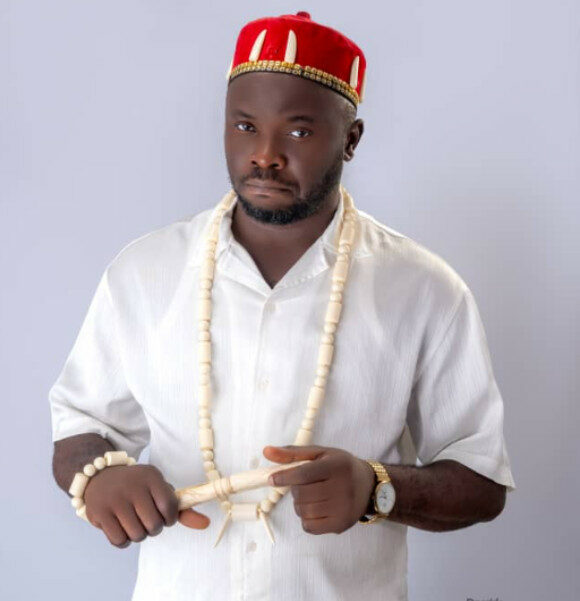
From the bustling cultural heart of Nnewi emerges a voice with a mission, a voice shaped by hardship, strengthened by resilience, and empowered by purpose. His name is Mr. Eloham Tochukwu Godwin, popularly known as “Nwoke Nnewi (Dibia Eziokwu)”, a musician, cultural advocate and traditional practitioner whose journey reflects the true spirit of survival against all odds.
Born on August 8, 1982, in Uruagu Nnewi of Nnewi North Local Government Area, Anambra State, Eloham is the 6th child among ten children of Mr. and Mrs. John Eloham Ezimuo. His early childhood, like that of many from humble beginnings, was filled with hardship, especially following the untimely death of his father, a once-thriving timber merchant at Nkwo Market, Nnewi.
Schooling was a luxury that slipped through his fingers early in life. After attending Akwuegbo Central School and completing JSS2 at Nnewi High School, financial struggles pushed him into street hawking and eventually forced him out of formal education entirely.
But destiny had bigger plans.
In 1999, while in Onitsha seeking a livelihood, a new path opened for him. He found a home in gospel music as a chorister at The Lord That Answereth by Fire Deliverance Ministry, founded by Prophet Ejima in Omoba Phase 2. That opportunity would become the foundation of his career in entertainment.
His path wasn’t smooth, he served under a difficult trader in Onitsha who denied him economic settlement after years of apprenticeship. Yet he refused to quit on himself. Escaping to Lagos, he ventured into Nollywood as a crew member, gradually developing creative skills that expanded into songwriting and screenplay.
Among his credited works are musical projects and movie scripts, including titles such as “Emotional Wreck” and “Echoes of Gun,” showcasing his storytelling strength.
Through self-education and consistent reading, Eloham honed fluency, artistic depth, and a commitment to telling stories that matter.
Today, Nwoke Nnewi stands boldly as a Dibia Eziokwu – a truthful traditionalist whose mission is rooted in cultural revival and protection of Igbo identity.
His latest music project carries a strong message: an urgent call for Igbo sons and daughters to unite against the constant killings and suppression in the region.
“Being a traditionalist came as a must-do task,” he says.
“My principal goal is to expose evil and promote our culture.”
Beyond advocacy, he aims to redefine highlife music, infusing spirituality, activism, and modern artistry into a genre that has been the heartbeat of the South-East for decades.
Financial challenges almost silenced his dream, but instead, they molded a fighter. His upcoming releases promise a mix of inspiration, revelation, and cultural awakening, drawing heavily from his personal experiences.
His story is more than an artist’s biography.
It is a testament that greatness can come from the toughest beginnings.