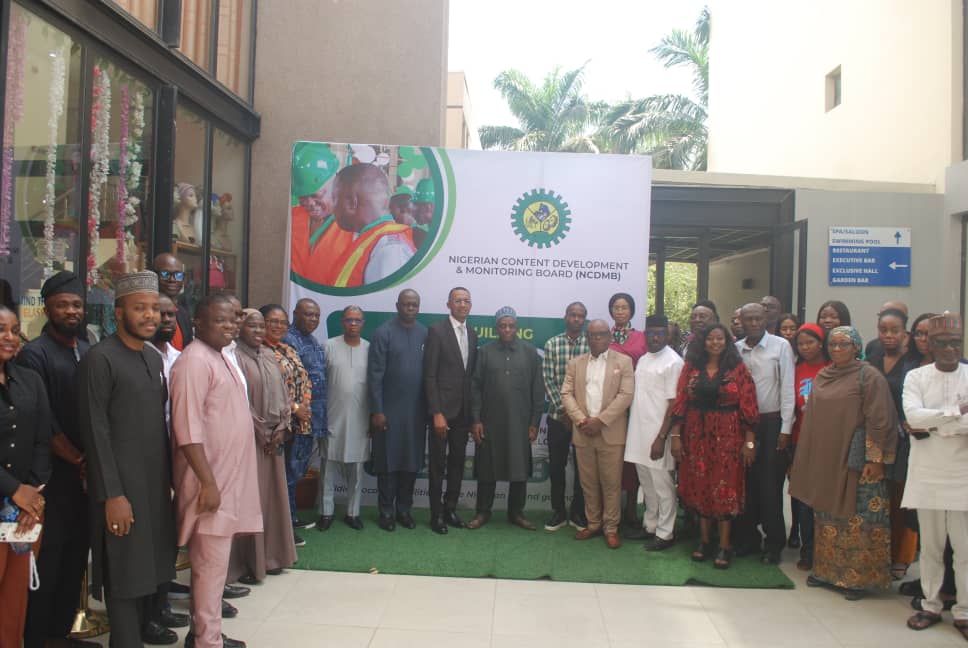
The Nigerian Content Development and Monitoring Board (NCDMB) has said sustained engagement with the media played a critical role in Nigeria’s attainment of 61 per cent local content implementation in the oil and gas industry.
Speaking at the Board’s annual media engagement forum, the General Manager, Corporate Communication Services, Mr. Obinna Ezeobi, described communication as a major driver of the successes recorded since the enactment of the Nigerian Oil and Gas Industry Content Development (NOGICD) Act in 2010.
According to him, the partnership between the NCDMB and the media, which formally began in 2010, has helped to project, propagate, and entrench the objectives of the Nigerian Content Act over the years.
“In 2010, when the law was passed, one of the first things we did was to engage the media as key stakeholders. From that time, we have continued to engage them,” Ezeobi said.
“We are proud to say that communication played a significant role in promoting and projecting the Nigerian Content Act. We can safely say it contributed immensely to what we have achieved today, which currently stands at 61 per cent Nigerian content implementation.”
He said the Board considered it important to continually deepen and improve the competencies of journalists covering the sector.
Ezeobi described the annual interaction, which has held consistently since 2013, as more than a routine engagement, noting that it had evolved into a “family ritual” built on trust, collaboration, and mutual growth.
“Our partners in the media look forward to this engagement every year. We use the platform to give updates on our activities, deepen friendships, and strengthen relationships,” he said.
He explained that beyond accountability and information sharing, the Board deliberately uses the forum to build the capacity of journalists, stressing that improved media competence enhances public understanding of Nigerian content and supports national economic development.
In line with this objective, Ezeobi said the Board invited a veteran journalist this year to lead discussions on value creation, professional growth, and monetisation of media practice, adding that learning also occurs through practical experience.
He also highlighted leadership milestones at the Board since Engineer Felix Ogbe assumed office as the fourth substantive Executive Secretary of the NCDMB.
According to him, the Board’s Nigerian content strategy remains practical and impact-driven, focusing on enforcing minimum local participation thresholds across the oil and gas value chain to ensure more goods, services, and skills are sourced locally.
“That is the practical way of putting your country first without making too much noise about it,” Ezeobi said.
Describing Ogbe as “a doer, not a talker,” he noted that the Executive Secretary had recorded notable achievements within two years in office.
“You don’t always have the same kind of CEO in an agency. This Executive Secretary made it clear from day one that he is a doer, not a talker, and the results of the past two years speak for themselves,” he added.
The annual engagement, Ezeobi said, remains part of the NCDMB’s broader strategy to strengthen transparency, boost stakeholder confidence, and sustain momentum in Nigerian content development in the energy sector.
Speaking at the forum, Senior Vice Chairman and Editor-in-Chief of Leadership Newspapers, Mr. Azu Ishiekwene, urged journalists to move beyond producing quality stories and deliberately create sustainable income streams from their content or risk being marginalised in the digital economy.
He said the collapse of traditional newsroom revenue models and the dominance of global technology platforms had fundamentally altered how value is created and captured in the media industry.
“Good journalism is important, but good journalism is no longer enough,” Ishiekwene said. “Beyond producing quality content, journalists must now learn how to generate sustainable income in the digital age.”
Citing industry data, he said advertising revenues had declined by more than 50 per cent, while print circulation had fallen by over 60 per cent, leaving many newsrooms underfunded and journalists poorly remunerated.
He explained that global technology companies such as Google, Meta, and Apple now control attention, data, and advertising revenue, capturing most of the value generated by journalistic content.
“These platforms do not pay for content; they pay for attention, data, and time. If you do not own your audience, you cannot own the revenue. Journalists are doing the work, but others are making the money,” he said.
Ishiekwene noted that although the platforms present themselves as technology companies, they effectively operate as media businesses by aggregating content, controlling distribution through algorithms, and monetising user attention.
He stressed that journalists must understand content ownership limitations, noting that materials produced under salaried employment typically belong to employers unless otherwise agreed.
However, he said journalists could still create personal value by building independent platforms, cultivating loyal audiences, and intentionally structuring content for monetisation outside traditional newsroom models.
He welcomed ongoing efforts by Nigerian media industry bodies to collectively engage global technology firms on fair compensation models, stressing that collaboration was essential to restoring balance in the media ecosystem.