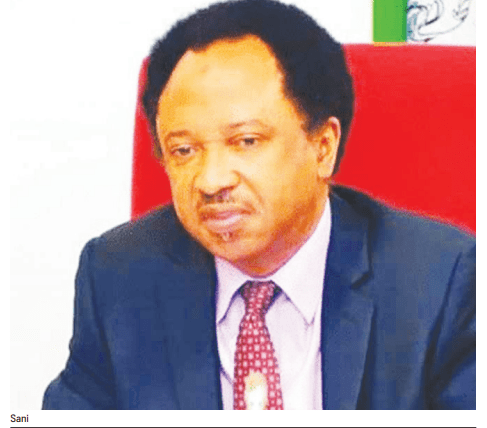
Senator Shehu Sani represented Kaduna Central Senatorial District at the National Assembly from 2015 to 2019. In this interview, monitored on Arise Television, he speaks on the creation of a Regional Security Trust Fund by the Northern States Governors’ Forum and their resolve to fight insecurity in the region, among other issues, ANAYO EZUGWU reports
What do you make of the Northern Governors’ meeting, their launch of a security trust fund and the proposal for the President to suspend mining for six months?
The Northern Governors’ meeting was long overdue in the very sense that the region has come under sustained attack by terror groups and bandits in the last 15 years. And since the coming of this administration, there has not been a serious regional effort in terms of addressing the problem. So, I believe that the governors, being the chief executives of the states, hold in some way the ace as far as regional effort is concerned in tackling this criminality. One of their resolutions was that there should be cessation of mining activities.
Well, it is a fact that in states like Zamfara, Niger and Nasarawa, illegal miners are working in cahoots with bandits, and for that very fact, there is a need to secure those areas. So, cessation of mining activities will help in some way. When you go to the hinterlands of Niger State, you will see that most of the areas where these bandits are operating are areas where these illegal mining activities are taking place.
As such, it becomes very difficult to separate who is a miner and who is a bandit. So, suspension of mining activities will give the military and our security agencies the opportunity to go into such ungoverned spaces and take actions as far as this is concerned. Mining is one that generates hundreds of millions of dollars but we are not in control of that important and significant component of our economy. So, I support the governors. But most importantly, the region has to accept and recognise that this is our problem.
The issue is that these in the North-West are basically Fulani people and the terrorists in the northeastern part of Nigeria are mostly Kanuri people. I don’t believe that people will keep on saying that these are people who come from Mali and Burkina Faso. They also have their own problems. So, it is for us to accept this fact that these are our nationals and that the region must stand up to this reality and address its own problem. Secondly, as far as these bandits are concerned, they have wreaked a lot of havoc in our part of the country.
They have destroyed our agricultural sector. They have destroyed education. They have made life a living hell for millions of our people but I still cannot understand how a nation of 230 million people will be held ransom by a gang of less than 5,000 people. Unfortunately, if you look at what is happening over the years, you will see that there is a failure of the state in terms of doing what needs to be done.
For example, in a city or in a town called Ibeto in Niger State, bandits invaded the village, operated for six to seven hours, to the point that even ordinary people were streaming it on their Facebook, and nothing was done. So, if we are interested in solving this problem, we can do it.
Sometimes it’s not simply about money. Niger, Burkina Faso, and Mali, the whole of their budget is less than the budget of two to three ministries in Nigeria and they are doing their best to secure their own part of the world. So, the leaders of the region, religious leaders, traditional rulers, political leaders and the civil society in the North, need to know that this is an existential battle that we need to fight in order to secure that part of our country.
What is your reaction to President Bola Tinubu’s list of ambassadorial-nominees and why is your name not on the list?
My name has never been in any list of ambassadorial positions. I read about it months ago. And as a former senator and also the vice chairman of the Senate Committee on Foreign Affairs when I was there, I know that there are procedures for appointment. You have to get a call. You have to submit your CV.
You have to go for security screening. But never has any of this procedure taken place. And I think I’m too young to be an ambassador at this very time. I still have a lot to deliver to my people in Kaduna State.
One of the things that people have said is that the governors themselves have failed and that part of the reason why we see a rise in criminality, banditry and terrorism, is the fact that basic social amenities they ought to provide for their citizens, they fail in doing that. What do you have to say about that and your wish list for the new Minister of Defence?
First of all, the banditry and the terror attacks in the North didn’t begin today or yesterday. This has been with us for 15 years and it evolved. First, the Boko Haram was engaged in acts of bombing of mosques, churches, motor packs, public spaces, schools. Somehow, the changed strategy to kidnapping and now bandits evolved from the terror groups. It’s important that people understand the difference between bandits and terrorists.
They all operate as criminals who kidnap and kill but the terrorists that have names called ISWAP, Boko Haram, Ansaru, Mamudawa are terror groups that have a theocratic agenda for Nigeria and could be called jihadist.
They are called Islamist. And they have a broader vision of what they want to do for Nigeria. Secondly, they are also affiliates of other terror groups outside of Nigeria. Boko Haram is aligned to al-Qaeda and ISWAP is aligned to ISIS. But that is the ones that operate in the north eastern part of Nigeria. And in the north western part of Nigeria, they are bandits.
These bandits have no ideological and theocratic agenda. Their basic strategy is to kidnap and collect ransom. So, if you have alternative of being kidnapped by bandits, you stand more chances of being freed because they will collect money from your family and release you.
But the Islamists have affiliated to other terror groups outside of Nigeria. Also, they have their own political agenda. So, money may not be the reason. That is why in their own case, people like Leah Sharibu can be in that place for years. But they are all criminals who engage in acts of killings.
Secondly, the region has been under this, like I’ve said, for one and a half decades. And one of the problems that we face in the North is this culture of silence and complicity. Under the Buhari eight-year administration, the region was silent. People don’t want to speak out when their people are killed or when their people are kidnapped.
When the idea of a six-month suspension on mining came about, people say if we shut down the mines, the terrorists will surely escape to our neighbouring countries where there are people with similar ideologies. What then happens in six months?
I said it very well that suspension of mining for six months has to be augmented with doing something on the ground. This is not the first time that mining is recommended for suspension.
There was a time when motorcycles were banned. There was a time we had sale of petrol in rural areas was banned. There was a time even when the social media was banned in an attempt to tackle this issue of terrorism and banditry in rural northern Nigeria, but it never worked. So, we can suspend the mining, but we have to go after the terrorists.
That is very important. And when I talk of culture of silence, I’m talking about the fact that when Buhari was in power, the same banditry and terrorism was going on, but people from our own part of the country, especially the political elites, kept quiet in the very sense that the government or the person in power at that very time came from our own region.
When I was a senator, each time I stood up to speak about the killings of my people and the kidnapping of my people, some of the strongest opposition I get are people from our region, who believe that I’m trying to damage or to spoil or to disrepute the government that is coming from our region, something they said I should be grateful for, for electing me into office.
That was even on video. At a certain time, even a traditional ruler in Katsina State was suspended for speaking out against insecurity under the Buhari administration. So, this silence now has built up to take us to where we are today. People are speaking out because of the fact that this has not solved the problem and this is where we have all landed today.
Some advocates and activists from the Middle Belt are saying that they will not contribute to the security trust fund because they are not sure that their interest will be protected. What do you say about that?
Who is the Middle Belt? If you say Middle Belt is North Central, I don’t see the difference between the thinking of Governor of Niger State and that of Kogi State, with that of Katsina State and Zamfara State.
And if you are talking of core Middle Belt, Benue and Plateau states, the governors are in sync. So, you can’t secure a certain region and allow other parts of the region to go.
Even if you create a wall around where you call the Middle Belt, as long as their neighbours are still in crisis, they will still be in crisis. So, it’s like Abuja now, we’re trying to create a paradise or an oasis of peace.
If Niger, Nasarawa and Kogi are having banditry issues, it’s a question of time before it spill into Abuja. Security is not simply about carving out a certain enclave of peace and harmony and thinking that other people can do whatever they want. I think what is important is that the governors must use the resources of their state to augment and support security agencies that are in their own very states here.
If you look at it, during elections, the governors bring out a lot of money to support the civil defence, police, DSS, and whatever, all for the purpose of securing state power. But after that, you find out that the security agencies in their own very state, some of them, you even go to their DPO offices, you don’t even have paper to write statement.
They don’t have communication equipment. They don’t have vehicles. And what the governors will say is that it’s a federal responsibility. You cannot say that. They have to fund the security agencies in their states with state resources and think less about funding politics. This is very important.