



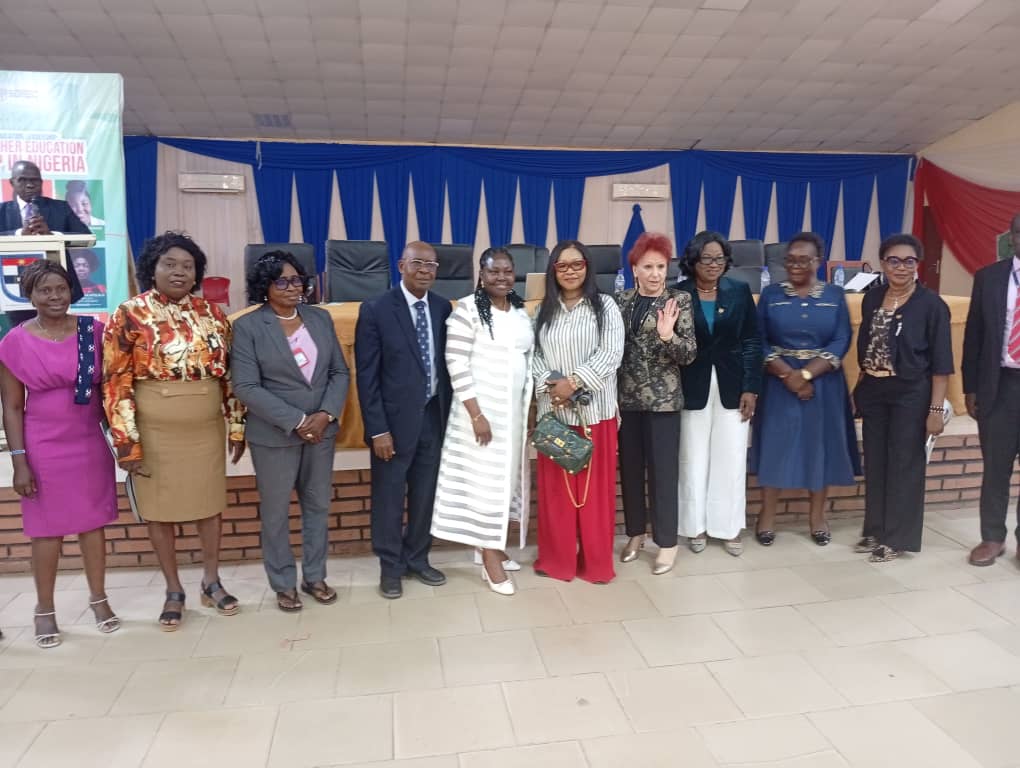
Afe Babalola University, Ado-Ekiti (ABUAD), has received funding support from a new British Council–funded £30,000 catalytic grant designed to strengthen gender equality and expand women’s leadership in higher education across Nigeria.
The development was announced on Wednesday at the opening of a three-day workshop titled “Empower: Leadership Training for Women in Higher Education”, held at ABUAD in collaboration with Buckinghamshire New University, United Kingdom.
Speaking to journalists, Professor Adetoro Adegoke, a Professor of Health Inequalities and Associate Dean for Research and Knowledge Exchange at Buckinghamshire New University, disclosed that the UK institution secured the grant from the British Council to launch a nationwide initiative aimed at developing women leaders in academia.
She explained that the project is being jointly implemented with ABUAD under a 50–50 partnership model, noting that the catalytic fund is intended to stimulate action and lay the foundation for larger grants, including an £8 million Wellcome Trust opportunity.
Prof. Adegoke noted that while the British Council grant will run for one year, the Wellcome Trust fund is expected to span five years, offering long-term institutional benefits, especially for ABUAD.
According to her, ABUAD stands to benefit immensely from the partnership, not only because it serves as an equal project partner but also because it hosts more ground-level project officers and research associates than its UK counterpart.
She emphasized that gender inequality in academia is a global issue, pointing out that women, particularly black and minority ethnic women in the United Kingdom continue to face systemic and psychological barriers such as limited support systems, mindset challenges, and imposter syndrome.
“We have been fortunate to receive funding from the British Council to support gender equality, specifically targeting women in leadership within higher education,” she said. “The aim is to support aspiring women leaders to ensure gender balance at leadership levels across higher education institutions. Participation is open to women who are passionate and willing to grow. Leadership begins from within.”
On the partnership with ABUAD, she added:
“It is a 50–50 arrangement. There is nothing the UK university has in terms of project leadership that ABUAD does not have. The catalytic fund is to spur action, after which additional funding — including the £8 million Wellcome Trust — will follow.”
In her remarks, the Vice Chancellor of ABUAD, Professor Smaranda Olarinde, said today’s higher education landscape demands visionary and compassionate leaders. She encouraged aspiring women leaders to rise above self-doubt, intimidation, societal expectations, and systemic biases.
Meanwhile, ABUAD also commissioned a new ultra-modern, fully equipped Information and Communication Technology (ICT) Centre, New Horizons, to enhance teaching, learning, and research.
Speaking during the commissioning, Professor Olarinde explained that the centre is equipped with 150 computer systems, enabling students to compete globally in the digital space.
She urged students to maximize the facility to innovate, create, and excel.
She reaffirmed the university’s commitment to providing a conducive learning environment for both students and faculty.