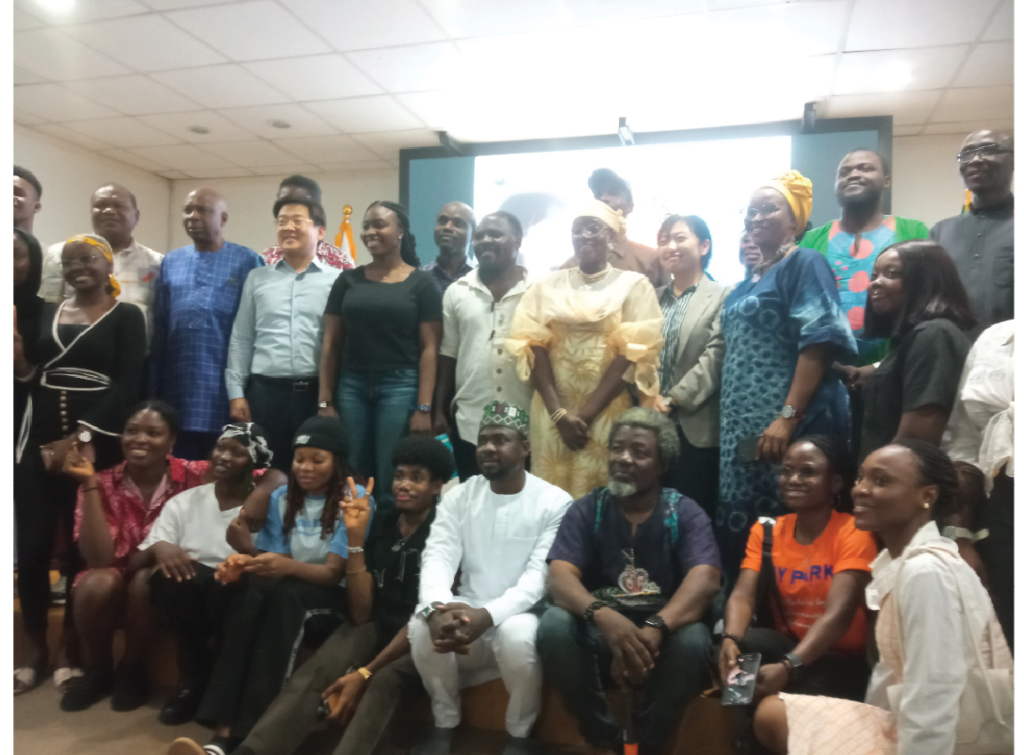
On Friday December 20, 2024, Arojah Royal Theatre (ART) in collaboration with the Korea Culture Center Nigeria (KCCN), Abuja hosted a literary event introducing the 2024 Nobel Laureate Prize for Literature winner, Han Kang.
The author and creative writing educator, is the first South Korean, and the eighteenth woman to win the prize. ‘The Vegetarian’ which won her the laureate, and the Man Booker Prize in 2016, was praised by the Swedish Academy, for its “intense poetic prose”.
Since the win, Kang has become a global figure, gaining increased readership of her work. Her works however, remain largely unknown to Nigerians due to their unavailability in local bookstores.
Hence, the need for the book reading, which ART Artistic Director, Jerry Adesewo, said will not only familiarize Nigerians to Kang’s works ‘The Vegetarian’ (2007), and her more recent prose ‘Human Acts’, but can foster the long-sought Nigeria Korea Literary Exchange.
Currently, ‘The Vegetarian’ isn’t available in major Nigerian bookstores like Ouida Books, Booksellers, Rovingheights Bookstore and Adam Pages located in Abuja and Lagos. The few, literary-inclined members of the population in possession of the book obtained theirs via commercial digital platforms like Amazon or stumbled upon a translated copy, like Adesewo did a while back in 2012 while in Korea.
The center’s newly acquired copies of the both books are not open to library membership users until January 2025.
“This event is key to not only introduce Nigerians to Kang’s work but promotes Korean literature,” said Adesewo.
Beyond the promotion of Korean literature, Adesewo said the event underlines the benefits of a literary exchange between Korea and Nigeria.
While there’s been cultural exchange between both countries in Sports (Taekwondo), and traditional music with Jang (Korean drum), decades old initiatives to foster literary collaboration/exchange hadn’t yielded the sought results.
“Five years ago, the ex-President of the Association of Nigerian authors attended the Seoul Writers Festival, nothing came from that. For nine years, we organized the Korea Nigeria Literary Festival and Publication, of which the essence was to encourage shared human experiences from both divides. It still didn’t happen.
“I think this experience (Han Kang’s win) will propel the organizations that be to look in that direction.”
To ensure a mutually beneficial exchange, Adesewo recommends Nigeria establish quality translation service as a means of promoting wider readership of Nigerian literature and culture to Koreans.
“Korea has a huge translation machinery in the world, such as the Certified Korean Translator Service, Asian Translation Service where they translate the smallest of pamphlet publications into English language in order to reach a wider audience. We need to have such. Otherwise, when that exchange happens, the benefit will be more to them than to us. If we are not careful.
“That’s because we have not promoted indigenous writing enough. It is not that we don’t have Igbo and Yoruba or Ibibio writers but there aren’t enough of them. Our colonial background restricts us to English.
“There is nothing wrong in writing in English. Better still, we can start translating our English literatures into indigenous languages. Because while there are increased Korean writers writing in English, they still prefer to write in Korean,” said Adesewo.
As a literary development organization, ANA, the theatre director said, has a huge role to play in connecting to their counterparts in South Korea and other countries to foster literary exchanges.
An experimental literature with a Kafkaesque twist, ‘The Vegetarian’ tells the story of Yeong Hye. Trapped in a patriarchal society and lackluster marriage, Yeon Hye decision to become a vegetarian, leads to a downward spiral and tragedy that exposes the effects of deeply entrenched patriarchy across generations.
‘Human Acts’ – set against the backdrop of the 1980 pro-democracy movement in Gwangju, it portrays the suffering and humanity of a young boy and those around him, as they endure the tragic and brutal events of history.
The former’s themes of patriarchy in contemporary Korean society, generational trauma, gender-based violence and mental health, resonated amongst the Nigerian audience, and panelists – writers Salamatu Sule, Adetola Adesewo, Ahmed Maiwada, Paul Liam and Oko Owoicho at the event.
Extrapolated to the Nigerian setting – it points to the tragic consequences of not just the absence of agency for women in a patriarchal society, but absence of agency for Nigerian youths facing hard knocks in their effort to live an honest means, said Sule.
“It looks at the influence of trauma in peoples’ lives and decision,” said Liam, and for audience members – it places emphasis on the need for mental health support for younger Nigerians living in the most difficult of eras; while also addresses the significance of dreams in peoples’ lives.
“This is what makes Kang’s work relatable,” said KCCN’s Cultural Event Manager, Yun Jin Lee. “Her works – as confirmed by the Swedish Academy are intense poetic prose, that explores human trauma. This is important because, while human beings are different, we all face and experience different things in our lives. Her works may background historical events, but her personal approach to weaving human trauma is relatable.”
On the possibility of the center hosting future events exploring shared literature and experiences, Lee is optimistic.
“While this is a very special event, I hope we can have more of such.”