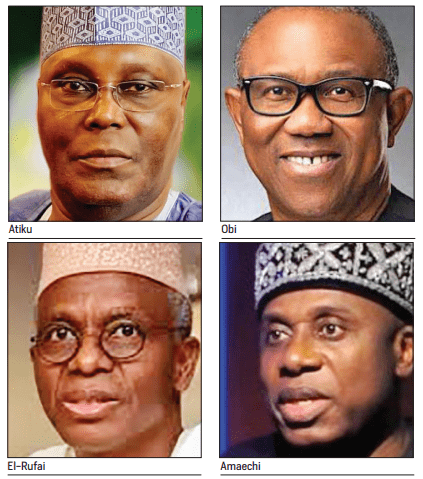
- Atiku, El-Rufai revs up ADC with party membership as Obi leaves party in dark
FELIX NWANERI writes on the twist and turns over the decision by some key stakeholders of the of the African Democratic Congress (ADC) to formalise their membership of the party and inability of some to resign from their parties thereby keeping its leadership in the dark as to whether they are still committed to the coalition’s course
There is no doubt that it was euphoria in some political quarters, when notable opposition leaders, announced adoption of the African Democratic Congress (ADC) as the platform they intend to use in their bid to wrestle power from the ruling All Progressives Congress (APC) in the 2027 general election.


The choice of ADC by these opposition leaders, including former Vice-President Atiku Abubakar, ex-Governors Peter Obi; Rotimi Amaech, Nasir El-Rufai and Aminu Tambuwal, among others, was after several back-and-forth movements, including moves that initially linked them with the Social Democratic Party (SDP) and application for registration of a new political party – All Democratic Alliance (ADA).
However, beyond the jubilation over adoption of the ADC by these opposition leaders on July 2, some political stakeholders warned at that time that it was too early to shout Eureka given the hurdles they must scale if their dream of defeating the APC is to materialise. This belief was majorly predicated on the presidential ambitions of the coalition’s leaders and the power sharing arrangement between the North and South (rotational presidency), which are knotty issues the coalition leaders must resolve.
Recall that the July 2, adoption of the ADC was sequel to the voluntary resignation of the Raph Nwosuled National Working Committee (NWC) of the party to make way for the emergence of David Mark (a former Senate president) and Rauf Aregbesola (a former governor of Osun State) as interim national chairman and interim national secretary, respectively, although some chieftains claimed that the party was forcefully taken over by the coalition leaders.
While the party seems to have navigated its way out of the initial legal impediment posed by the suit filed by some aggrieved legacy members of the, following the Independent National Electoral Commission (INEC) recognition of the Mark-led leadership, there is no doubt that the presidential ambitions of the coalition’s leader has turned to a political landmine for the ADC.
The belief in most political quarters is that the dream of the coalition promoters to unseat President Bola Tinubu is gradually becoming a tall one as arrowheads like Atiku, Obi and Amaechi are merely looking for a platform to actualise their ambitions and are not likely to step down for each other given the mind game being played their various camps.
The concerns over the mind game by the presidential hopefuls may have prompted the directive by the leadership of the ADC in September for leaders of the coalition to resign from their current parties and register fully with the party. National Publicity Secretary of the ADC, Bolaji Abdullahi, then described the directive as a final quit notice to the coalition partners still holding on to membership of their original political parties. “This quit notice to our coalition partners is the last one. The time has come for everyone to make a choice and identify fully with the ADC,” he said, while declining to give a specific deadline for compliance.
While Amaechi was the first among the arrowheads of the coalition to formalize his membership of the ADC, when registered as a member of the party in July, Atiku, who resigned membership of the Peoples Democratic Party (PDP) on July 16, waited till November 24, before he officially registered as a member of the ADC.
El-Rufai, on his part, officially joined the party on November 28 and there is no doubt that these developments have revved up the ADC. However, the party’s leadership is in the dark over inability of one of its key partners, Obi, to fully identify with the opposition coalition as he is still holding on to the membership of the Labour Party on which he contested the 2023 presidential election.
Amaechi as early bird
The immediate past Minister of Transportation and ex-governor of Rivers State, formally joined the ADC shortly after its adoption by the coalition in July. He later declared that he will contest the party’s primary election, vowing not to step down for any aspirant. “I will contest the ADC presidential primary, and by God’s grace, I hope to win so that I can face Tinubu in 2027. I am not stepping down for anyone. Let the people decide who they want to lead,” he said. He stressed that the ADC must conduct an open contest, adding that internal democracy will strengthen the party.
On the possibility of zoning in the ADC, Amaechi, who contest the APC presidential primary for the 2023 election against Tinubu and place a distant second, said the decision on which part of the country will produce the 2027 flag bearer rests with the party leadership but maintained that he would remain in the race regardless of the outcome. He described himself as one of the most qualified contenders in the country.
“If you look at all those aspiring, including Tinubu, who is better prepared than I am? My candidacy offers unity because I come from the South, and we are not in conflict with any region,” he added. On suggestions that his political base in Rivers had weakened due to the influence of Federal Capital Territory Minister, Nyesom Wike, Amaechi dismissed the claims.
“Recently, when I visited Rivers to inaugurate the ADC, the turnout was massive from the airport to the venue, and nobody paid for that mobilisation. That should tell you where the people stand,” he said.
Atiku confirms 2027 bid with membership
The former vice-president’s official registration as members of the ADC on November 24, not only signaled a major realignment in opposition politics ahead of the 2027 general election but confirms the belief that he will take another shot at the presidency.
Atiku announced his membership of the party via his X (formerly Twitter) handle, posting images of himself holding the party’s membership card alongside a brief caption that read: “It’s official.” By formally joining the ADC, the former vice-president is expected to enhance the coalition’s visibility and leverage, particularly given his extensive nationwide political network and decades of experience in Nigerian politics.
However, his bid for the 2027 presidency has continued to face opposition in some political quarters, particularly on account of his age and the power sharing arrangement between the North and South. Atiku is 78 and would be 80 by 2027, and it is against these backdrops that some stakeholders are of the view that he should step aside and support a younger person after six attempts that have seen him made it to the ballot as a presidential candidate on three occasions – 2007, 2019 and 2023. The merit or otherwise of this argument, Atiku’s camp is confident that he will pick the ADC’s ticket if he vies for it.
A former presidential aspirant on the platform of the PDP and known supporter of the former vice president, Dele Momodu, who has repeatedly pushed back at critics of the Wazirin Adamawa, wondered why they are scared of Atiku’s ambition. Momodu, not only insist that only God and destiny will determine whether Atiku will achieve his presidential ambition come 2027 or not, he is also of the view that those criticising the former vice-president’s ambition on the basis of age did not support young candidates during the 2023 elections.
Citing immediate past President of the United States, Joe Biden, and his successor, Donald Trump, as examples of politicians who became presidents at an advanced age, he said: “Age cannot be an automatic qualification or disqualification in politics. It is up to God and destiny. If Atiku decides to run, good luck to him. If he doesn’t want to run, no problem, but nobody should muzzle him.” On whether Atiku would be a threat to President Tinubu’s reelection bid, Momodu said: “I’m sure they (the critics) believe so. I know those who believe that he is the only one right now. Atiku will be a threat if he is able to galvanise a mega political party. He will be a threat.
The mood of the nation is overwhelmingly opposed to the current leader.” Momodu also believes that no southern candidate can take on Tinubu. “You have to be realistic. It’s a game of numbers and it’s also a game of your network. There’s no one in Nigeria today as experienced, as exposed, as networked as Atiku from 1993, when he stepped down for Chief MKO Abiola in Jos. So, when people mention him, it is based even on what has happened elsewhere. “For anybody to face a Tinubu, that person has to come from the opposite direction. Which means it must be someone who can get the North to coalesce behind him.
So, I pray that the coalition will be able to achieve that. I don’t know if they will, but I’m sure they are working on that. “Then it must be someone who has a substantial network in the South. There is no other person I can see who has that kind of network behind him. So, that’s why everybody is talking about Atiku. And those who are trying to demarket him; the same people are not discouraging Tinubu.”
Kenneth Okonkwo, the 2023 campaign spokesperson for Obi, who also believes that ADC must present a northern candidate if it intends to defeat Tinubu, declared that any attempt to field a southern candidate will guarantee the President’s re-election. Okonkwo, particularly warned that the political arithmetic of 2027 favours the incumbent unless the opposition adopts a pragmatic and strategic approach.
“My strategy this time around is that I am going to support a northerner in 2027. The person must be qualified, and if he has experience in the presidency, it is an added advantage. When he pairs with someone from the South; it will push him through,” he said. While the debate on whether Atiku should quit the political stage ahead of the 2027 elections rages, the fact remains that whatever choice he will make is not likely to be informed by the wishes of his critics as it will amount to succumbing to what many have described as “cheap political blackmail.”
Those who hold this view believe that Atiku’s envisaged emergence as ADC’s presidential candidate is a done deal, considering his political network and financial strength. Others are of the view that adoption of the ADC by leaders of the coalition was solely for Atiku’s 2027 presidential project. This, they say, informs why he has continued to shun entreaties for him to jettison his ambition.
These assumptions, perhaps, informed why the former vice-president, in October, dismissed reports that suggested that he intends to step down for another presidential aspirant ahead of the 2027 elections. Atiku, who spoke with BBC Hausa Service then, was quoted to have expressed willingness to abandon his presidential ambition for a younger, vibrant and acceptable candidate under the ADC.
But a statement by his Media Adviser, Paul Ibe, described such claims as a misrepresentation of his position. Ibe explained that a careful review of both the video and transcript of the interview showed that Atiku never said, suggested, or implied that he intends to step down for anyone. The statement read in part: “After a thorough review of both the video and transcripts of the interview – in the original Hausa and the English translation – it is evident that at no point did the former vice-president expressly state, suggest, or even imply that he intends to step down for anyone.
“What Atiku Abubakar clearly and unambiguously said was that young people, as well as other prospective presidential aspirants, are free to enter the contest. He further stressed that if a young candidate were to emerge through a competitive primary, he would readily support such a candidate without any hesitation.”
The clarification by the former vicepresident is understandable. He has never pretended about his intention to lead Nigeria, and it dates back to 1983, when he made an unsuccessful bid after placing third behind Chief MKO Abiola and Alhaji Babagana Kingibe in the presidential primary election of the Social Democratic Party (SDP). In 1998, he was elected as governor of Adamawa State but was picked before his inauguration by the presidential candidate of the PDP, Chief Olusegun Obasanjo, as his running mate, and both won the presidential election held in February 1999. After his first term as vice-president, some governors elected on the platform of the then ruling party came up with a plot to deny Obasanjo a second term.
The plan was to hand Atiku the party’s presidential ticket in the 2003 general election but he opted for a joint a ticket with his principal and the duo were reelected. However, the aftermath of the botched plot against Obasanjo, not only pitted Atiku against the then president, the cold war that ensued after their inauguration, degenerated to a bitter political battle by 2006, when Atiku declared ambition to succeed his principal.
Obasanjo’s insistence that Atiku will not succeed him forced the then vice-president to leave the PDP for the Action Congress (AC), which handed him its presidential ticket. The poll was won by the candidate of the PDP and Obasanjo’s anointed, Umaru Yar’Adua, but Atiku rejected the result and called for its cancellation, describing the poll as Nigeria’s “worst election.”
The former vice-president returned to the PDP in 2009. Despite resistance by his state chapter of the PDP, he was granted a waiver by the party’s national leadership, which paved the way for him to contest the 2011 PDP presidential primary election. He was selected by the Northern Elders Political Leaders Forum (NPEF) led by a one-time Minister of Finance, Mallam Adamu Ciroma, as the region’s consensus candidate, but was floored by the then acting President, Goodluck Jonathan, who went ahead to win the election.
The ADC agreed to the terms and conditions of the coalition leadership… By the grace of God, we are going to repeat what we did in 2015
The 2011 defeat did not deter Atiku as he returned to the political turf again in 2014 for the 2015 presidency. He had before then made good his threat of dumping the PDP over what he described as failure of the party’s leadership to return it to the vision of its founding fathers, following his defection to the then opposition APC.
While many thought that Atiku would be the candidate to beat in the APC presidential primary given his financial strength and political structure, he lost the ticket to a former Head of State, General Muhammadu Buhari, who went ahead to win the main election. Atiku returned to his business, but a rumoured ambition sometime in 2017, prompted the belief that he has not foreclosed his presidential ambition.
While the former vice-president described the rumour as the handiwork of political mischief makers, who were out to draw a wedge between him and President Buhari, it was not long before it became clear that he will take another shot at the presidency. However, there was an impediment to this quest – Buhari’s second term bid. This barrier forced Atiku to resign from the APC on November 24, 2017 over the party’s failure to deliver on its promises to Nigerians.
He later returned to the PDP and the stage was set for him to join the 2019 presidential race. As expected, he defeated 11 other aspirants at the party’s national convention held in Port Harcourt, the Rivers State capital on December 7, 2018 but lost the election to Buhari by over a million votes. He challenged the outcome of the election but the Supreme Court dashed his hope of turning the table against Buhari.
Despite, he threw his hat to the ring again immediately INEC blew the whistle for the 2023 general election. What however ensued over his ambition was infighting over zoning. As expected, the May 28, 2022, presidential primary election of the party was characterised by high level politicking that pitted the aspirants against each other. The contest was however won by Atiku, who polled 371 votes to defeat his major challenger and the then governor of Rivers State, Nyesom Wike, who garnered 237 votes.
However, he PDP’s inability to resolve the pre and post-presidential primary election crisis contributed to Atiku’s loss of the presidential poll. He polled 6.9 million votes to place second to his APC counterpart, Tinubu, who had 8.7 million votes. Many had thought that Atiku would quit politics after his bid to upturn President Tinubu’s election was dashed by the Supreme Court but he vowed to fight on.
He later called on the opposition parties to come together to create a more formidable front that will salvage Nigeria’s democracy from sliding into a one-party state. That call, no doubt, culminated in the coalition that adopted the ADC and informs the belief that Atiku kick-started his 2027 presidential bid immediately after the judgement of the apex court that affirmed President Tinubu’s victory in the 2023 elections, and so, is not likely back down for anyone.
El-Rufai says opposition will reenact 2015 feat
For El-Rufai, who has repeatedly said that he is not interested in the 2027 presidency but determined to contribute his quota to ensure that the APC is defeated in the election, declared during his formal registration with the ADC that he chose to join the party after the Social Democratic Party (SDP) failed to agree to the terms and conditions of the opposition coalition leadership.
The former Kaduna State governor, who is one of the founding fathers of the APC formalised his move to the party on November 28, when he registered and collected his membership card at his Unguwar Sarki ward in Kaduna. Accompanied by political associates and former appointees who served under him as governor of Kaduna State, including the ADC National Vice Chairman (North-West), Jafaru Sani, and the National Membership Secretary, Sadiq Yar’adua, said: “I’m a bona fide member of the ADC.”
He added: “The SDP would not agree to open up to the coalition leadership because the government has bribed and compromised some of the leaders. However, the ADC agreed to the terms and conditions of the coalition leadership. “I want to call on all citizens of Kaduna State, 18 years and above, to come out en masse and register with the ADC. By the grace of God, we are going to repeat what we did in 2015, when we got rid of the incompetent, thieving, stealing, and corrupt PDP administration.”
Concerns over Obi stand
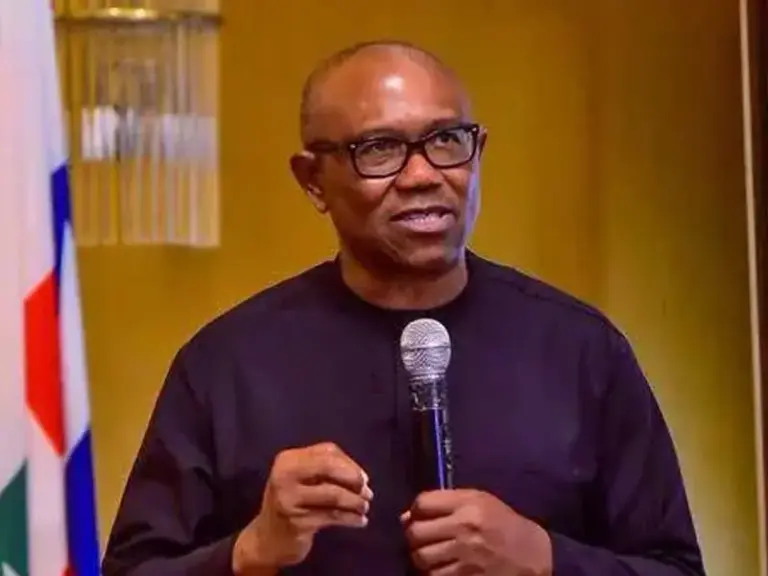
For the 2023 presidential candidate of the Labour Party, Peter Obi, who had during the formation of the coalition, maintained that he is not against the opposition parties coming together to challenge the APC, but insisted that he will never be part of any alliance solely focused on seizing power without prioritising the welfare of citizens.
It was on the basis of Obi’s position at the formative stage of the ADC that some people concluded that he would not be part of the coalition, but politics being a game in which nothing is foreclosed, Obi’s decision to team up with other opposition leaders, not only buoyed the coalition but unsettled some camps within the ADC fold and even beyond. However, his inability to declare for the ADC up till now, has not only left the leadership of the party in the dark but casts doubts over whether he will eventually join the party.
Obi was expected to formalize his membership of the ADC after the November 8 governorship election in Anambra State given a waiver for him to support the candidate of the Labour Party who emerged before the adoption of ADC by leaders of the opposition coalition. However, a month after the gubernatorial election in his home state, Obi has not made any pronouncement on whether he is joining the ADC or not.
Perhaps, his insistence on contesting the 2027 presidential election, which is viewed as a threat to Atiku’s ambition, is the reason why the former Anambra governor has decided to keep his next move to himself. But as Obi continues to weigh his options, there is no doubt that his success or otherwise at the ADC’s presidential primary would be one of the major factors to determine how far the coalition will go in the elections.
An indication to this is the insistence by Obi’s camp that it is either the presidential ticket or no deal. The Obididents, Obi’s main supporters, believe that some people within the coalition are only out to ride on his back to power like many did in the 2023 elections even when they do not share in his vision of “a New Nigeria.”
This view is equally held by some members of the ruling party although they have insisted that the opposition cannot defeat Tinubu. For instance, the Minister of Aviation and Aerospace Development, Festus Keyamo, in his thought on the coalition, suggested that the its leadership aims to leverage Obi’s voter base without offering him the presidential ticket.
Keyamo warned that excluding Obi from the ticket could alienate his supporters, especially given his strong performance in the SouthEast and South-South geopolitical zones in the last election. “The person who the old, cunning guards want to take for a ride in all of this is Obi. They want his votes, but don’t want to give him their presidential ticket, because this is Atiku’s show. That is why David Mark is the interim chairman. Those who know politics know what I am saying. But if you do not give Obi the presidential ticket, you lose his supporters,” Keyamo said.
Yusuf Datti Baba-Ahmed, Obi’s running mate in the 2023 election, who has repeatedly expressed opposition to any arrangement that will see the former Anambra governor, pairing Atiku as vice presidential candidate, on his part, said: “I think the position of vice president is very big anyway because I wanted to be one, and I was rigged out, but I think Obi should not be a vice president having gotten a disputed 10 million votes in 2023. It is all about a narrative that was sold out to Nigeria very quickly that to defeat Tinubu, it has to be a coalition.”
No doubt, Obi’s support base cuts across the country, mostly the youth, who want a break from the old order, the questions are: Can Obi match Atiku in terms of structure and cash in a primary election given recent experiences, and would he accept to be running mate to Atiku if he fails to get the ticket or will he stick on Labour Party, which seems to be factionalised at the moment? While the former Anambra governor is the only one to answer the questions, those urging Obi to pair Atiku as running mate, are of the view that such arrangement is likely to be supported by most voters in the North.
But Obi, in a push back, has declared his readiness to serve a single four-year term if elected. He also reaffirmed his commitment to the zoning arrangement that rotates power between Nigeria’s northern and southern regions given that the incumbent, Tinubu , who succeeded Muhammadu Buhari (a northerner that spent eight years in power), would have spent four years by 2027.
“If you take the arrangement which is, understandably, what you can call an unwritten agreement that power would go South and North, and if that arrangement is to be followed strictly, you would see that anybody, not just me, who happens to come from the South as president in 2027, must be ready to leave on May 28 not 29, 2031. “I campaigned for zoning. I championed zoning in Anambra State. That is one of the reasons today some people feel we must deal with this man. I insisted on it, I maintained it and I followed it to the last letter and till today, I still follow it religiously,” Obi said.
The former Anambra governor, who reiterated his position in a recent interview, however said that the ADC coalition is faltering because it is yet to settle questions on zoning and the rotation of key offices. He added that the coalition must tidy up loose ends and agree on a shared direction for the country. His words: “Today, I’m a member of the Labour Party and I subscribe to the coalition — the ADC coalition — for the 2027 election and I believe in it. But as much as I believe in it, I need to know the fundamentals that we all agree to respect.
But in all this, there are still some lines that we need to respect, where things must be done properly, where we must sit down and talk about where we’re driving the country to. “Today, we have what we can say are unsigned agreements about the presidency, unsigned agreements about rotation of offices. Which is why if you say this person will come from here and this person will come from there, all those things need to be organised. The reason why it needs to be organised is: If you don’t do it, you create confusion for the future.”
Asked whether he would remain committed to the coalition even if he is not chosen as its presidential flag-bearer, Obi said he is driven by the desire to see Nigeria progress rather than personal ambition. “I’m not desperate to be president of Nigeria, I’m desperate to see Nigeria work,” he said. Despite Obi’s position, insistence by his camp on the ADC presidential ticket is practically based on what they termed his acceptance by the electorate.
There are still some lines that we need to respect; things must be done properly, we must sit down and talk about where we’re driving the country to
The 63-year-old former governor’s first attempt at the presidency was in 2023, after running with Atiku in the 2019 elections, but he was among the frontrunners for the PDP presidential ticket before he announced his withdrawal from the contest and resignation from the party as well, few days to the primary election. He later opted for Labour Party (LP) and emerged as its candidate.
This development, not only turned the party to a movement, but altered the political calculation for the 2023 presidential election, and for the first time since 1999, Nigerians witnessed a three-horse presidential contest. Obi was unable to win the election, but the massive mobilization by his supporters, mostly youths under the aegis of Obidient Movement and some other Nigerians, who wanted a break from the past, shook the political landscape.
He polled 6.1 million votes, winning in 11 states and the Federal Capital Territory (FCT), Abuja. Obi’s influence also contributed to the appreciable number of legislative seats LP won across the country as well as the governorship position in Abia State.
Perhaps, it is against these backdrops that the Obidient Movement, at a time expressed worries over whether the coalition party will zone its presidential ticket and offices of the party. The group also said that it is more worried over the ultimatum given to Obi to officially declare for the coalition party in view of agreements that he will do so after some off-season elections that he is committed to before the birth of the coalition party.
National Coordinator of the Obidient Movement, Dr. Tanko Yunusa, said: “As the Obidient Movement, being part of the main consulting bloc, we are particularly concerned about how the party intends to zone its presidential ticket. Considering that the presidency is currently held by the South, issues of equity and fairness must guide such decisions if the party truly aims to secure victory in the 2027 elections.
“We are equally interested in how the party zones its principal offices within the coalition, as this will ensure justice, fairness, and inclusivity – factors that will enable us to mobilise effectively across the country. It must be emphasised that Obi is not desperate to be president of Nigeria. His ultimate mission is to see Nigeria work – to lift people out of poverty, to improve the economy, education, healthcare, and security.”
Party says no preferred aspirant
While it may be too early for anyone to predict where the pendulum is likely to swing regarding the presidential ticket of the coalition, the ADC National Chairman, Mark, who spoke on the issue, said there is no preferred aspirant. He averred that the coalition’s focus is to build a party that will be well accepted by Nigerians.
“The ADC has no preferred or favourite presidential aspirant but has set out to first put out a platform that would be attractive and acceptable to majority of Nigerians,” Mark said with a promise to be fair to all as all members of the party are “equal stakeholders, equal joiners and equal owners.” He added: “We are doing this because we do not want this great ship called Nigeria to sink because if we do not rise up now, they will sink all of us.
I don’t own this party more than any of our members and I urge all members to prepare to show Nigerians that ADC is a different party; a different party that is ready to properly run democracy in our country.
All Nigerians must come together and take ownership of the ADC.” The former Senate president urged members of ADC to put their differences aside and work as a team. “We must bond together to build the party before we can talk of ambitions,” he said.